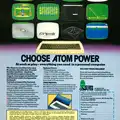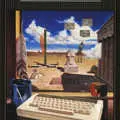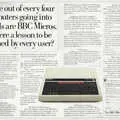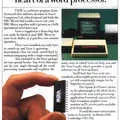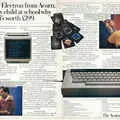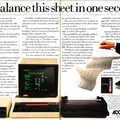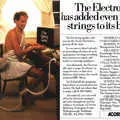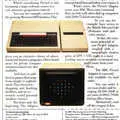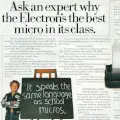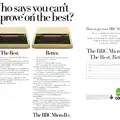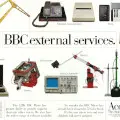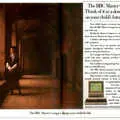
Acorn Advert - May 1980
From Personal Computer World
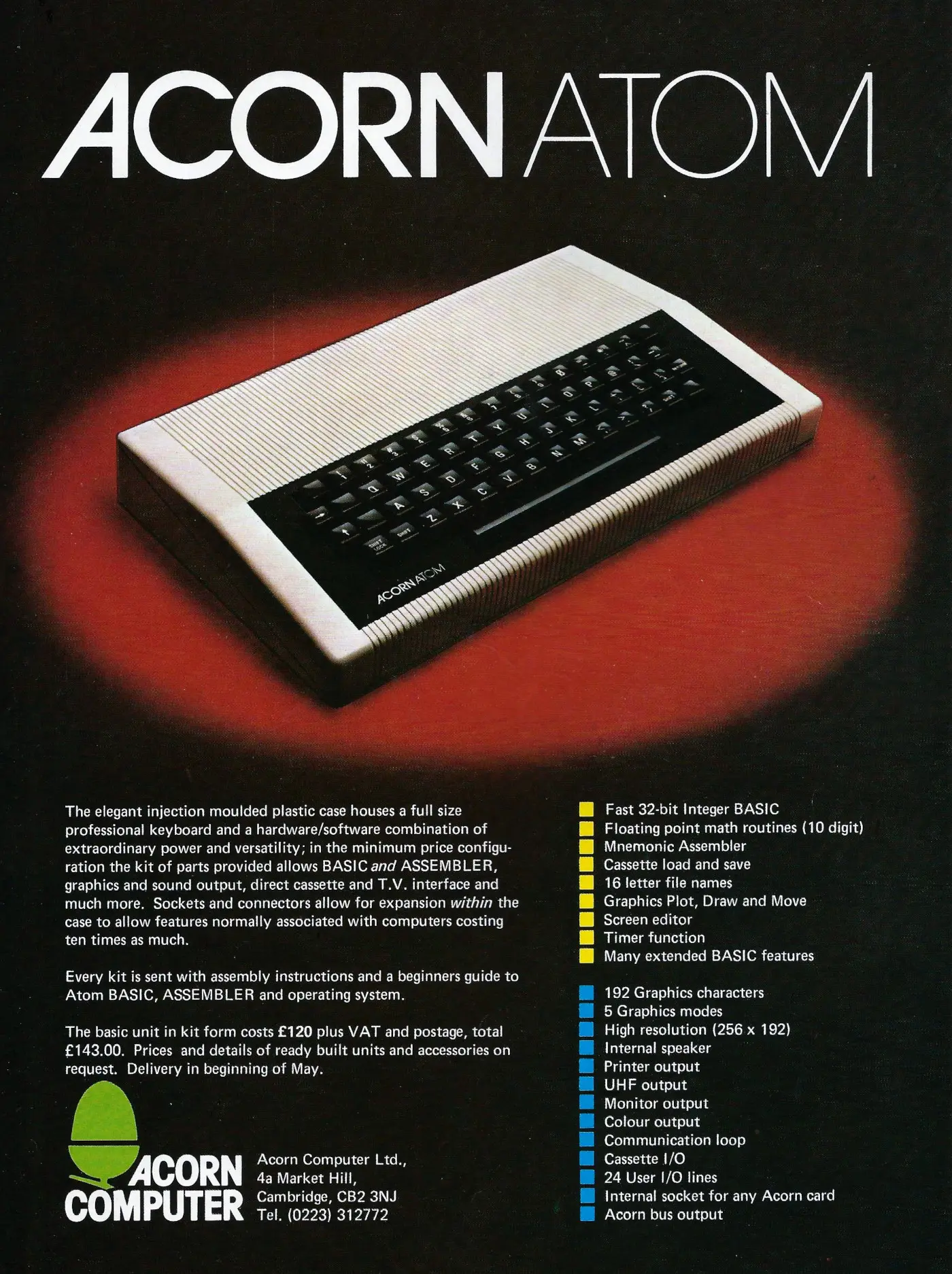
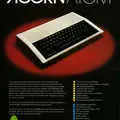
Acorn Atom - from Acorn Computer
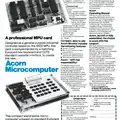
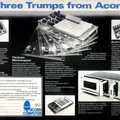
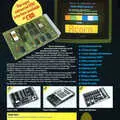
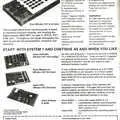
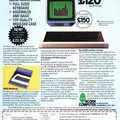
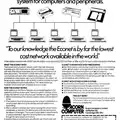
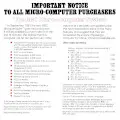
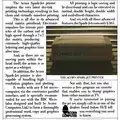
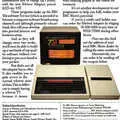
This was Acorn's first advert for its first full consumer-oriented micro - the Acorn Atom. It was a 6502-based machine and was available primarily in kit form.
The Atom was a natural progression from Acorn's 6502-based "System 1", which had been launched in January 1978, as it contained slots for the same Acorn expansion cards that were available for the earlier machine.
Even the Atom's BASIC was only slightly modified from the fast, control-oriented, BASIC that went into the System 1.
However, the Atom was aimed at the home market rather than hobbyists with its real keyboard and injection-moulded case.
The case - the presence of which, according to Acorn's co-founder Hermann Hauser, was said to be almost unheard of at the time - was an example of fellow co-founder Chris Curry's flair for marketing.
Hauser recounted in an interview published in May 1993's Personal Computer World that:
"[Curry] produced the most beautiful case that you've ever seen, and we put this advert in Practical Electronics, a full-page ad - we scraped all the money together. In those days you could get all these things mail order. We put that ad out, and we just couldn't shovel the cheques to the bank. It just flooded us with this enormous demand"
Acorn had been founded in 1978 with £200 to its name, but from the launch of the Atom onwards the one thing it always struggled with was producing enough machines.
In one year, the company went from revenues of £8 million to £40 million, with Hauser saying:
"We never put more than £200 into that company personally; at one stage every pound we put in was worth £1 million. It was great while it lasted".
To fund the company's early growth, it arranged an overdraft with a local bank, just over the road from King's College, which could be seen from the bank manager's office.
The original overdraft of £5,000 was followed up a month later with a £10,000 limit, with a similar situation going on for the next couple of years - all the while Acorn was in the black at least once a month, which was enough to keep the bank happy.
When Acorn got the contract to supply a micro for the BBC's computer literacy project, Hauser returned to the bank manager, recounting in his 1993 interview:
"Look, the £10,000 isn't really enough. He said 'Well, it's going jolly well; I know because I see your accounts. How much do you need now?' and I said 'Well, a million actually' and this completely freaked him out".
Luckily for Acorn, an employee of Barclays and a reporter on the "Cambridge phenomenon" - Matthew Bullock - stepped in, having seen how similar Silicon Valley companies could sometimes expand spectacularly. The bank gave Acorn its £1 million, and according to Hauser, things went "extremely well for a while"[1].
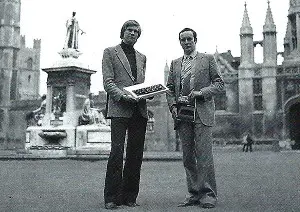
Hermann Hauser and Chris Curry pause for a photo in 1980 with their Atom on the lawn in King's College Great Court, Cambridge. © Acorn User, August 1984The entry-level Atom was available for £143, or around £930 in 2026, and was sold until 1983 when it was effectively replaced by the Acorn Electron.
The £400 (£1,980) Proton, otherwise known as the BBC Micro and which came out (late) at the beginning of 1982, was in a different market category entirely and so the two co-existed for some time.
The Atom's BASIC was unusual in that it would run in-place Assembly Language, using regular 6502 mnemonics. It had been written by Sophie Wilson of whom it was said:
"had a 6502 assembler in [her] head and can at any stage in the program apparently recall what is in the various registers, stack pointers and status flags; [she] can do amazing short cuts"[2].
In what would be a common theme for the entire microcomputer industry for the next few years, the Atom was beset with early delivery delays, prompting many letters to Personal Computer World.
This generated a response from none other than Chris Curry, managing director of Acorn, who responded:
"Our original production plan was delayed by nearly six weeks because of last-minute problems with the case moulding and this caused a backlog of orders which is taking some time to overcome. However, we are now despatching in sufficient quantities to allow an order placed at the beginning of October [1980] to be delivered within six weeks, halfway through October within four weeks and halfway through November delivery should be ex-stock."[3].
Curry and co-founder Hermann Hauser had met whilst Curry was still working at Clive Sinclair's Science of Cambridge, where he had been involved with the MK 14 development computer.
Acorn had been chosen as the company's name because the philosophy was that each machine's design should take into account future developments, whilst retaining some compatibility with its predecessors. Curry said of the Atom that "it was going to be an expanding and growth-oriented system".
The Cambridge connection was important to Curry, and he had chosen to remain in the town because of its university. Writing in October 1982's edition of Practical Computing, Curry said:
"The university processor group, or its computer lab, has maintained Cambridge as one of the leading universities in computer science. So there is a good supply of bright people to go into the industry. One of our directors is a lecturer at the computer lab, and he is on the watch for good people about to leave that might want to work for us. And of course an awful lot of hobbyists come out with software that they have written in their spare time to sell us, and we make contact that way. Cambridge is a fairly small town; people know each other. There are lots of small software houses, all closely interlinked with the university, and we talk to each other".
Whilst the Atom was Acorn's first consumer microcomputer, the company was still intending to support it even after it launched the Proton (BBC Micro) at the end of 1981, which was followed in turn by the Electron in 1982.
This continuity philosophy meant that whilst the company looked ahead, it did not lightly throw away tried and tested systems - a philosophy that perhaps would come back to haunt it as it hung on to the Proton for years without significant change.
The Atom did have a particular usefulness which contributed to its longevity which was that, unlike Acorn's later micros which made use of ULAs - Uncommitted Logic Arrays, a sort-of hard-wired custom-programmable chip which were both hard to copy and impossible to tinker with - the Atom was "conventionally" built.
As Curry said:
"The beauty of the Atom is that you can get inside it, you can tack bits on to it, you can use it as part of another, larger, piece of kit. The Atom is still a fine machine for tampering with hardware"[4].
Date created: 30 January 2015
Last updated: 13 January 2026
Hint: use left and right cursor keys to navigate between adverts.
Sources
Text and otherwise-uncredited photos © nosher.net 2026. Dollar/GBP conversions, where used, assume $1.50 to £1. "Now" prices are calculated dynamically using average RPI per year.