Casu Electronics Advert - June 1984
From Practical Computing
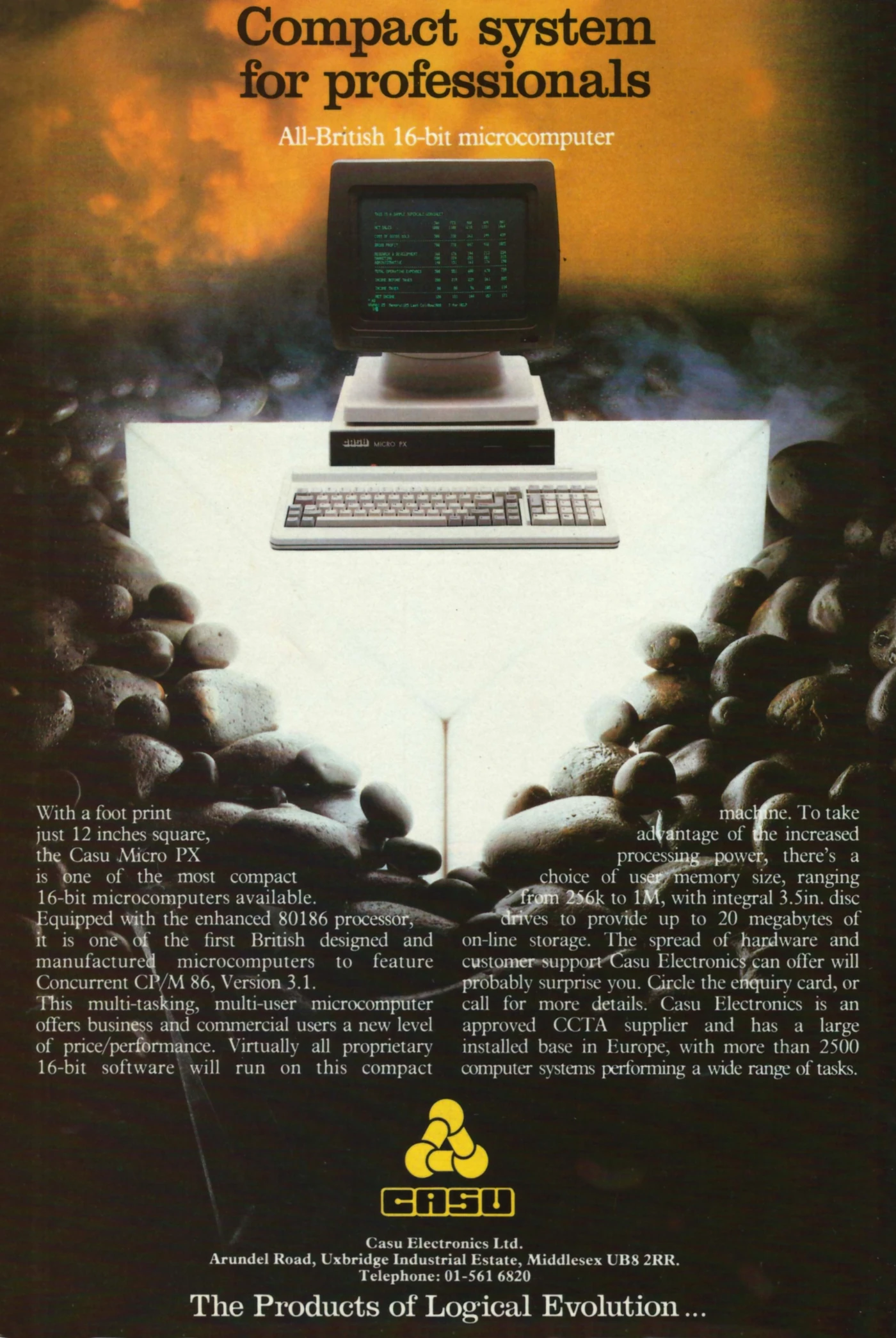
Compact System for Professionals
Once mentioned in Parliament[1] as one of only two British computer manufacturers on the government's Central Computer and Telecommunications Agency list of approved suppliers to have also been members of the British Microcomputer Manufacturers Group - the other being Comart - Casu seemed to specialise in compact desktop microcomputers, with models including the Mini C and this, the Micro PX.
Based in Uxbridge, Middlesex, the company's unusual name was said to have been formed from the first names of the founder's daughters - Caroline and Suzanne[2].
It was also another of those companies that despite building micros with components which mostly came from the Far East or the US, liked to claim its computers as being all-British.
This particular claim was questioned on the letters page in November 1984's Practical Computing by Roger Sinden of Country Computers Ltd, who pointed out that it used an American-designed Slicer motherboard, and that other components like its disk drives, controllers, keyboards, etc, were probably non-British too[3].
The Micro PX, measuring only 30 centimeters square, was based on a 6MHz Intel iAPX 186, otherwise known as the 80186 - a processor that wasn't hugely popular as it wasn't motherboard-compatible with the rest of Intel's x86 line, although that didn't stop Practical Computing from calling it "the chip to have"[4] in its June 1984 issue.
Casu's compact micro shipped with 256K of RAM, 3½" floppy drives formatted to 737K, and Concurrent CP/M 3.1, which by now had been renamed as Concurrent DOS version 4 in an effort to distance itself from its 1970s legacy.
However, the version of CP/M that had been installed was a restricted version that had been modified to only support serial terminals, with no status line, no windowing, some "undisciplined" scrolling behaviour and no PC mode - a CP/M extension which allowed some MS-DOS software to work.
Although Casu wasn't particularly aiming at the IBM market and hadn't yet tried running MS-DOS on it, it was - by October 1984 at least - planning to move in that direction, once it had added mempory mapping to the Micro PX's display.
It was also planning to investigate adding support for CP/M's PC Mode, which could potentially make MS-DOS unneccesary, but the lack of MS-DOS was still seen, by Practical Computing at least, as a large hurdle made worse by the fact the machine's 3½" floppy drives weren't even IBM compatible.
According to Practical Computing, Casu had apparently admitted that this all made the Micro PX "an intermediate product"[5].
Despite that, the machine still reviewed quite well, with Chris Bidmead concluding:
"The Casu Micro PX is a powerful and fast Concurrent CP/M micro for user who do not need the flourishes of the latest commercial applications software, but do need big disk capacity, speed, and the access to the impressive range of compilers now in the Digital Research stable. A British firm that uses largely British-made components is probably good news when it comes to support, but without a dealer network you will have to make your own arrangements. A price of £3,450 for a 20MB machine looks like excellent value for money[6]".
The single-disk version of the micro retailed for £1,650, or about £7,200 in 2026, with the 20M Rodime Winchester system going out for £3,450 - that's a hefty £15,000 now.
Date created: 24 March 2025
Last updated: 05 November 2026
Hint: use left and right cursor keys to navigate between adverts.
Sources
Text and otherwise-uncredited photos © nosher.net 2026. Dollar/GBP conversions, where used, assume $1.50 to £1. "Now" prices are calculated dynamically using average RPI per year.