Onyx Advert - August 1981
From Practical Computing
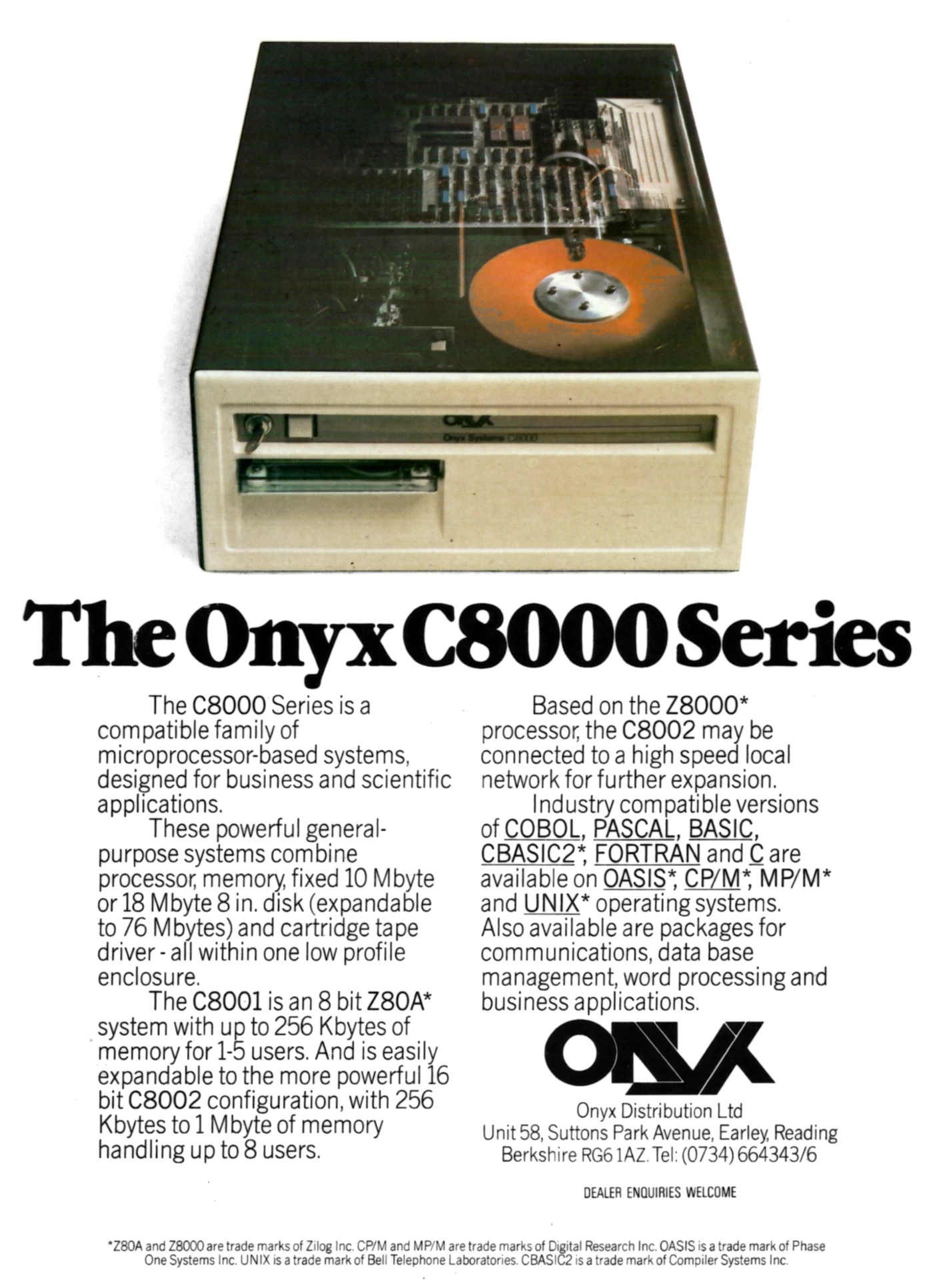
The Onyx C8000 Series
Onyx was formed in December 1978 by two former Zilog employees, Robert Marsh and Kip Myers, with some additional input from fellow former Zilog employee Doug Broiles, who had left the CPU company to join Winchester disk manufacturer IMI.
Onyx's founders had left Zilog following a management shake up and decided to start the new company because they "liked the idea of selling a packaged microsystem for small businesses", but they also wanted that system to be based on a 16-bit processor, aimed higher at the higher end of the market[1].
When the company first started shipping products in April 1979, there weren't any readily-available 16-bit processors around, and so its first product was based on their former company's 8-bit Z80 processor.
This micro - initially called the C8000 - found some early success when the company won a contract to supply 600 machines to Telema, which exported them into Europe.

The Onyx C-8001 in action in an office somewhere. From Practical Computing, January 1982
Although the C8000 became the first microcomputer to use an 8" Winchester disk drive[2], thanks to Doug Broiles's IMI connection, the machine the company really wanted to produce was waiting upon Zilog's Z8000 processor, which the chip company was promising would be widely available by the January of 1980.
Onyx's eventual 16-bit machine - the C8002 - started shipping around April of 1980. It was essentially a C8000 - now renamed as the C8001 - but came with plug-in board hosting the Z8000, which was also made available as an upgrade to existing C8001 users. Co-founder Marsh said:
"When [Zilog's Z8000] does become available in the quantities we need, we'll just plug in the Z8000 board as an upgrade, keeping the Z80 in the system to handle disk and tape. The RAM will be used as a cache for tape or disk"
The C8002 shipped with Bell Labs' Version 7 of Unix, which supported up to eight users and which was almost identical to Western Electric's Unix for the DEC PDP-11. The only changes were a new kernel (which the advert calls "nucleus") and some additional compilers.
Shipping Unix on the C8002 made Onyx one of the very first sellers of a microcomputer-based Unix system.
This hardware and software combination, according to Sue Eisenbach in the March 1981 edition of Personal Computer World, helped make the C8000 the first "supermicro", a machine which could almost be considered as a minicomputer.
In a review comparing the C8002 favourably to DEC's PDP-11/23, she wrote:
"A few years ago, computers could be divided (by word-length) into mainframes and minicomputers — fewer than 20 bits to the word and it was a mini-computer; otherwise, it had to be a mainframe. When the microcomputer came along with an 8-bit word length, it fitted in neatly below the mini but when the 32-bit ‘superminis’ were announced, the dividing line began to blur and it became necessary to find other ways of classifying machines. Some people just said, ‘a mini is a computer produced by a minicomputer manufacturer’ and left it at that. Now that microcomputer manufacturers are producing 16-bit machines which compete directly with minicomputers, it is difficult to know whether it is appropriate to think in terms of ‘supermicros’ or to treat them as normal minis".
Meanwhile, the older C8001 was available with a multi-user version of Oasis, called Moasis, as well as CP/M and Pascal. It retailed for $12,500, which is about £62,400 in 2026 terms.
The choice of model names was somewhat confusing, as whilst Onyx's C8002 did indeed use Zilog's Z8002 processor, the C8001 had kept with the older Z80A, even though Zilog had also released a Z8001 CPU - like the Z8002 but in a bigger package, support for a few more instructions, and a 23-bit bus, enabling it to support over 8MB of memory.
The Z8001 processor was actually the better chip, but it was delayed and so Onyx added its own extended memory-mapping system to get beyond the 64K memory limit of the Z8002[3].
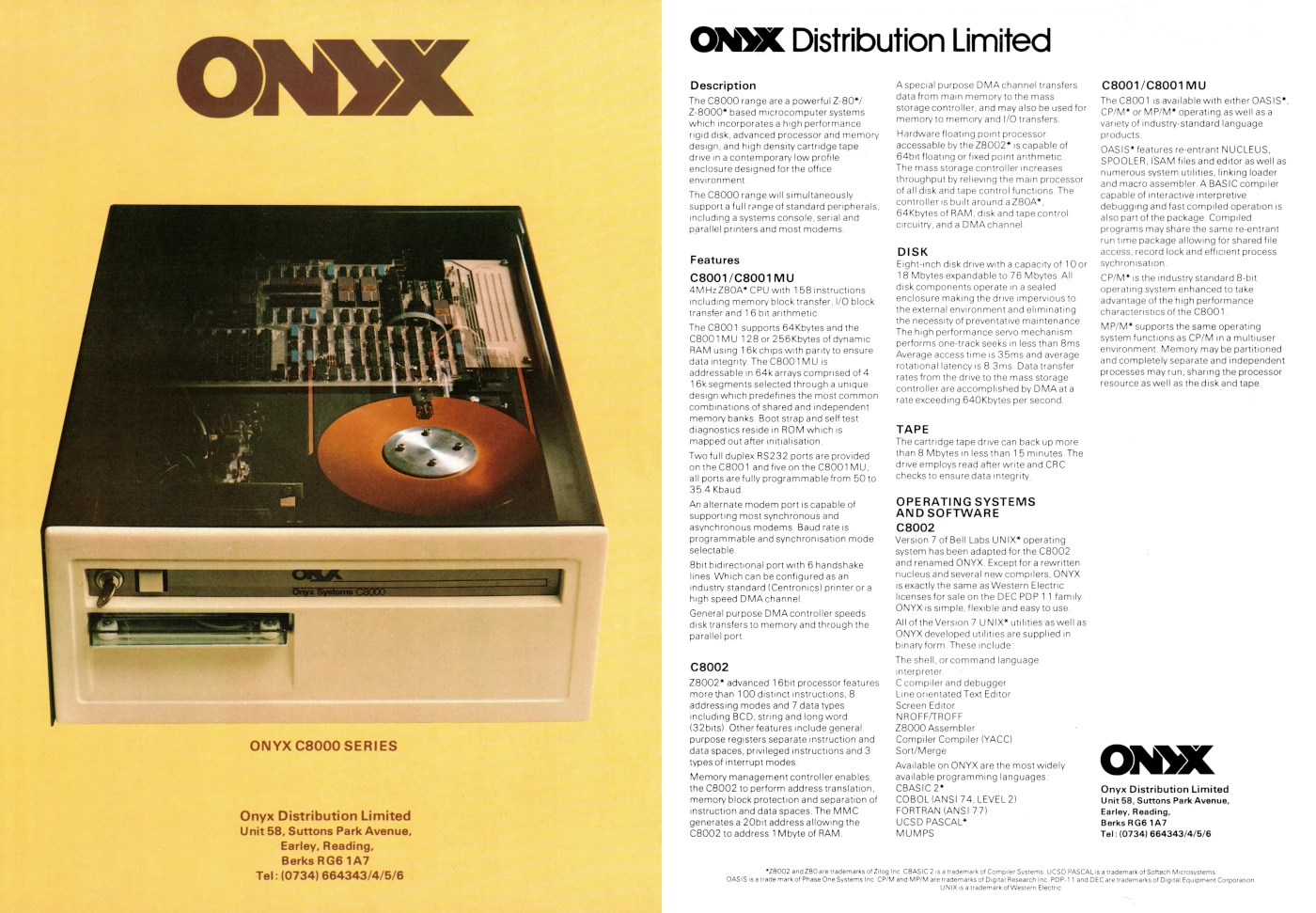
An earlier advert, from Onyx's UK distributor Onyx Distribution Ltd, for the C8000 series showing more details about the systems available, and also showing a much-less-mangled Onyx logo. From Practical Computing, April 1981
Practical Computing had been loaned a C8001 for an extended review in its April 1981 edition, with the magazine reporting that "no more than an hour had elapsed from the arrival of the van to having the system up and running".
The review, which was done using a pre-installed bundle of software from Graham-Dorian Software (GDS) and which was written from the perspective of a small business switching to a computer for the first time, concluded:
"Anyone considering a change to computers would be well-advised to consider the C8001/GDS combination. The computer is a beautiful piece of equipment by any standard and is a joy to use whether you are a programmer or an end user[4]".
Personal Computer World also liked the C8002 when it reviewed it for its March 1981 edition, with Sue Eisenbach concluding:
"Did we like it? Definitely - it was exciting to have such compressed computing power humming away in the front room [when] all we had to pay for was the electricity ... It is a pleasure to welcome the first of the supermicros into the British computing arena[5]".
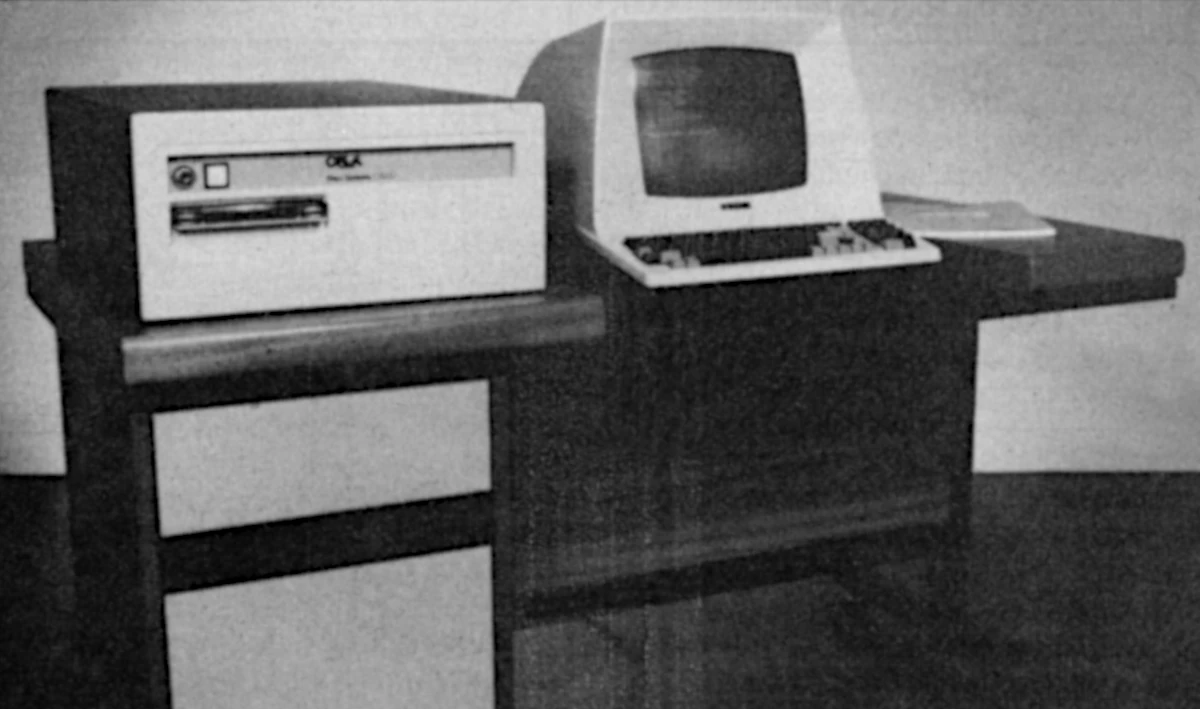
The Onyx C8001 as installed in Practical Computing's offices whilst under review. From Practical Computing, April 1981
Onyx eventually merged with its Winchester disk supplier IMI Systems Incorporated to become Onyx+IMI Inc. This company was in turn merged into Corvus, a company famous for its Omninet networking system, in 1985[6].
Unfortunately, by 1987 Corvus was in serious financial difficulty, largely caused by its lateness in adapting to the rise of the IBM PC, as well as some misguided acquisitions - which included Onyx.
Its then-president Jim Seile ended up shutting down Onyx and selling off its remaining inventory. Rights to a couple of Onyx's product lines were also sold[7].
--
Sun Microsystems' founder Scott McNealy worked for Onyx in 1982, before leaving to found the more-famous Unix workstation company Sun, along with Vinod Khosla, Andy Bechstolsheim and Bill Joy[8]
Date created: 15 July 2025
Last updated: 09 September 2026
Hint: use left and right cursor keys to navigate between adverts.
Sources
Text and otherwise-uncredited photos © nosher.net 2026. Dollar/GBP conversions, where used, assume $1.50 to £1. "Now" prices are calculated dynamically using average RPI per year.