NeXT Advert - October 1991
From Personal Computer World
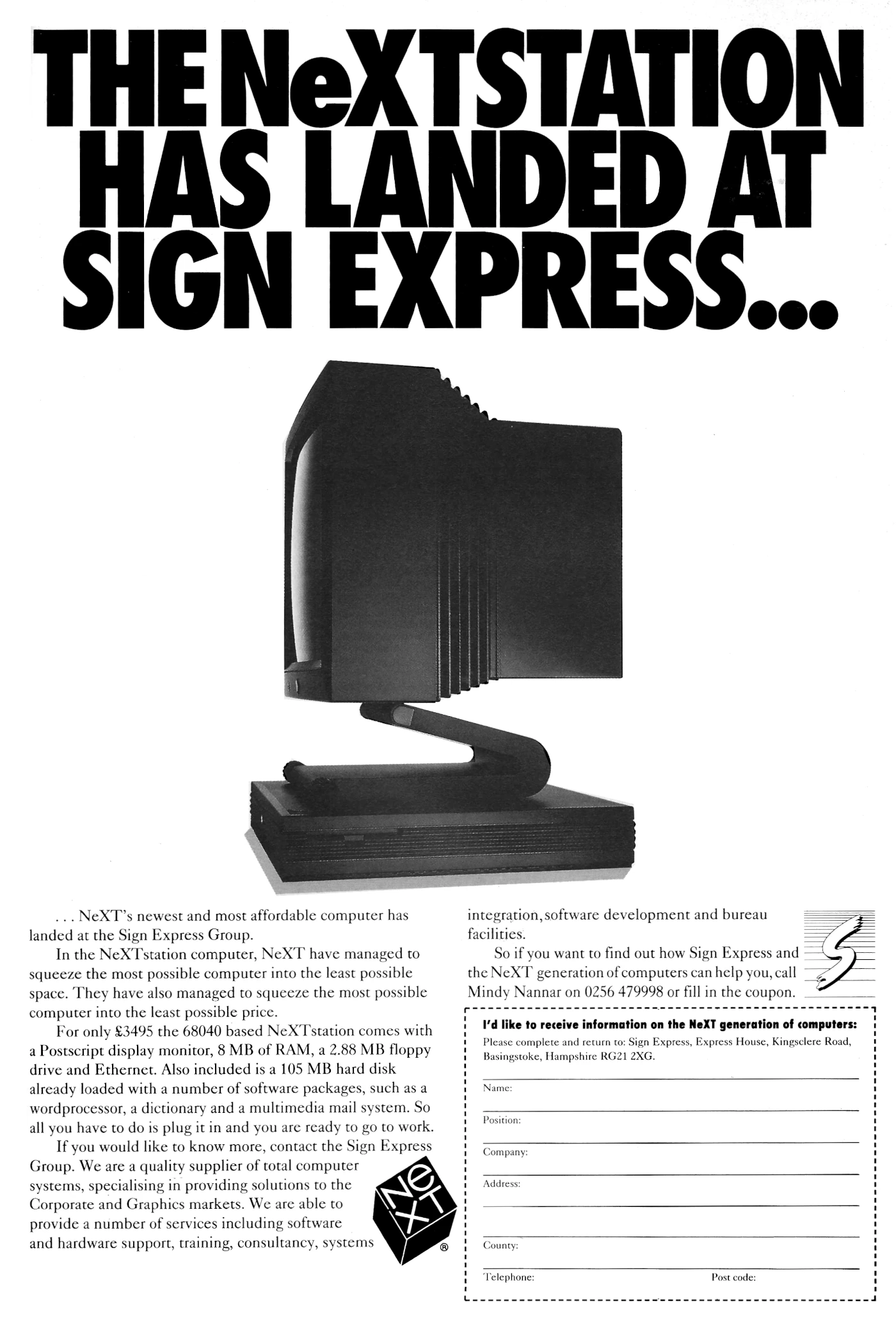
The NeXTStation has landed at Sign Express
After Apple had released its Macintosh in 1984, it was almost immediately found to be slow, thanks to its limited memory and disk space, and by 1985 there were already plans for a "fast Macintosh".
These were temporarily shelved in the summer of 1985 because of personnel changes - Steve Jobs in particular was struggling with John Sculley, the man he had hired from PepsiCo, who was effectively forcing Jobs to take a back seat. One anonymous source was quoted as saying:
"the folks in charge don't include some whose egos were rather too involved in their work"
Meanwhile the whilst company itself was saying:
"Steve Jobs [is] taking on a more global role in new product innovations and strategies".
However, the Mac was very much Jobs' machine, so his losing control over its development effectively called a halt to the whole thing[1].
After Jobs had effectively lost control of his pirate-flag-flying company-within-a-company Mac team, a power struggle between him and Sculley broke out early in 1985, and by spring, Apple's board was on Sculley's side enough for Jobs to be given the boot.
After some soul-searching, Jobs started again by founding NeXT, which by the spring of 1988 was on the cusp of unveiling its new workstations - the NeXT Computer - developed from technology which stemmed from Jobs' 1986 aquisition of a controlling interest in Pixar[2] - the graphics workstation company founded by George Lucas and which as part of Lucasfilms had produced much of the computer-aided graphics in the Star Wars franchise.
According to sources close to NeXT, the new machines would bring high-power graphics to the PC market for less than $10,000 - a fulfillment of Jobs' apparent belief that he was a technological messiah who would bring the world the next generation of PCs.
The NeXT machine, as well as systems from Sun, with its SPARC RISC-based system, and workstations from Apollo were all part of a convergence of high-end graphics to low-end workstations - the PC of 1990, according to Personal Computer World[3].
Jobs's NeXT machine, based on the Motorla 68030, had been delayed somewhat from its originally-scheduled release date of February 1988, and ongoing problems with both the hardware and the software meant that it wasn't going to appear until the summer.
The machine's secret weapon was its Pixar card-based graphics accelerator, which was said to have given it graphical power previously only found on machines that cost $55,000 and up - all for less than $10,000.
Jobs was intending to position the NeXT in the educational market, however NeXT board member and billionaire investor H Ross Perot - who would go on to become a two-time US presidential candidate[4], and who had once turned down an opportunity to invest in Microsoft - reckoned he could use his influence to lobby for military and government contracts.
There was also the prospect that the NeXT might become the next power-user machine in the business market, going up against Sun and Apollo, both of which were building low-cost versions of their Unix workstations[5].
NeXT, the company, came over to the UK on the machine's launch in August, for what Guy Kewney of Personal Computer World dubbed the "Steve Jobs Media Hype" event.
The company was being tight-lipped about exactly how many of its machines were being sold, with the only significant examples being Robert Maxwell and Queen's University, Belfast.
However, it did admit to selling "hundreds" of machines throughout Europe each month.
Meanwhile, there was some new software available, and the UK branch, based in Windsor to be near the Queen, probably, had a new managing director in the shape of Richard Strong, formerly of Adobe UK[6].
Steve Jobs's NeXT machine was launched in the US in the spring of 1989, and by the early summer of 1990 it was clear that user feedback generally agreed that the machine was "user friendly".
However that wasn't translating into a move away from traditional platforms for applications, although Lotus was planning to release its 1-2-3 spreadhseet for the machine later in 1990.
The reason for this seemed to be Jobs' "blatant disregard for standards", according to Merlyn Skye, writing in June 1990's Personal Computer World.
Although IBM had licenced NeXTStep - the NeXT's Unix-based operating system - for use on its own RS/6000 workstations, sales figures were showing that less than 1% of these were actually shipping with NeXTStep installed.
Meanwhile, the OSF was considering NeXT as an option, but it was not regarded as being anything like a standard, especially compared to AT&T's SVR4 or IBM's AIX.
All of this meant that NeXT's revenues, because it largely relied on royalties from NeXTStep to generate a return for its investors, weren't what they could have been.
Another problem for NeXT was that by the time the machine was widely available, its 68030 processor was slow compared to the latest SPARC/RISC workstations from the likes of HP and Sun.
This was even more so because of the overheads of running NeXT's desktop system, in which everything was rendered as Display Postscript, rather than as just plain characters.
Many previous US and European manufacturers, armed with what were "ergonomically superior" machines, had already failed to conquer a market where businesses were quite happy to buy Amstrad instead of Compaq
NeXT was clearly hoping that the improvements in user-friendliness and functionality would compensate for the machine's lack of raw speed.
NeXT reseller Businessland reckoned that this not unlike the situation with the original Apple Mac, which was also exceedingly slow but where the productivity of the user interface was said to compensate for the machine's lack of performance.
Apparently users agreed that whilst the DTP package Frame ran more slowly on the NeXT, projects were still being completed faster because of the ease in which the software worked.
That trade off might have worked in the US, but the UK market though was said to be the most demanding anywhere in terms of value for money, and many previous US and European manufacturers, armed with what were "ergonomically superior" machines, had already failed to conquer a market where businesses were quite happy to buy Amstrad instead of Compaq.
Jobs however dismissed the price/performance issue and made it clear that an upgrade to the 68040 CPU for his expensive machine would be sufficient to provide all the processing power required, and that there were no plans to move to RISC for at least five years[7].
In order to address some of the price/performance issues of the NeXT Computer/NeXTcube, the company released the NeXTstation of the advert in 1990.
Designed to be a relatively low-cost system - for what remained a high-end graphical workstation - the NeXTstation had fewer features and was not as expandable, enabling it to fit in an under-the-monitor pizza-box case.
Delays to the release of Motorola's 68040, which the NeXTstation used, meant that it was delayed until the end of 1990, along with an update to the original Cube.
The entry-level model retailed for $4,995, which is about £9,780 in 2026.
NeXT exits the hardware business
Market analysts International Data Corporation (IDC) had forecast sales of only 15,000 for the NeXT Computer in the year 1990, which was less than it was predicting for IBM's rival RS/6000 workstation.
By the end of 1992, NeXT had lost a number of its top executives, including Todd Rulon-Miller, vice president of sales, and marketing head Mike Slade.
In early 1993 it lost its co-founder, Richard Page, formerly one of Apple's principal engineers who had worked on the design of the original Macintosh.
These losses all fuelled rumours that NeXT was about to leave the hardware business, whilst Steve Jobs was under pressure from the company's main investor - Canon, which had put $100 million into the company - to start making some money[8].
However, the low sales figures quoted by IDC seemed to be about right, as only around 50,000 machines in total had been sold by the time NeXT announced that it was indeed exiting the hardware business, as reported in Personal Computer World in March 1993.
50,000 users was about the same as Windows NT was thought to have had at the time, but that operating system hadn't even been launched yet.
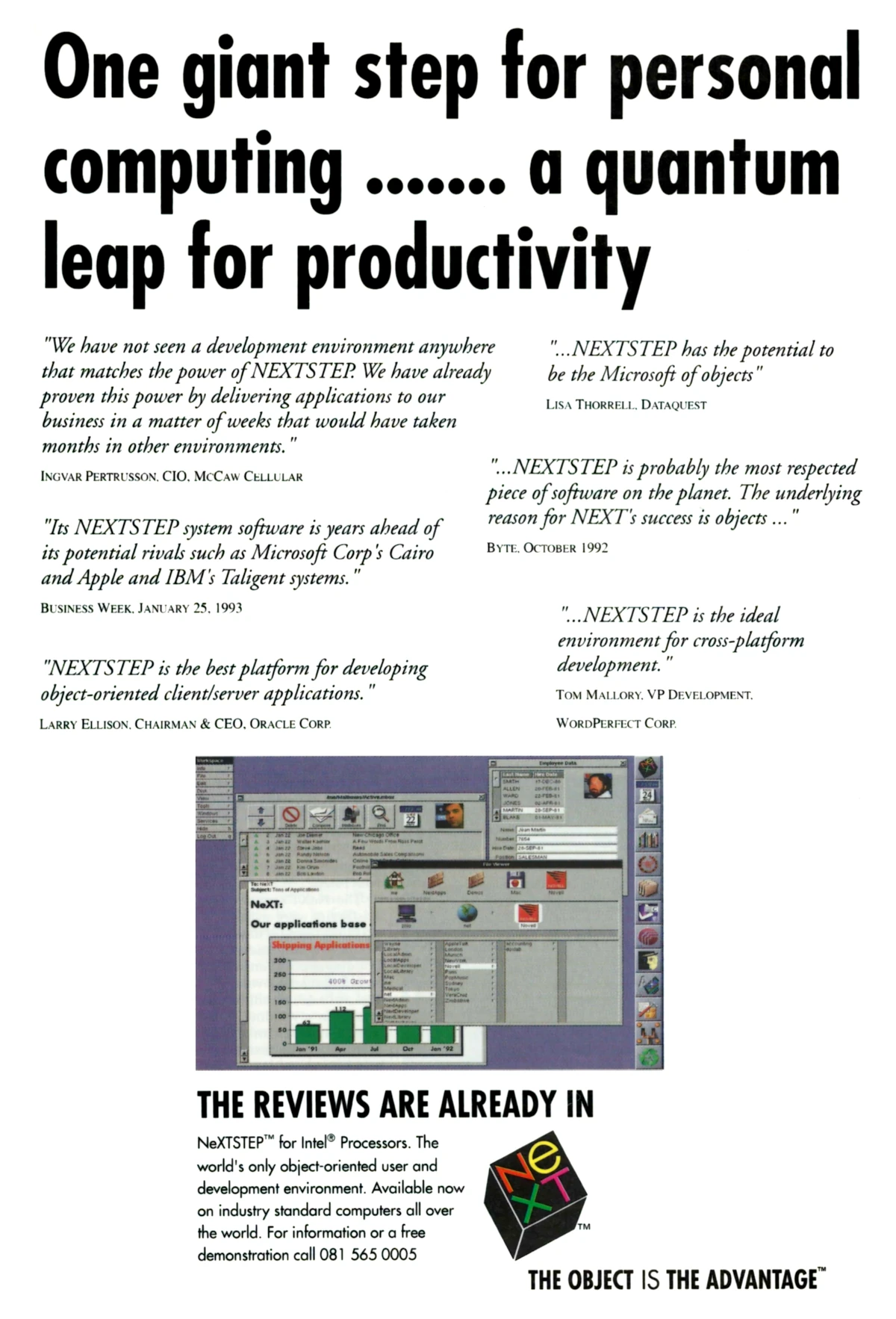
An advert for NeXTStep - "The world's only object-oriented user and development environment" - for Intel processors, from Personal Computer World, July 1993
The problem for NeXT was that it now had no hardware to run its next upcoming operating system - NeXTStep 486 - which was to debut at NextWorld Expo in San Francisco, held on 25th May. However as Personal Computer World pointed out:
"NeXTStep 486 is getting on for a year late, and perhaps NeXT couldn't wait any longer"
Canon, which was set to waive the $30-$40 million it had spent on NeXT so far, was lined up to get NeXT's production facilities and R&D department, whilst 280 NeXT employees had already been made redundant. That left around 200 employees on the software side who got to keep their jobs.
The other Jobs - Steve - said of the situation:
"This is a very painful move for us, but we wouldn't want to wake up a year from now and wish we hadn't done it. We need to act now to capitalise on our market lead before [Microsoft's object-oriented rebuild of Windows NT] Cairo and [IBM's] Taligent enter the game".
Whilst Jack Schofield, writing in April 1993's Personal Computer World, concluded:
"NeXTStep is very nice, but it is up against fierce competition: there's Solaris, Windows NT, UnixWare, SCO Unix and OS/2, with PowerOpen on the way. Jobs might be right about NeXTStep being years ahead of its time, but I suspect most potantial buyers will see it as one of a bunch, and probably not one of the top five[9]".
After NeXT was bought by Apple in 1996, its operating and windowing system - NeXTStep and OpenStep - were rolled in to macOS[10], which would eventually be based on the Unix-like operating system BSD, as was NeXTStep itself.
NeXTStep was also the operating system upon which Tim Berners-Lee developed the first web browser - WorldWideWeb - in 1990, whilst working at CERN near Geneva.
Date created: 06 February 2026
Hint: use left and right cursor keys to navigate between adverts.
Sources
Text and otherwise-uncredited photos © nosher.net 2026. Dollar/GBP conversions, where used, assume $1.50 to £1. "Now" prices are calculated dynamically using average RPI per year.