Clenlo Advert - February 1982
From Practical Computing
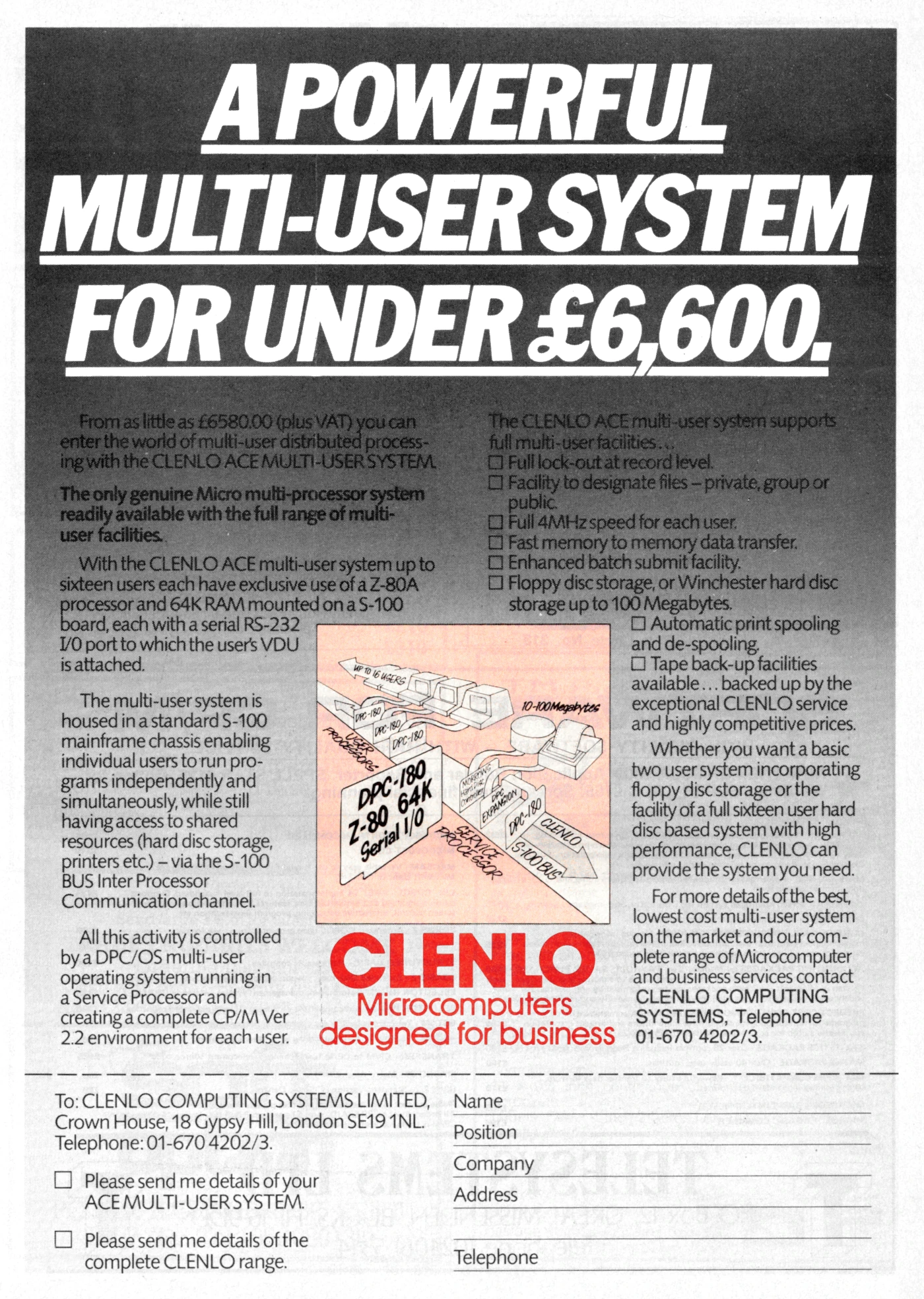
A powerful multi-user system for under £6,600
As more adverts are added to the collection, the challenge is on to discover more and more obscure microcomputers that time forgot.
And this is defintely one such computer: the Clenlo Ace Multi-User System, from Clenlo Computing Systems of south-east London, a company that disappeared without trace but which was at one point a reseller of Morrow Design's Decision 1.
The company had however been around since at least the October of 1980, when it was offering a single-user Z80/S-100 system called the Clenlo Conqueror.
By early 1981 it was offering a version of the Conqueror with the optional extra of an "attractive desk unit" to house the computer. It was pitched as a word-processing system and retailed, complete with a daisy-wheel printer, for £4,600[1] - about £25,500 in 2026.
There was also a System B version available for £1,950 and a hard-disk-only System D for a hefty £5,150, or £28,500 now.
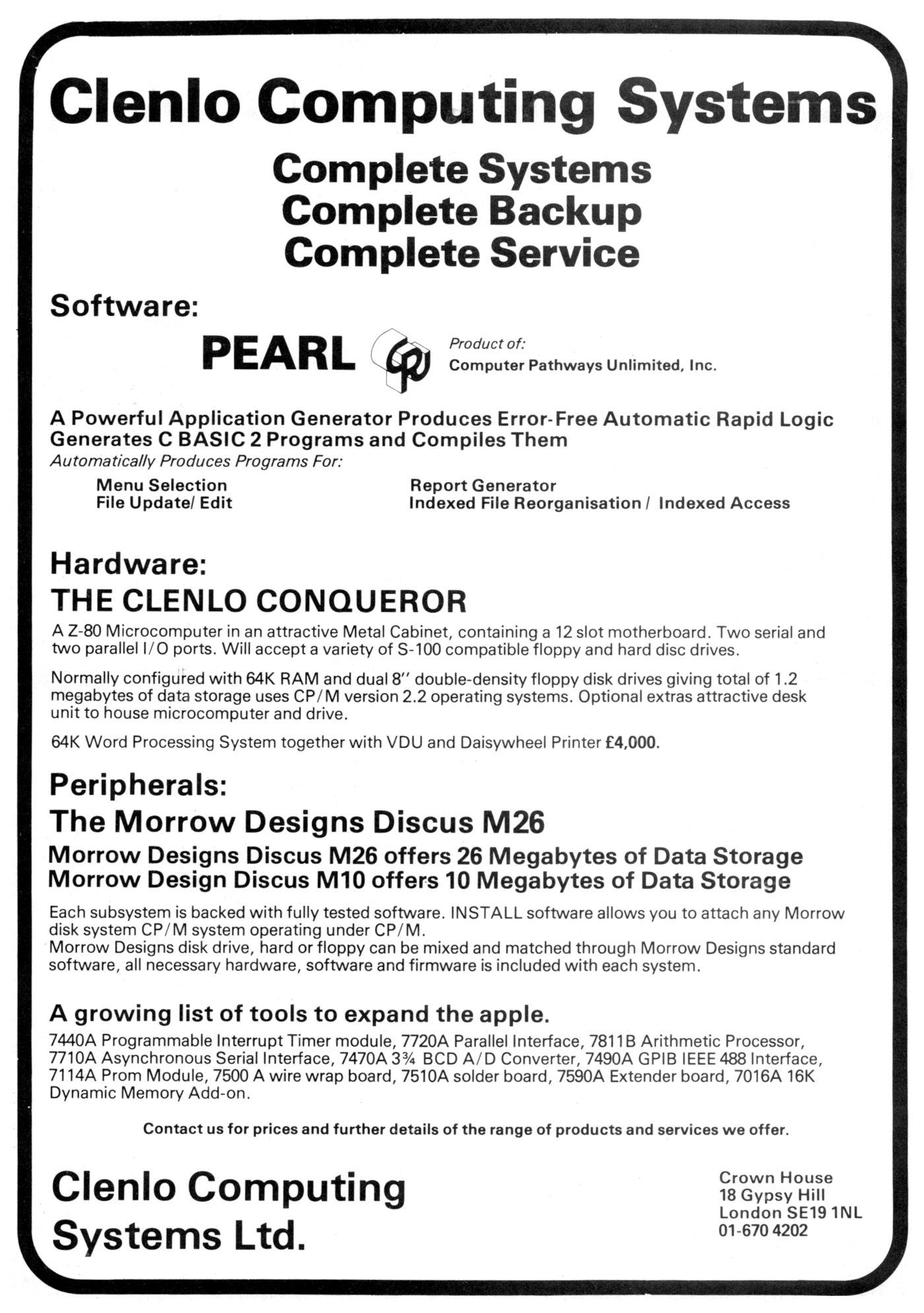
An advert for Clenlo Computing Systems from Practical Computing's March 1981 edition showing the company as a general value-added reseller, selling software and Morrow disc-storage units, but also the Clenlo Conqueror - a Z80 machine with a twelve-slot S-100 motherboard
Clenlo's Conqueror was popular enough to have been one of the machines supported by Prospero Software's ProPascal[2], where it was in illustrious company including the Comart Communicator, Nascom 3, North Star Horizon, RML 380Z and even the Apple II.
It was even possibly the system that Pro Pascal was developed on, or at the very least Prospero Software had one in their office for testing[3].
The Ace, meanwhile, was a multi-user system in the style at the time, which was to host an individual processor and memory board for each user - which Clenlo called the DPC-180 and which was based on a Z80A - on an S-100 bus, with another Z80A CPU to manage everything.
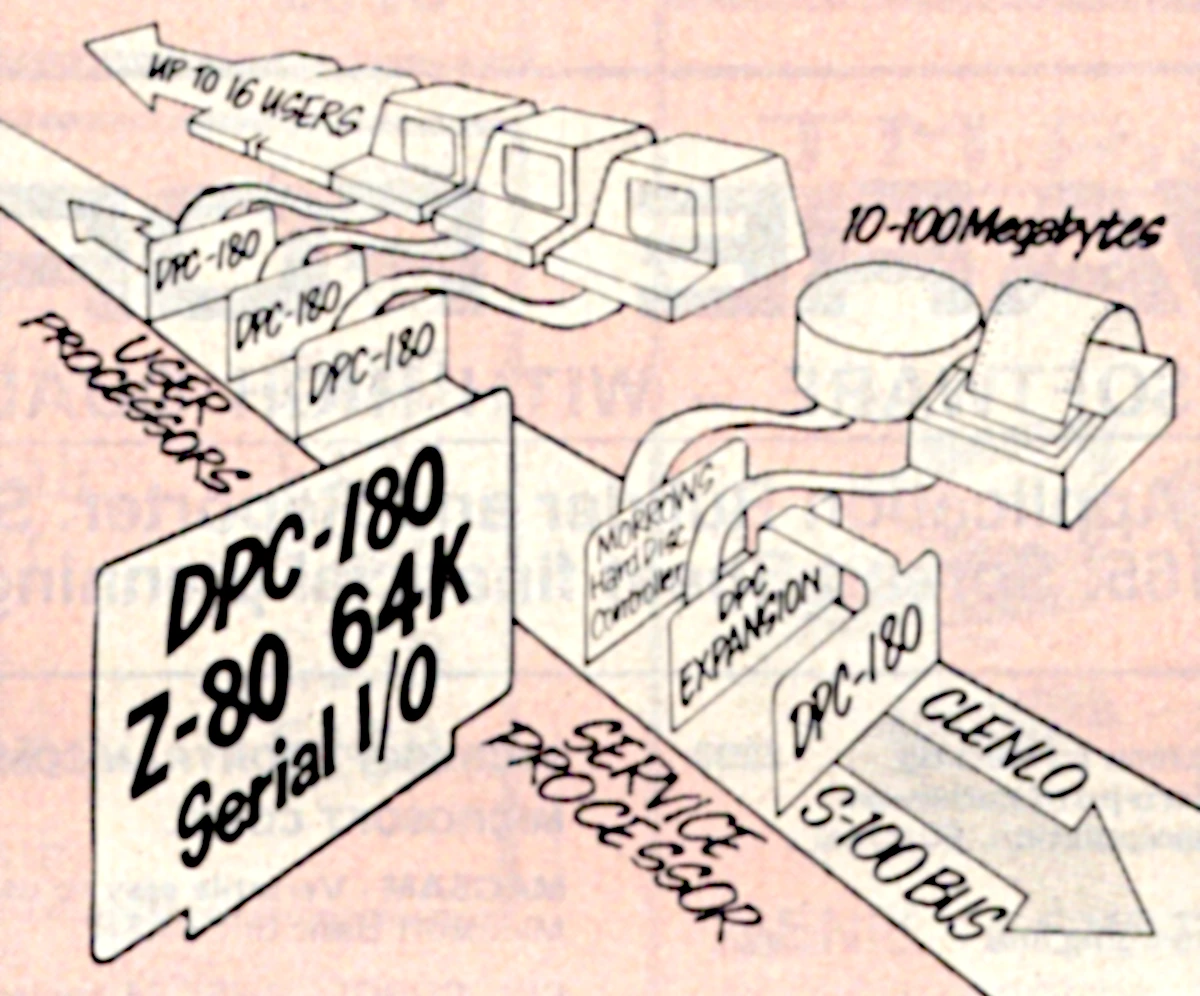
The illustration from the advert which nicely shows the multi-user architecture in use at the time: multiple plug-in boards, each with their own CPU and memory, on an S-100 bus
Each user then shared systems resources like printers and hard disk, whilst connecting to "their" processor, which ran CP/M, over RS232 serial with a terminal of some sort, whilst the system itself ran DPC/OS multi-user operating system.
That terminal could even be a Commodore PET, which despite being a fully-functional micro in its own right was actually cheaper than many dedicated mainframe terminals[4].
Hard disk storage, which could be up to 100MB, was managed via a disk controller from Morrow Designs, founded by George Morrow.
A basic two-user system retailed for £6,580 plus VAT, which is about £37,700 in 2026.
That works out at a hefty £18,800 per user for the initial system, although that was actually about the same as a reasonably-specified IBM PC, when that was finally released in the UK in 1983.
The point of multi-user systems like this though was that incremental prices for the next fourteen users were significantly less, although sadly the advert doesn't say how much the DPC-180 cards cost.
Date created: 18 February 2026
Last updated: 20 February 2026
Hint: use left and right cursor keys to navigate between adverts.
Sources
Text and otherwise-uncredited photos © nosher.net 2026. Dollar/GBP conversions, where used, assume $1.50 to £1. "Now" prices are calculated dynamically using average RPI per year.