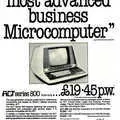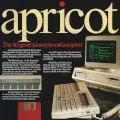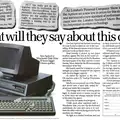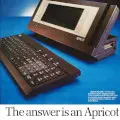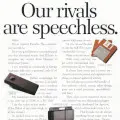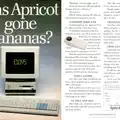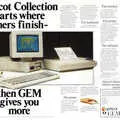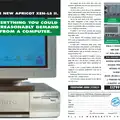
ACT/Apricot Advert - January 1985
From Practical Computing

Has Apricot gone bananas?
Launched in June 1984 at the Royal Albert Hall, with an event including "dancing girls", broadcaster Ned Sherrin and "the first micro comedian", Ronnie Corbett[1], ACT's Apricot F1 was a follow-up to 1983's Apricot PC - a machine which featured compatibility with Chuck Peddle's Sirius 1, which ACT had a lot success with as an importer, shifting some 25,000 machines in the UK alone.
Unlike the earlier machine, the F1 was aimed more at home users as well as perhaps small businesses, shipping with the ability to plug in to a television and using infra-red to connect its keyboard and mouse - making it possible to use from a sofa several metres away, as long as the user had a pair of binoculars handy in order to see the screen.
The F1 - like the Apricot before it - was designed and built in the UK, with only components not made locally being the integrated circuits like the Intel 8086 CPU.
It was also the first "all in one" microcomputer to use Sony's new 3½" floppy disk drive[2] - the format that would become dominant until floppy disks were effectively replaced by portable storage based on flash memory at the very end of the 20th century.
And whilst it ran MS-DOS, it wasn't actually IBM compatible, even though it was sometimes referred to as a "British PCjr", in reference to IBM's flawed attempt at the home market.
Reflecting its target market, the F1 was quite cheap, retailing for only £1,095 plus VAT, which is around £5,240 in 2026, although that's without a monitor.
And if that was still too expensive, ACT also released an even-cheaper version - the F1E - at the same time.
Aimed at the education sector, which ACT claimed was "poorly served" by existing micros, the F1E shipped with 128K rather than the 256K of its bigger sibling, as well as a single 3½" floppy disk drive.
It did, however, offer the full 16-bit MS-DOS experience which was like that increasingly found in business and industry, rather than that of incumbent Acorn with its BBC Micro and the BBC BASIC that came with it.
As Practical Computing put it in a preview of both of ACT's machines in its October 1984 edition, it might still be a challenge for cash-trapped schools and colleges choosing between an £800 micro or a £400 one, but that:
"A crucial factor could be ACT's success or otherwise in persuading the BBC that it should back more than one horse in the micro stakes and that Acorn's stablemate should be ACT[3]".
Date created: 21 July 2026
Last updated: 05 November 2026
Hint: use left and right cursor keys to navigate between adverts.
Sources
Text and otherwise-uncredited photos © nosher.net 2026. Dollar/GBP conversions, where used, assume $1.50 to £1. "Now" prices are calculated dynamically using average RPI per year.