Sirton Advert - June 1982
From Practical Computing
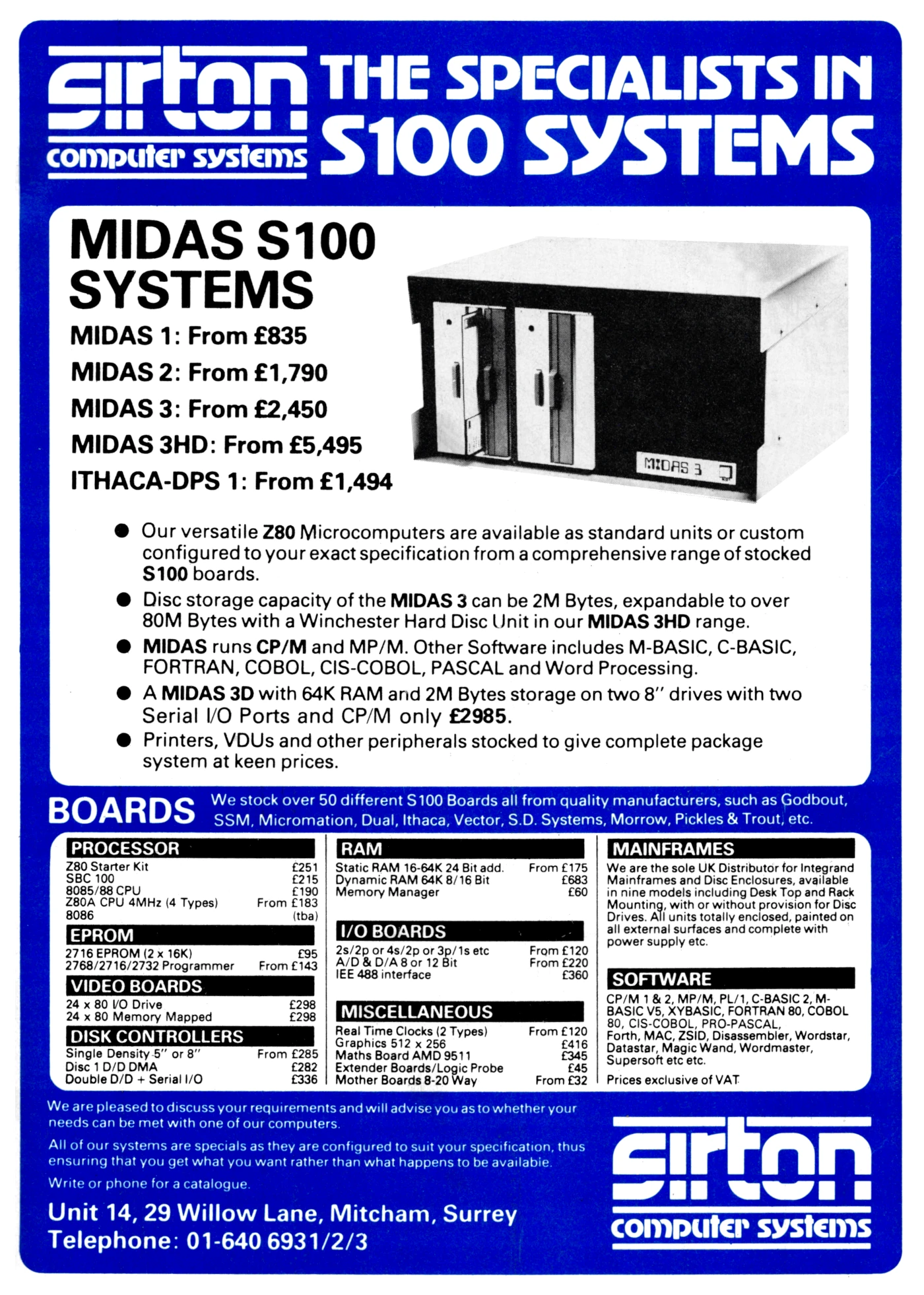
Sirton: the specialists in S-100 systems
Sirton Computer Systems was established in 1979 by electronics engineer Lionel Moon as an S-100 systems specialist, stocking - according to the advert - over fifty different S-100 cards from the usual roster of US microcomputer or board manufacturers such as Godbout, Micromation, Ithaca and Morrow.
It looks like the company followed the common pathway for many similar board-selling companies when it decided to start building its own microcomputers, rather than just importing everyone else's, launching its Midas range sometime around late 1980 or early 1981.
Also in common with pretty much every other business micro builder at the time, the Midas range was Z80-based, and ran CP/M, with the option of MP/M, making it a multi-user machine supporting either two or four external terminals depending upon the chosen interface board.
However, Sirton's machines were not off the shelf, with the company claiming that it configured each one specifically to suit customer requirements. This approach seemed to work, at least according to Richard Whinney of the Winchester Archaeology Office which purchased one in February 1981, with Whinney stating in a report published in 1984 that:
"The Midas has been in almost continual use since February 1981, and has proved itself to be extremely reliable and consistent in its operation. In the whole of the three years there has been no failure of the hardware, despite the best efforts - albeit unwittingly - of some of the staff, including the present author. Sirton have been unfailingly helpful and encouraging when queries and problems have occurred. A better choice could not have heen made[1]."
Sirton offered various configurations of its Midas machine, including the Midas 1 single-board computer for £895 plus VAT, or around £5,100 in 2026 money, up to the top-of-the-range Midas 3HD - a machine with an 80MB Winchester disk which retailed for £5,495 plus VAT, which is around £31,300 now.
The company also offered Ithaca's DPS-1 as an alternative, but by early 1983 it appeared to have dropped this in favour of its own Midas 86 - a micro based on the 16-bit Intel 8086 and which retailed for £3,520, or about £18,400 now.
By late 1984 - well into the era of the IBM PC - Sirton was still selling its Midas systems, and even launched a model aimed at "third-world users".
The Midas 2D/TE came with extra fans as well as dust filters, and was built using DC-only components, none of which required voltages over 35V[2]. This helped to make it more reliable when plugged into unreliable power supplies.
Around the same time it also launched the Midas-MPS, a Distributed Processing System using an architecture where each user had their own CPU and memory board, as well as continuing with its built-to-order approach, by now offering systems running on a choice of Intel's 8085, 8088 and 8086, National Semiconductors' 16032, or Motorola's 68000 CPU.
Sirton's micros appear to have been manufactured by its own offshoot of Cejam Electronics Limited, however this changed its name to that of its parent - Sirton Computer Systems - in February 1985, possibly signalling a scaling back of retail hardware operations.
Although whilst it was still advertising its manufacturing capability of S100 and VME boards, it now appeared to be selling purely ad-hoc custom-made machines with a range of enclosures, rather than specific models[3].
By 1986 it seemed to be focusing on "PC components for science and industry", and continued selling various specialist boards, including the PC Mirror CCTV-grabbing card launched in 1987[4].
At some point the company appeared to switch to small-scale business software development, whilst making most of its money from property. It was voluntarily dissolved in April 2013[5].
Date created: 29 June 2026
Hint: use left and right cursor keys to navigate between adverts.
Sources
Text and otherwise-uncredited photos © nosher.net 2026. Dollar/GBP conversions, where used, assume $1.50 to £1. "Now" prices are calculated dynamically using average RPI per year.