Micro Craft Advert - January 1985
From Practical Computing
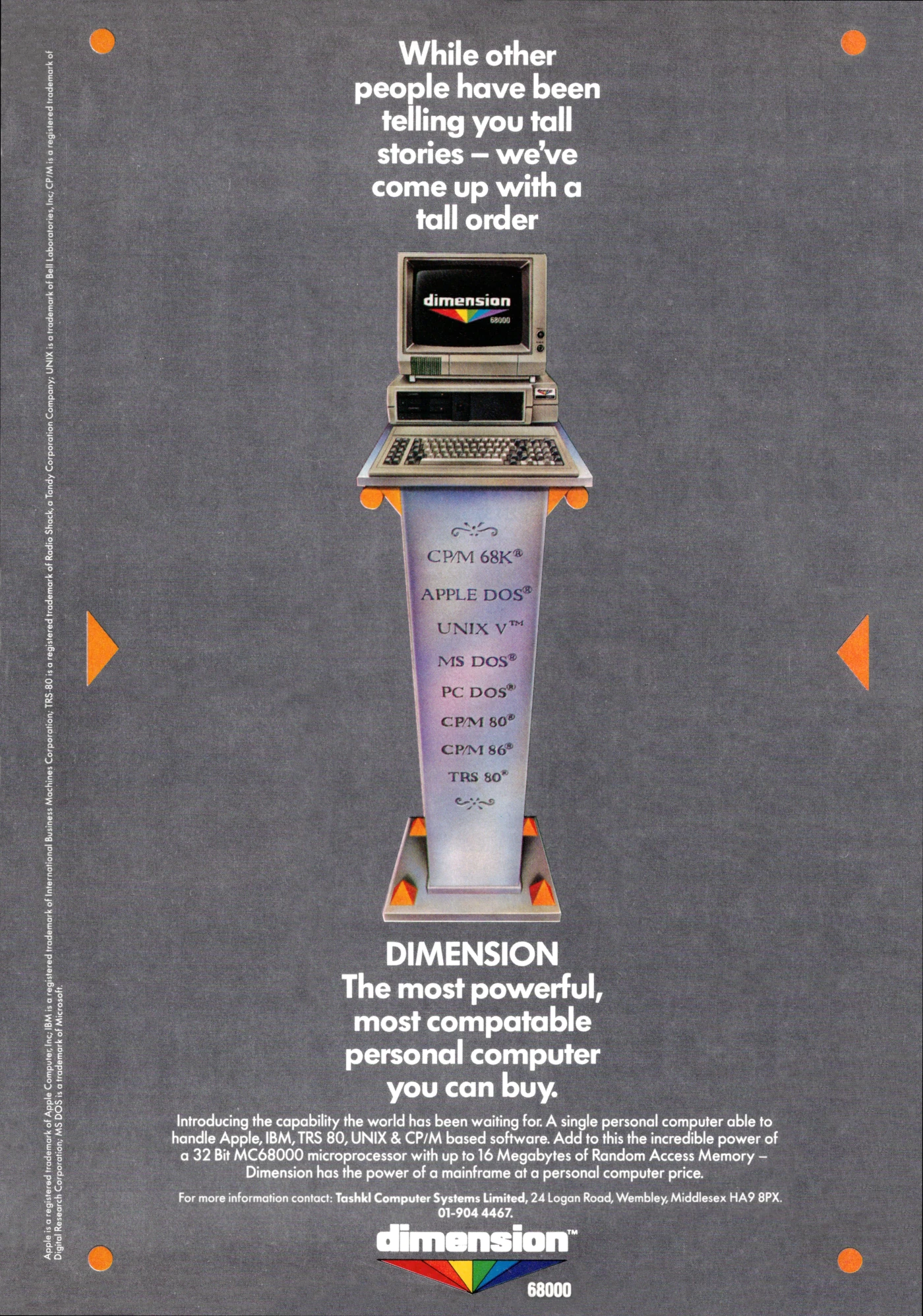
While other people have been telling you tall stories - we've come up with a tall order
Imported and distributed in the UK by Tashkl Computer Systems of Wembley, Middlesex, the Dimension 68000 was built by Micro Craft Corporation of Texas in the US - a company founded by Mike Carpenter specifically to develop the Dimension, a multi-system-compatible "hybrid" desktop computer.
Carpenter - a former president of Scientific Machines - had even contacted former engineers from each of the companies he wanted to emulate in order to help build the micro, which was finally released at Comdex towards the end of 1983.
By the spring of 1984 the company had shifted 500 units, although Barbara Henry-Arnold, Micro Craft's director of corporate communications, suggested that "response [to the Dimension] has been overwhelming" and that an early advert generated 50,000 enquiries. Henry-Arnold also said that:
"We're having to apologize to the public for not being able to get information out promptly to everybody who has requested it[1]".
The selling point of the machine itself - nominally based on Motorola's 68000 processor - was that by plugging in the appropriate co-processor cards it was possible to emulate the Apple II, IBM PC or Tandy's TRS-80, as well as generic CP/M.
Whilst the company claimed that Flight Simulator and Lotus 1-2-3 ran in IBM PC mode and that it kept an eye on the latest software releases in order to check compatiblity, there were some differences.
For example, the Apple II co-processor board differed from a real Apple II as it used MOS Technology's 6512 - as used on the BBC Micro B+ - instead of the original 6502, because the 6512 used an external clock which made it better suited to multi-processor environments.
It was also possible to purchase a Dimension without any add-in cards, in which case the machine would run a version of the little-used CP/M-68K operating system. It would even run Unix, although apparently it took the company until the end of 1985 before it actually delivered a four-user version of the operating system which would run on its machine.
The Dimension 68000 was reviewed by Peter Bright in September 1984's Personal Computer World, where he concluded:
"Technically the Dimension is a very innovative product, and the machine emulation is well executed for the most part. My only worry is whether this is a case of building a machine for its own sake rather than because the market needs it. As a standard single-user machine it is overpriced and runs an unpopular version of CP/M. As a multi-user machine it could be competitive with the right operating system. As an emulation machine it is unique as far as I know. But I am not sure how large the market is for this kind of multi-personality machine. I feel that its major appeal will be to people who are upgrading from, say, an Apple II but who still want to be able to run their old software. It is not a machine for beginners, it is not particularly friendly and the documentation is not written for beginners. As long as you bear this in mind you will be OK[2]".
Meanwhile, whilst the advert claims that the Dimension is "the most powerful, the most compatible personal computer you can buy", it doesn't claim it's the cheapest, and gives no idea of the price.
However, according to April 30th 1984's InfoWorld, the base system - which came without the terminal which was required to actually use it - retailed for $3,995, or about £11,600 in 2026, whilst a fully-stocked system with the extra co-processor cards and the additional memory required to use them went for $6,230, which is about £20,800 in today's money.
By the time Personal Computer World came to review the fully-specced machine, it was retailing in the UK £5,175 plus VAT - a hefty £25,900, although the magazine pointed out that as it was still priced in US Dollars, "the UK selling price is likely to vary".
Date created: 16 August 2026
Last updated: 17 August 2026
Hint: use left and right cursor keys to navigate between adverts.
Sources
Text and otherwise-uncredited photos © nosher.net 2026. Dollar/GBP conversions, where used, assume $1.50 to £1. "Now" prices are calculated dynamically using average RPI per year.