Ferguson Advert - March 1981
From Personal Computer World
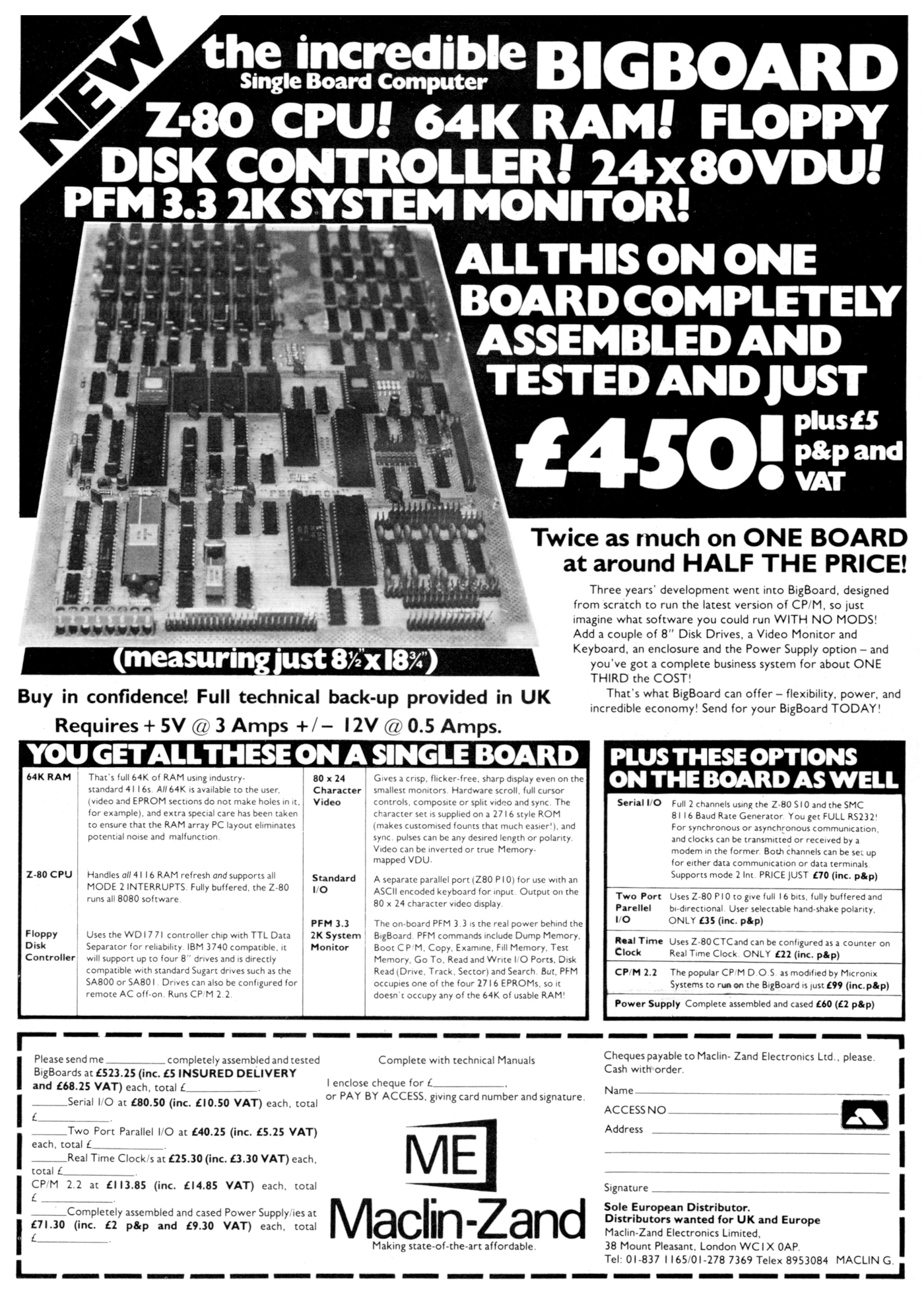
The incredible Bigboard single-board computer
Launched in 1980, the Bigboard was one of a number of single-board computers - bare boards that shipped with everything needed to run a microcomputer, but which didn't however come with a case, a power supply, a monitor or a keyboard, although these were all available as extras.
Designed by Jim Ferguson and manufactured and supplied by Digital Research Computers of Texas[1] - a company that had nothing to do with the other Digital Research, the makers of CP/M, the Bigboard was nevertheless "designed from scratch" to run CP/M.
Its size of 8½" x 18¾" was apparently intended to match Shugart's 801 or 851 8" floppy disk drives.
It was also initially supplied in kit form - DRC was primarily a retailer of electronics components which it sold via mail order - and as such it was advertised as "being suitable for people with some hardware/software experience".
Apparently when first launched in the US, even the components and integrated-circuits were extras, with the board arriving with absolutely nothing on - just a parts list and a schematic diagram[2].
However, in the UK it was also available assembled and fully tested via its sole European distributor, Maclin-Zand Electronics of London - also known as Microbyte[3] - although that was still the board only, with the purchaser still having to connect a power supply, put it in a case and either find a terminal or buy a keyboard and monitor.
Even so, a working system - the board, serial I/O, power supply and a copy of CP/M 2.2 - could be cobbled together for around £715, which is around £3,960 in 2026.
Thanks to the apparent success of the Bigboard, Jim Ferguson eventually incorporated his own company - Cal-Tex - in 1982[4] in order to produce the follow-up machine, the Bigboard II - a single-board computer incorporating many of the "extras" available on the original, as well as a faster 4MHz Z80 CPU.
Its success was at least in part because a version of the original Bigboard was used as the basis of Xerox's 820 micro - complete with the relatively pedestrian 2.5MHz speed of the Bigboard's Z80 processor.
The Bigboard was reviewed in March 1981's Personal Computer World, with Dr. Neil Cryer - who had first encountered the micro at the Breadboard Exhibition in November 1980 - concluding:
"Overall I consider Bigboard to offer good value for money. I found it very easy to set up and use and I suspect that for those with some experience it would be fairly straightfoward to build it from a kit. The lack of a bus arrangement limits expansion considerably but then you do get quite a system for your money. The ability to use CP/M makes an enormous number of packages available to the user and that, coupled with the 64K memory, must be one of the strongest points in Bigboard's favour[5]".
Its relative success also led to the creation of an entire magazine devoted to the micro, with Micro Cornucopia starting out in July 1981 as a "journal of Bigboard users".
Date created: 21 August 2026
Last updated: 19 October 2026
Hint: use left and right cursor keys to navigate between adverts.
Sources
Text and otherwise-uncredited photos © nosher.net 2026. Dollar/GBP conversions, where used, assume $1.50 to £1. "Now" prices are calculated dynamically using average RPI per year.