ACT/Apricot Advert - June 1984
From Practical Computing
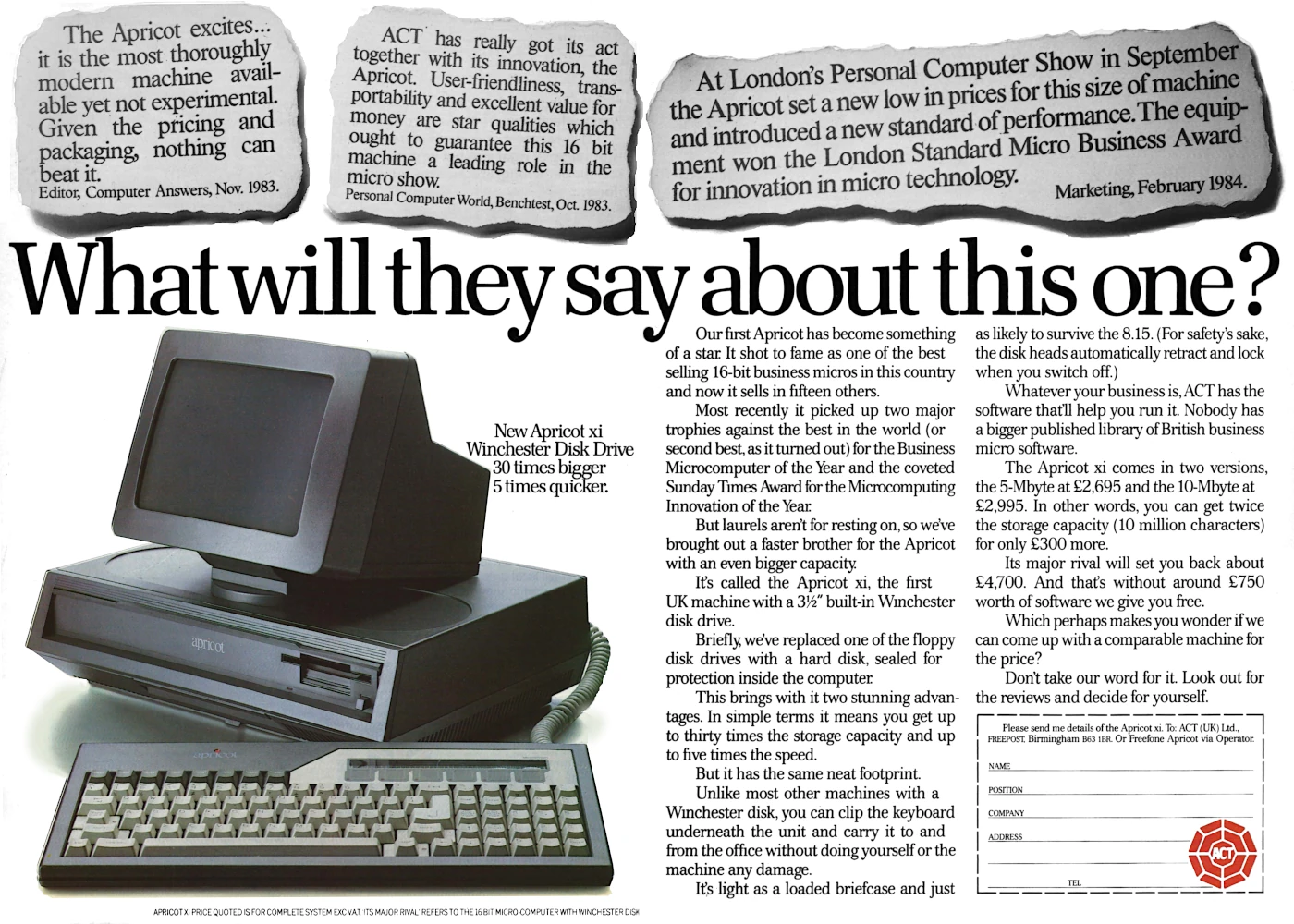
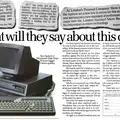
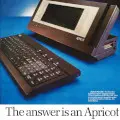
Apricot Xi: What will they say about this one?
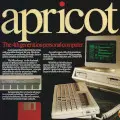
Less than a year before Applied Computer Techniques, or ACT, changed its company name to that of its first computer - Apricot - comes this advert for its Xi model.
ACT, which had started out primarily as a time-sharing bureau in Birmingham, became more well known when it signed a deal in 1982 to sell Chuck Peddle's Victor 9000 in the UK, naming it the ACT Sirius 1.
In Europe, the Sirius had a head-start on IBM's PC - which it wasn't compatible with - and for a while outsold it.
By the autumn of 1983 ACT had developed its own machine - the Apricot, the name being a roughly-fitted "pretend-onym" derived from the company's full name - APplIed COmputer Techniques.
According to the advert at least, this became one of the best-selling 16-bit micros in the UK, and won several awards, including the Business Microcomputer of the Year.
The Xi - its name apparently deriving for the Roman numeral for ten (the size of its hard disk[1]) with a trailing "i" because it sounds more technical, probably - was its follow-up micro.
It was essentially the same as the original Apricot, but with one of the floppies removed and replaced with an internal 3½" Winchester - making it the first micro in the world to use the latest small-format hard disk drives.
In keeping with the theme, the original Apricot had been the first micro outside Japan to use 3½" floppy disk drives[2].
In the early summer of 1985, Apricot launched a private Viewdata system for the Xi-10s - the 10MB Winchester disk model in its Xi range.
Supporting up to 8,000 frames (more-or-less pages) and 16 simultaneous users, the system was accessible via a dedicated Viewdata terminal, available for £250, or about £1,040 in 2026, or televisions capable of supporting Ceefax or Oracle.
It was also possible to connect to it via other Apricots, the regular PSTN dial-up telephone network, Packet Switch Stream (PSS) or an internal telephone exchange, making it not unlike Prestel, with which it was compatible.
It wasn't especially cheap though, costing £9,930 - about £41,300 in 2026 - for the hardware and software[3].
The company continued to produce sometimes highly innovative machines, including the first computer in the world to use Intel's 80486[4].
However this history of constant innovation - and the expenditure it required - combined with its insistence on designing and manufacturing everything itself, led to various financial crises.
IBM clones and the growing Microsoft/Intel hegemony were also making life difficult for a radical outsider, and it was eventually bought out by Mitsubishi in 1990.
The combined operation nevertheless continued producing computers up until 1999[5].
Date created: 26 March 2025
Last updated: 29 January 2026
Hint: use left and right cursor keys to navigate between adverts.
Sources
Text and otherwise-uncredited photos © nosher.net 2026. Dollar/GBP conversions, where used, assume $1.50 to £1. "Now" prices are calculated dynamically using average RPI per year.