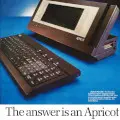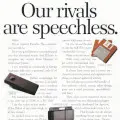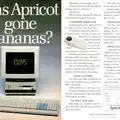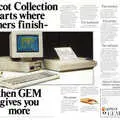
ACT/Apricot Advert - October 1983
From Personal Computer World
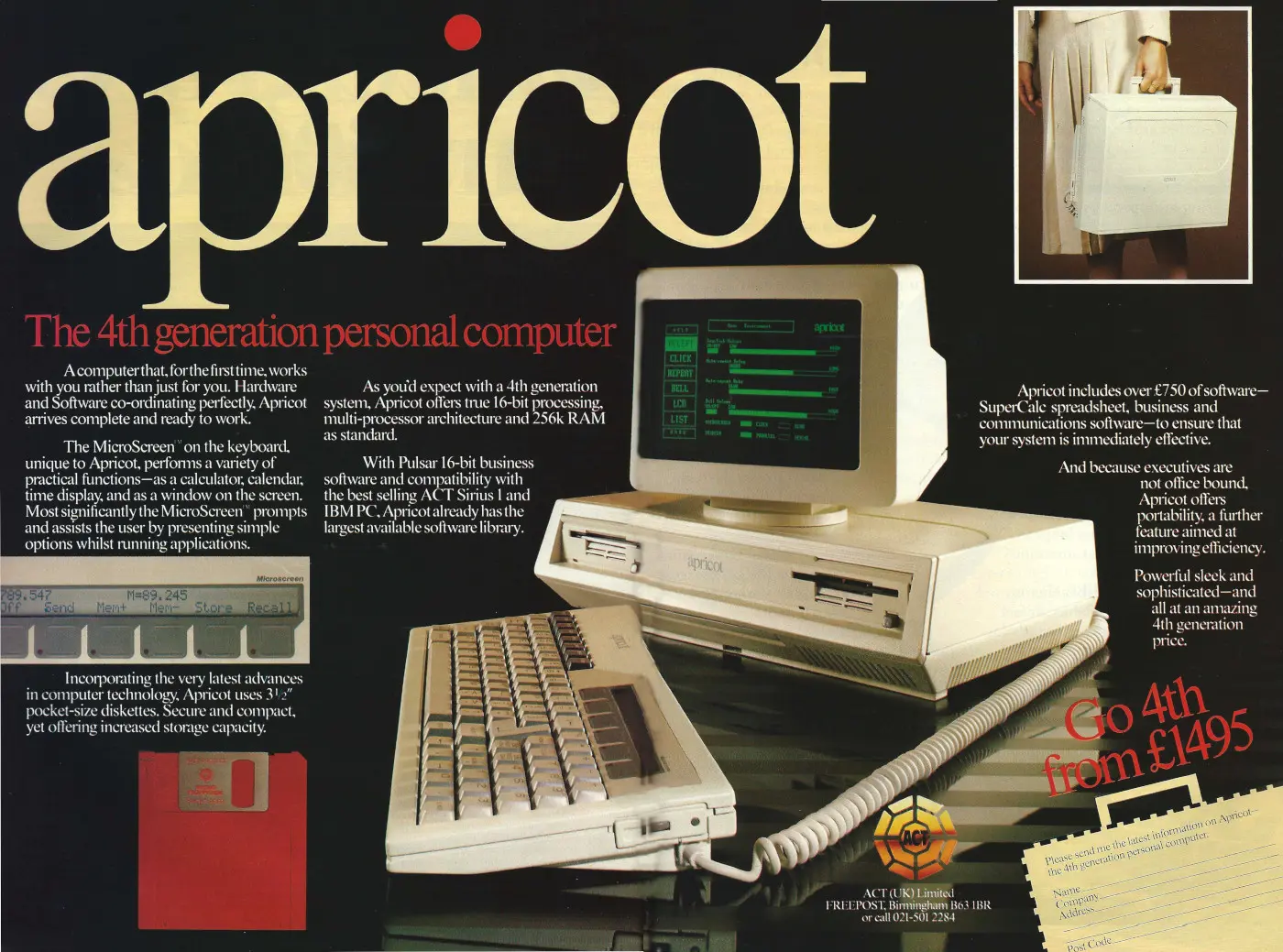
Apricot - the 4th generation personal computer
ACT - Applied Computer Techniques - of Dudley, near Birmingham, was set up in 1965 as a mainframe accounting bureau by Roger Foster.
Foster had left Wolverhampton Grammar School in 1957 before qualifying as an accountant in 1962. After this, and during a three-year stint at multinational aerospace and automotive company GKN, he was introduced to computers, saying of the encounter that:
"The first time I ever saw a computer, which was probably around 1963, I think I had an instinctive desire to get involved with them. They were clearly the way of the future"
After setting up ACT, not much was happening and so Foster and his colleagues decided to write a book about the future of computing, which included the prediction that software would become integrated into everything, saying after the company started on its own software that:
"It was one of the pillars of the software that we prepared during those late sixties when we wrote an integrated accounting system for mainframe computers. One which has been refined over a period of 15 years now, and which we sell as Pulsar on the micros"
ACT set up a minicomputer division in 1976, and then acquired a continuous stationery manufacturer in 1977. It then floated 10% of its stock on what would become the Unlisted Securities Market in 1979.
It also diversified into reselling office equipment and producing software for microcomputers via its PETACT subsidiary[1], which came about after it had got involved with Commodore PET software supplier PETSoft - company which it eventually bought in 1979[2].
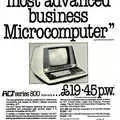
ACT then branched out in 1980 by selling its first microcomputer - the ACT Series 800, a machine which was actually built by Computhink of California, where it was known as the Minimax, and which had been initially sourced by Julian Allason of PETSoft.
It turned out that the name of the machine was somewhat apt, as ACT only sold around 800 of them.
Thanks to the Commodore connection, the company had got to know Chuck Peddle - co-designer of the 6502 processor and the Commodore PET.
Peddle eventually left Commodore to start a new company - Sirius - in order to build a new 16-bit business computer, which he asked ACT to take a look at.
Even though it was still at the design stage, ACT was impressed enough with the specification and the credibility of Peddle and his team that it signed a deal for the new machine in 1982[3].
It would call the machine the ACT Sirius 1 in the UK and Europe, where ACT had an exclusive distribution deal, whilst in the US it was known as the Victor 9000, thanks to its manufacturer and State-side distributor.
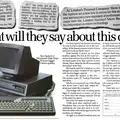
The Sirius 1/Victor 9000 became, at least for a while, the top-selling business micro in Europe, even outselling the IBM PC, which although having been launched in the US in 1981 didn't officially make it to the UK until the beginning of 1983[4], giving ACT and the Sirius 1 a useful head start.
After Victor ran into financial difficulties, ACT attempted to buy the company, however after "lengthy negotiations" the deal collapsed, an outcome which in the long run probably benefitted the company - not least as Victor would eventually enter Chapter 11 bankruptcy protection in the US.
Meanwhile, its positive experience with the Sirius - which sold around 25,000 units in the UK alone - meant that it didn't take long for ACT to decide to do its own thing, with the company's first self-designed-and-built micro being unveiled to the public at the sixth PCW Show, held in the autumn of 1983.
Announced as "Project Apricot"[5], it was shown alongside a cake "modelled to look just like ACT's new piece of leading-edge technology" which included a separate screen and keyboard, also in the form of cake[6].
The show ran from 29th September to 2nd October 1983 and was staged at London's Barbican Centre, where the Apricot - a roughly-fitted "pretend-onym" derived from the company's full name, APplIed COmputer Techniques - was billed by Personal Computer World as "the tastiest silicon cocktail for some time"[7].
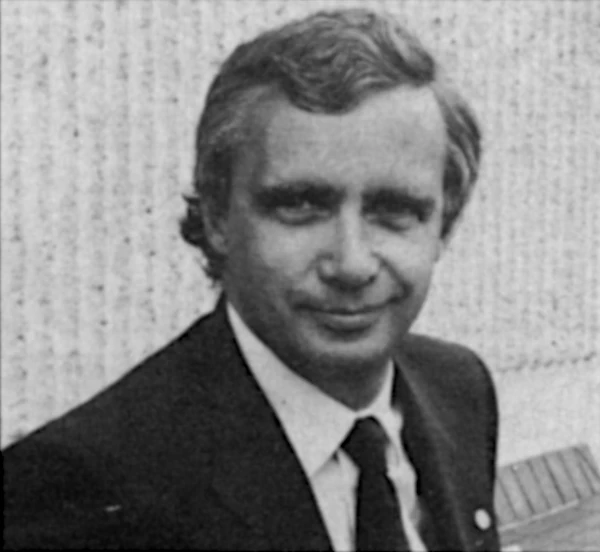
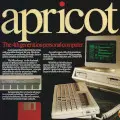
ACT's founder Roger Foster, from Practical Computing, November 1984Incorporating either one or two Sony 3.5" 315K floppies, high-resolution 800x400-pixel graphics and a true 16-bit 8086 processor running at 5MHz, the 23lbs (10.4kg) Apricot was billed as a "transportable", rather than the more optimistic "portable" which even-heavier machines like the Osborne 1 claimed.
It had been co-designed with external agency QED and was probably the first (and one of only a few) machines launched with ACT Sirius 1 compatibility as a headline feature, rather than the increasingly-dominant IBM PC format.
The machine had gone from conception to launch in less than a year, with much of its system design down to founder Roger Foster.
However, Foster - speaking in an interview with Practical Computing in its November 1984 issue - was quick to point to Apricot's history as a factor in the design's success, saying:
"I think being a distributor for many years and a software company we approached the design of computers from the point of view of what the market wants. Too many products are design by electronics engineers for their own electronics standards, and they then try and find a market for the product having made it".
As the company moved in to manufacturing its own machine, it set up a factory in Scotland which was capable of building one Apricot computer every minute.
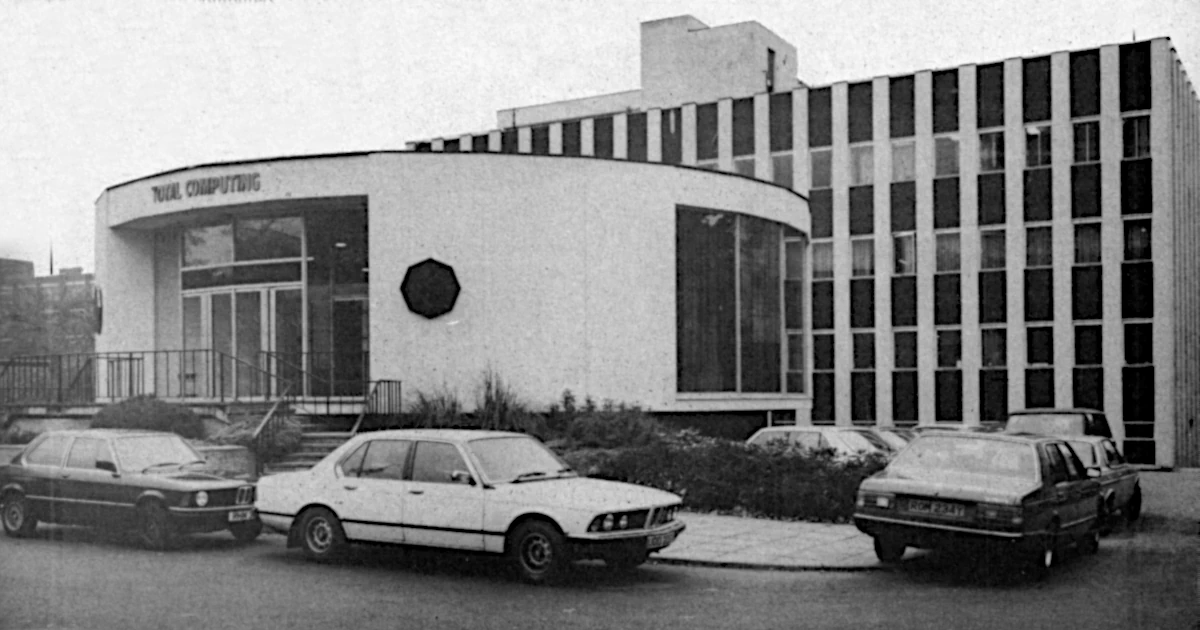
ACT's headquarters near Birmingham, with the company motto - "Total Computing" above the entrance. From Practical Computing, November 1984
ACT also approached Tandy, which in 1983 was the market leader in the US, with a view to jointly producing an "Apple beater".
These talks came to nothing, so the company made use of its Victor connections as an alternative way into the US - which was perhaps a brave move given the IBM's dominance over the pond - in a deal which enabled Victor to also build the Apricot in the US (and vice-versa) if necessary.
ACT's foray into the US market was ultimately unsuccessful, largely because of its Sirius-only compatibility. As managing director of ACT, Peter Horn, said:
"The US market had gone [IBM] compatible by then, so we didn't sell that many products".
ACT didn't seem to learn anything from this failure, and did the same thing when it became one of the first companies to launch an Intel 80286-based machine. Horn continued:
"By then we knew it was too late. They should not have been Sirius compatible, they should have been IBM compatible, so we were a year late[8]".
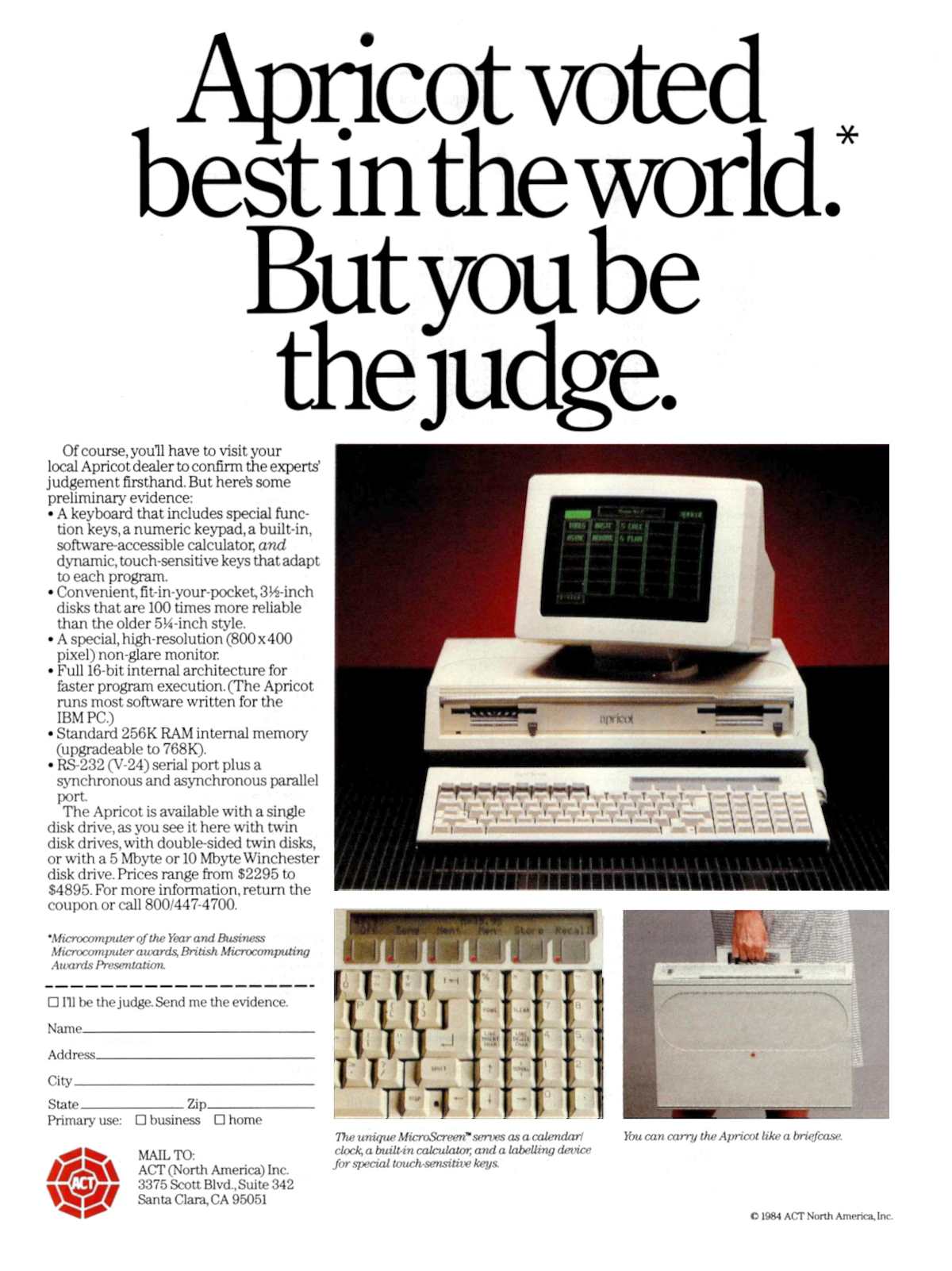
An advert from ACT North America Inc. for the Apricot, also showing the machine's luggability in handy briefcase format. The price for the entry-level system was $2,295, or about £6,680 in 2026. From Byte - The Small Systems Journal, August 1984
Meanwhile, the Apricot's keyboard was connected to the main machine with a full serial link, rather than the usual PS/2-style keyboard connection.
This was because the keyboard contained an unusual feature called "Microscreen" - a two-line, 40-character LCD, which at start-up showed the date and time but which could also switch in to being a calculator, without having to run any software.
It could show dynamic labels for the fully-programmable touch-sensitive function keys next to it - much like the soft keys of a modern smartphone keyboard, or like Apple's Touch Bar, which Apple "invented" some 35 years later.
The machine also came with a £750-worth of bundled software (£3,420 in 2026), including no fewer than three operating systems: MS-DOS 2, CP/M-86 and Concurrent CP/M-86.
Reviewed in October 1983's Personal Computer World, the Apricot came out very well, with Peter Rodwell summing up that it was a machine which:
"precisely and expertly designed for the modern micro market; it incorporates no barely-tried leading-edge technology, just careful, clever and well-proven software and hardware techniques and a good deal of original thinking. And it provides these at a price which is going to cause a few people something of a shock"[9].
The Apricot retailed for £1,495 + VAT, or about £7,850 in 2026.
Date created: 01 December 2014
Last updated: 29 January 2026
Hint: use left and right cursor keys to navigate between adverts.
Sources
Text and otherwise-uncredited photos © nosher.net 2026. Dollar/GBP conversions, where used, assume $1.50 to £1. "Now" prices are calculated dynamically using average RPI per year.