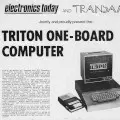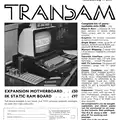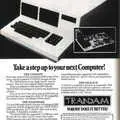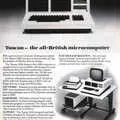
Transam Advert - October 1980
From Personal Computer World
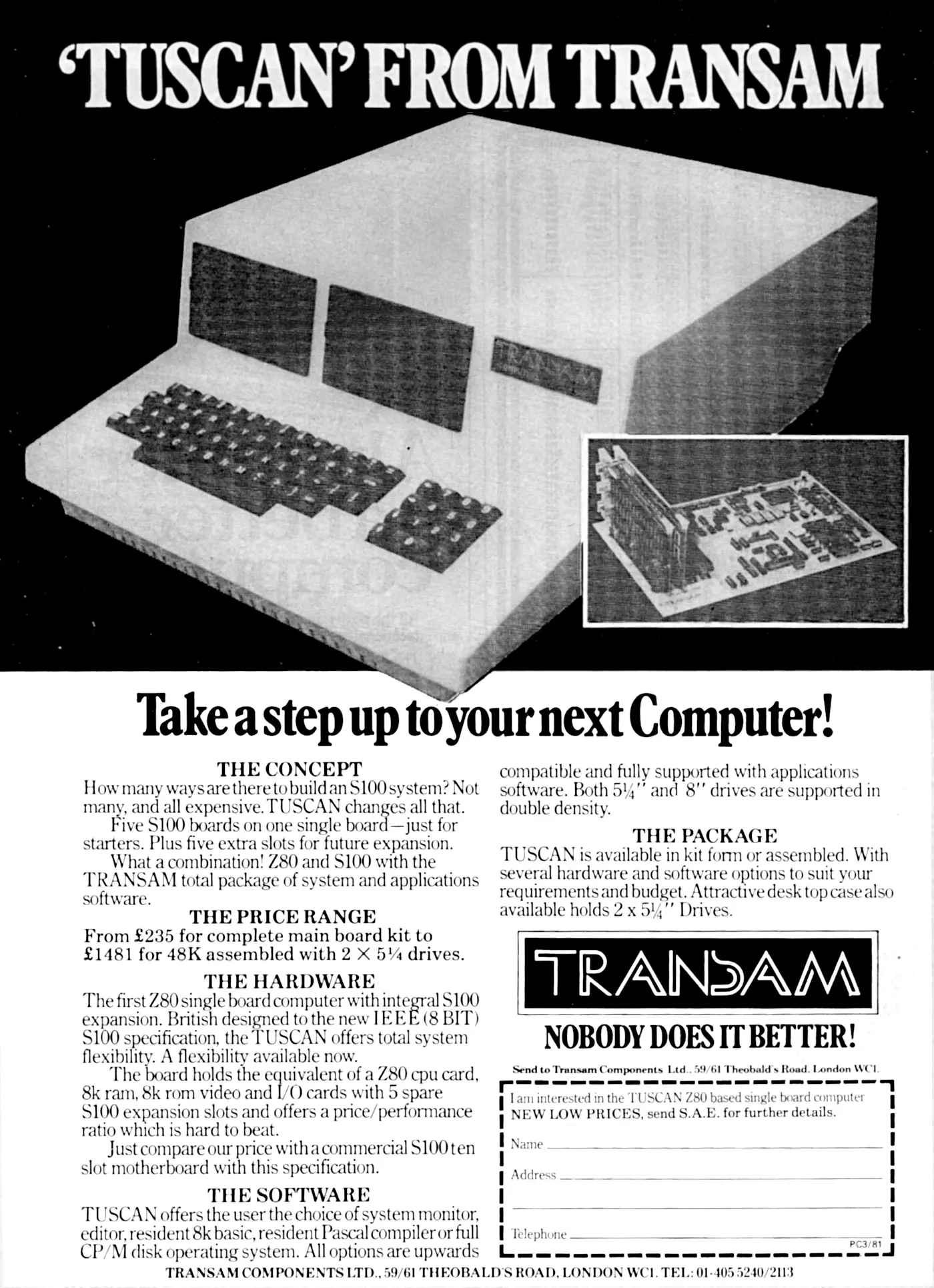
Tuscan from Transam - Take a step up to your next computer!
Another entry in the "who?" category is this advert for the Tuscan, from little-remembered British computer company Transam, or actually Transam Components Ltd of Theobold Road in London.
Designed by Mike Hughes and launched in June 1980, the project to build a follow-up to the company's successful Triton single-board computer started in February 1979.
The first decision was whether the company should supersede the previous Triton, a decision which seemed "unthinkable".
Instead, it wanted something which could could be marketed alongside the older machine rather than replacing it, which meant looking for a different market segment.
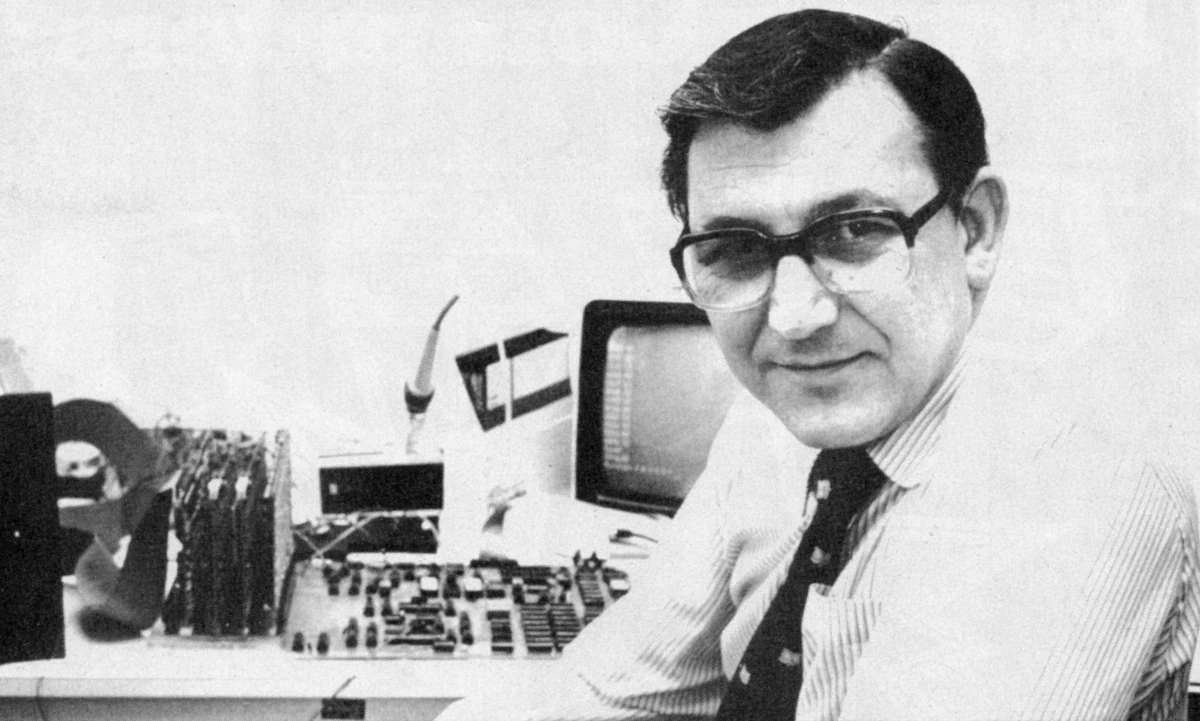
Transam's Mike Hughes, designer of the Tuscan. From Practical Computing, July 1980
Hughes initially considered going down-market into the territory occupied by small evaluation kits like Sinclair's MK14, with a machine that could be sold for around £100, however upon reflection decided that this offered far too little in the way of expansion, rendering it "useless for serious applications".
Going for the top end was also ruled out simply on the grounds of expense, leaving the middle of the market where existing micros like Commodore's PET, Tandy's TRS-80 and the Apple II ruled.
However the company identified that many of these machines lacked true versatility, and often had software that was tailored for each micro and which would not run on anything else, so it was keen to develop a machine which used CP/M, which would give it a potential library of thousands of cross-platform software packages.
At around the same time, Altair's popular bus format, by now known as S-100, had just been accepted as a provisional IEEE standard.
Transam had previously considered S-100 but thought it too expensive and unreliable, with the popular Ithaca implementation being described as "imprecisely defined", and with various manufacturers' boards being incompatible.
The other issue for Transam was that it wanted to to design a single-board computer whilst S-100 systems tended to have the CPU on one card, memory on another, disk controllers on a third and so on - making for relatively expensive systems.
Whilst the design was being thrashed out, with various drawings of S-100 boards - all at roughly 10" square - lying around, engineer Nigel Stride compared a physical 16K memory board with one of the sketches and suggested:
"Why don't we extend the board a few inches and build the S-100 bus on to the end?"
Hughes realised that with a good compact design, plus the latest modern high-density memory, it would be possible to build a micro that was much the same size as the existing Triton board but which had much more expansion, saying:
"The potential of a system based on this concept would be enormous. The single-board could be built in modules, depending on the degree of sophistication the user required — or on his pocket — and with four or five S-100 cards added. With a few peripherals such as printers and disc drives, we had the makings of a system which would be suitable for applications ranging from Mastermind to bridge design, or Chess to Satellite Navigation — not to mention stock control, word processing, dental records, vetinary accounts and the like. Furthermore, the system would be self-contained, needing only external devices like printer, disc drive, display screen and a tape recorder. It might even be possible to build a disc drive into the system’s cabinet."
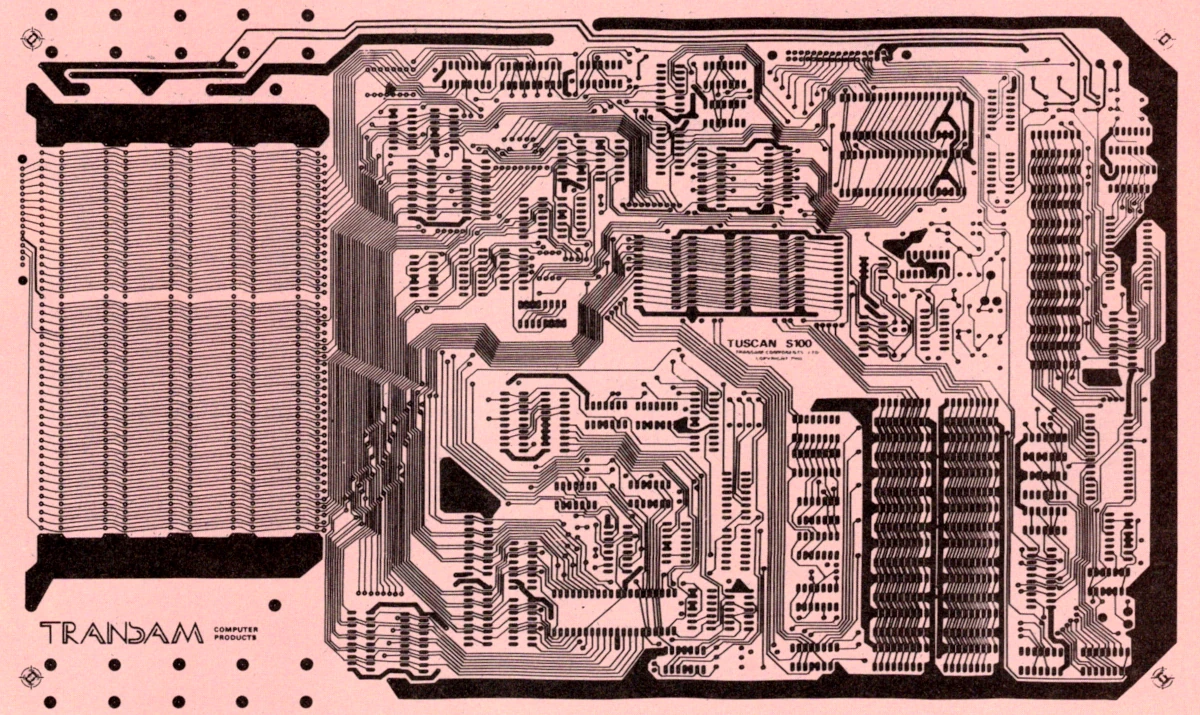
The Tuscan's design schematic, showing the relatively-dense design of the microcomputer's own motherboard alongside the on-board five-slot S-100 bus on the left hand side. This layout is very much a precursor to the standard ISA motherboard found in IBM's 5150 PC - which wouldn't appear for another year - and all the clones that followed it. From Practical Computing, July 1980
By April 1979, the design for the Tuscan had been completed, at least on paper, leaving Hughes to start on the actual layout. He continued:
"The [layout issue] was now well and truly mine and I was not happy. I became even less happy when I started the initial PCB layout. The essence of the problem was to cram the contents of five normal S-100 cards onto two - the Tuscan board is about the size of two standard S-100 boards. These five were 1 x Z80 CPU card, 1 x 8K static RAM card, 1 x 8K EPROM card, 1 x video display card and 1 x I/O card. I would also have to group the various bus rails into the logical sequence required for the S-100 bus and provide slots for five extra cards to be added as optional extras. If this could be done, we could have a conventional S-100 system and a saving of several hundred pounds[1]".
Once the layout design had been completed, the next step was to get some software running on the machine. To do this, part of the existing Triton machine-code monitor was patched to convert it from Intel's 8080 to Zilog's Z80 and to allow for the hardware configuration of the newer machine.
The updated monitor was first tested on the Triton, the idea being that if it ran there but failed to run on the Tuscan it would indicate a hardware, rather than a software, issue. This approach proved itself useful as Hughes was able to identify several hardware issues with little time lost.
The software team could now be briefed on the final hardware architecture, and the company's own TCL BASIC could be updated to run both as a resident program, burned into EPROM, or as a disk-loaded program to work under CP/M.
Mike Hughes gave credit for the choice of the S-100 bus and CP/M as the two things that enabled the Tuscan to happen, whilst suggesting that it had been successfully designed to be "all things to all people".
This was demonstrated by the Tuscan being used as a £300 (about £1,960 in 2026) home micro right up to a complete business system with disks, a printer and a remote terminal costing around £4,000 (£26,200), whilst it was appearing in locations as diverse as schools, polytechnics, photographic studios and doctors' surgeries.
He concluded in a follow-up article in December 1980's Practical Computing that:
"Perhaps it was luck — we thought it was good planning — everything suddenly began to happen at once. Brendan Owen and Keith Frewin had their respective firmware packages ready, the final — tidied-up — printed circuit arrived in all its glory with solder mask and silk screening. The specially-wound transformers landed with a thud on the Transam doorstep as did the prototype cabinet. Transam, no doubt with a sigh of relief, took delivery of the outstanding bulk component orders — the only things remaining were, if I recall correctly, the power-supply capacitor mounting clips but that was soon put right. Drawings were back from the artist and the manuals well advanced through the final stages of typing. Advertising managers were requiring confirmation that the reserved pages were to be taken. Everyone associated with the project now started to operate in a quiet sort of frenzy — nothing could be stopped or slowed at this stage and the complete Tuscan system was launched in June 1980. Tuscan has been on the market for six months and we are now able to see how our initial thoughts are being transformed into reality[2]".
Beyond its unusal S-100 single-board design, the Tuscan was otherwise yet another Z80-based system, built into something like an over-sized Commodore PET case.
However, it was also available as a kit - perhaps surprisingly so, given that it's now 1980 and three years since the 1977 Trinity changed personal computing and introduced the concept of the ready-made complete computer.
In kit form it retailed for £235 - about £1,530 in 2026 - which was less than half the price of the cheapest 1981 PET.
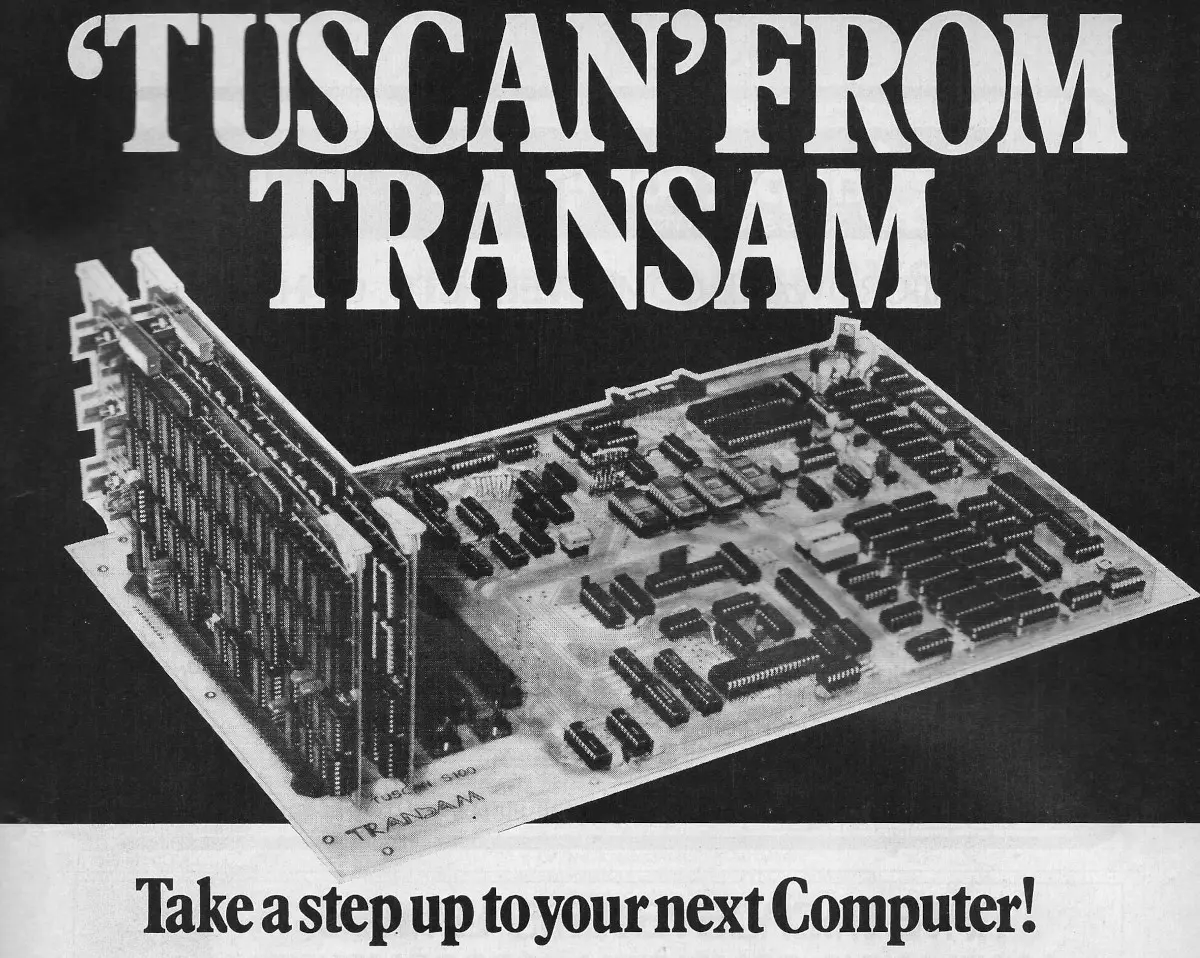
The Transam Tuscan in its bare-board/kit form. From Practical Computing, August 1980
There was another PET connection for Transam when in July 1980 the company announced its version of Pascal for the machine.
Transam had "covered itself in further glory" by securing the contract to get Pascal on a Commodore PET, a feat which considered particularly difficult as the standard PET at the time shipped with only 32K memory[3].
TCL Pascal was available, on floppy, for £120 - about £780 in 2026.
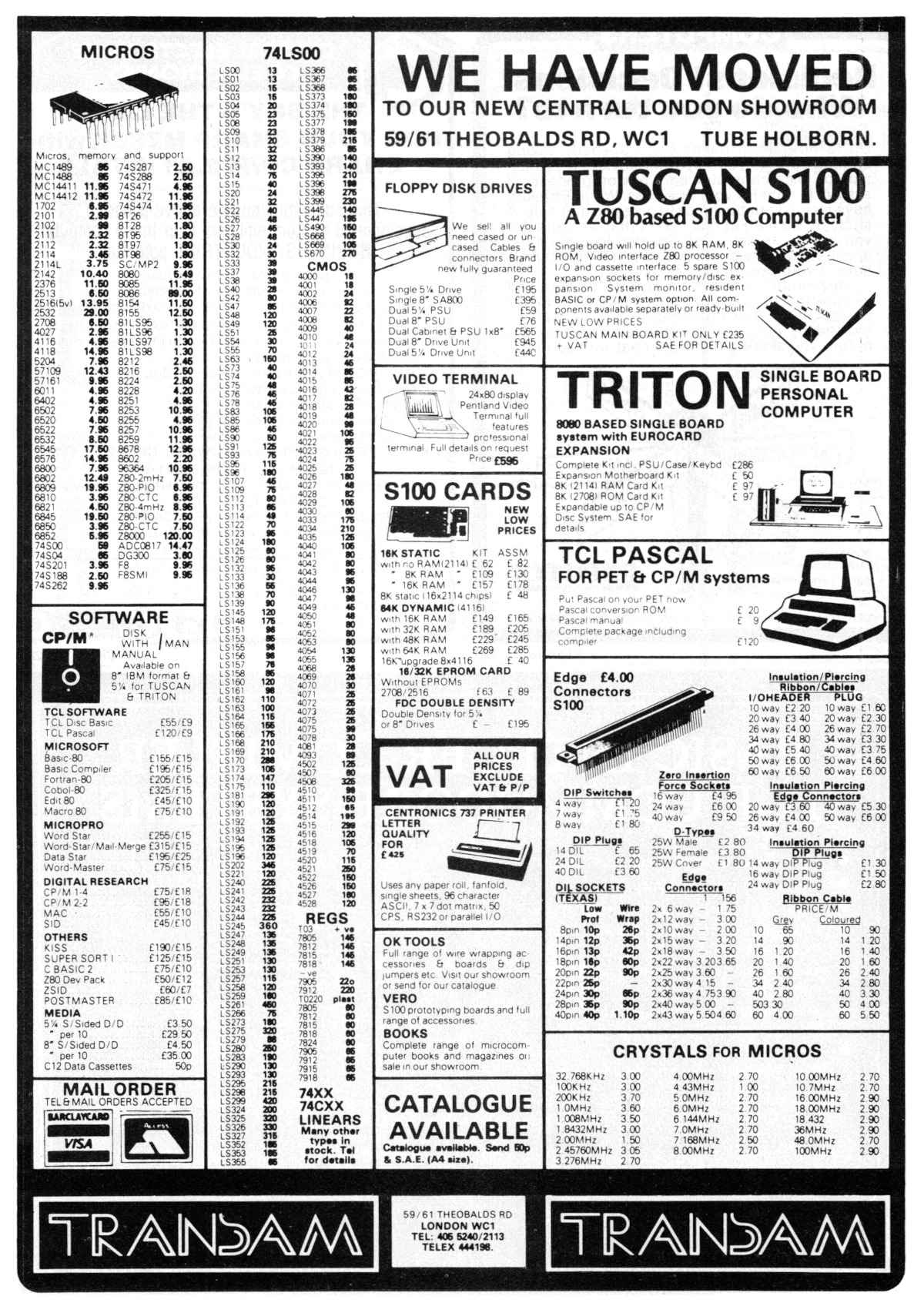
Transam's heritage as a components reseller is evident from this advert in April 1981's Practical Computing. It also shows that Transam has moved its north-west London address of Chapel Street into the heart of Holborn, and that the company's aim of not replacing its earlier Triton was successful, with the earlier still for sale
According to the company, the Tuscan was one of the few systems around that had been designed with "its total concept in mind right from the outset[4]".
This concept appeared to be one where you'd start with the S-100-based single-board micro, which included a Z80 CPU, no fewer than eighteen input/output ports, integral graphics, 8K of RAM, an 8K ROM and an RS232 serial port, and then build up from there.
It was a natural evolution of Transam's earlier Triton single-board computer, which had been launched in 1978 as a joint project between Transam and Electronics Today International (ETI), although the Triton had used Intel's 8080 and the Eurocard expansion format, a feature shared with Acorn's System 1.
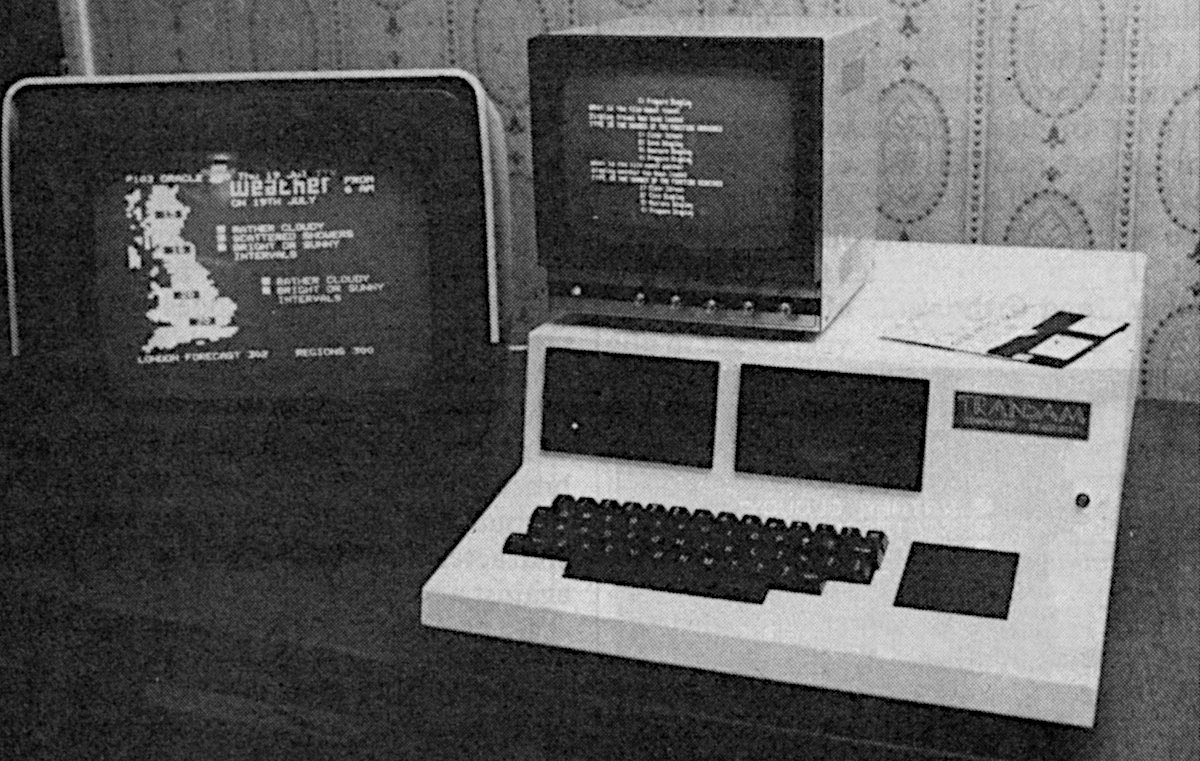
A Transam Tuscan in use as an S-100 host to test a Viewdata card from Hi-Tech Electronics of Southampton. From Practical Computing, April 1981
The Tuscan was apparently popular, or at least common enough, to feature as the host machine for Practical Computing's test of an S-100 Teletext/Viewdata card, shipped by Hi-Tech Electronics of Southampton.
The card, which could support the BBC's Ceefax, ITV's Oracle and - with the addition of an S-100 modem - Prestel, retailed for £295 plus VAT, which is about £1,880 in 2026 money.
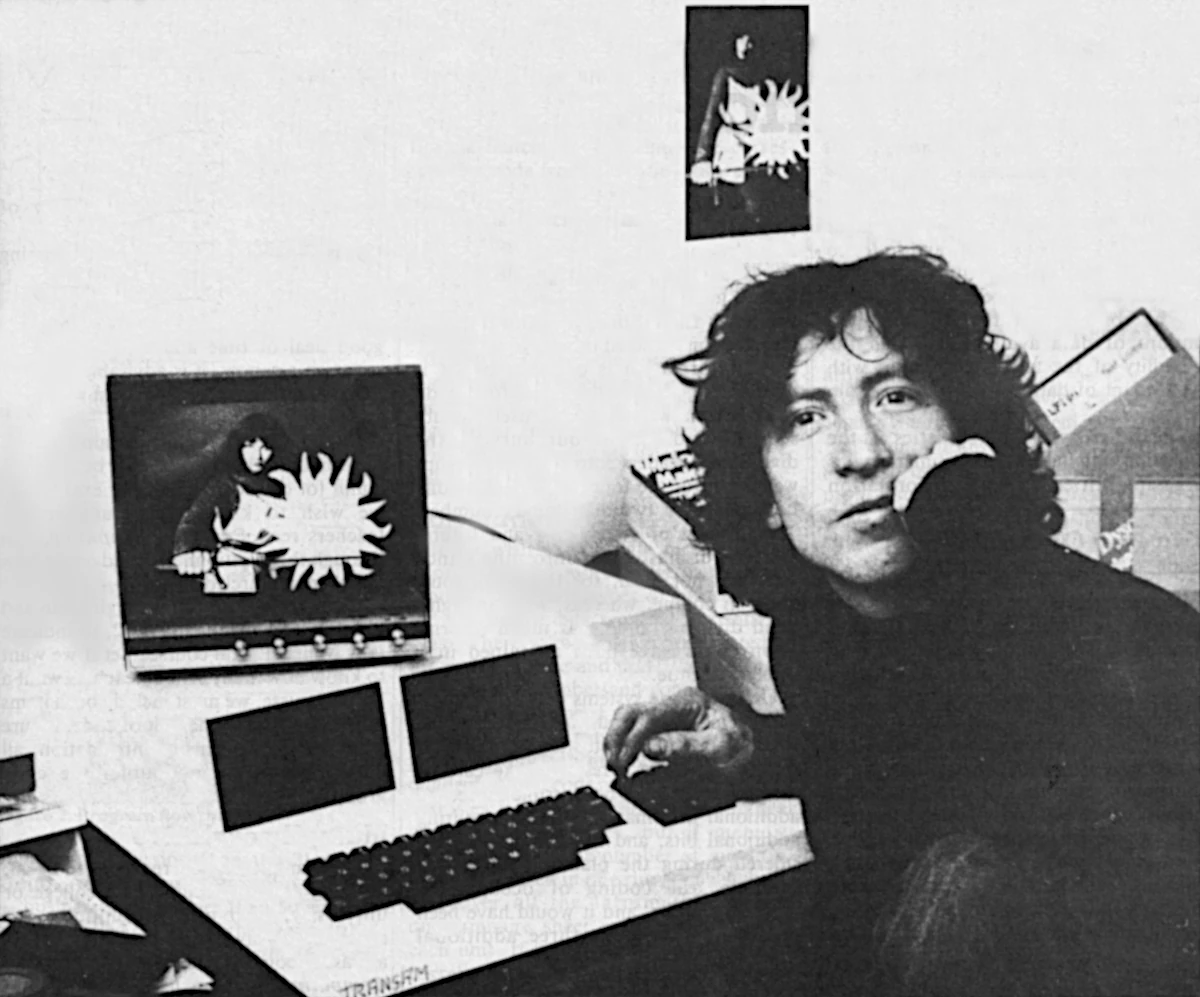
Adrian Boot's self portrait sitting at his Transam Tuscan, with a possibly-faked screenshot of a photo of Kate Bush. From Practical Computing, April 1981
It was also the micro of choice of famous music photographer Adrian Boot, who had previously been using Transam's 4K Triton, a kit micro which took him three days to build.
He had picked Transam partly because of the cost: his company London Features International (LFI) had spoken to IBM a few years before about computerising their photo library and had received a quote of around £15,000, which is about £120,600 in 2026.
However it was also Transam's approachability, with Boot saying about his experiences with the Triton that:
"I liked their attitude. There's a kind of snobbishness about microcomputers; if you're in the know, everything is fine and you're a member of the club. If you aren't, it's really difficult to learn anything. [Transam] answered even my most stupid questions patiently and very helpfully".
LFI ended up with a Tuscan with dual double-density floppies, 48K of RAM and a fast dot-matrix printer, all for around £4,000, or about £22,200 now.
Date created: 01 July 2012
Last updated: 08 October 2026
Hint: use left and right cursor keys to navigate between adverts.
Sources
Text and otherwise-uncredited photos © nosher.net 2026. Dollar/GBP conversions, where used, assume $1.50 to £1. "Now" prices are calculated dynamically using average RPI per year.