A history of the microcomputer industry in 300 adverts
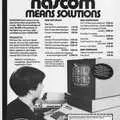
Nascom/Lucas
December 1982
Nascom means performance. Nascom means solutions
Nascom - now owned by car-parts-to-semiconductors industrial conglomerate Lucas Industries, or at least its Lucas Logic division - is still trundling on with its re-packaged Nascom 2 motherboard in a...
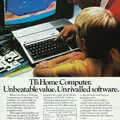
Texas Instruments
December 1982
TI's Home Computer. Unbeatable value. Unrivalled software.
The original TI99/4 had been released back in 1979 and was the first ever 16-bit home computer, running TI's own TMS 9900 CPU. It didn't get off to a good start in the UK, as early models of the micro...
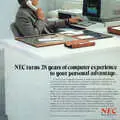
NEC
November 1982
NEC turns 28 years of computer experience to your personal advantage
NEC's PC-8000 - known as the PC-8001 outside of Europe - was part of NEC's PC-8000 range. It was only the third fully-assembled microcomputer specifically made for the Japanese market, being beaten only...
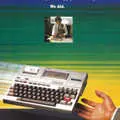
Epson
December 1982
Imagine a totally portable computer that slips into your briefcase. We did
Considered by some as the first "true" laptop, Epson's HX-20 was actually designed - in 1980 - by Yukio Yokozawa, an employee of Seiko. It ran two Hitachi 6301 CPUs - a clone of Motorola's 6800 - at...
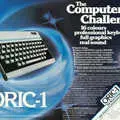
Oric
December 1982
Oric-1: The computer challenge
The Oric was aimed very much at Sinclair's ZX Spectrum market, with even the models and price being similar. It actually started out significantly cheaper than the Spectrum at £99.95, compared to the...
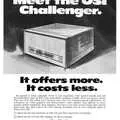
Ohio Scientific
January 1977
Meet the OSI Challenger
Before it was even the Challenger 1 is this advert for Ohio Scientific Instruments' Challenger. It was an S-100-based system which derived from the company's earlier "Superboard 400" micro boards, however...
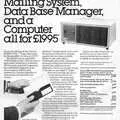
Equinox/Parasitic
January 1981
Equinox: A Word Processor, Data Base Manager and a computer all for £1,195
Parasitic Engineering of Albany, California, would go bust in 1983, but prior to that it had established a network of resellers for its Equinox micros throughout Europe. This included its UK dealer -...
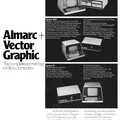
Vector Graphic
January 1981
Almarc and Vector Graphic - the complete partnership in microcomputers
Here's another straightforward advert from Vector Graphics' sole UK distributor, Almarc Data Systems of Nottingham. It shows nicely Vector's range of micros available at the time. They were all Z80-based...
Comart
January 1981
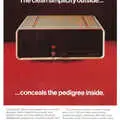
Comart Communicator: The clean simplicity outside... conceals the pedigree inside
Comart - based in St. Neots, Huntingdon - was founded in 1976 by David Broad and John Lamb as a mail-order supplier of imported software and S-100 boards, but by 1977 was reselling products from Cromemco,...
RAIR
December 1979
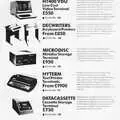
RAIR - Terminals for your micro
This an very early advert for RAIR - the enigmatic British company which started out in 1978 as a time-share consultancy and supplier of terminals. It shows a range of peripherals that would be needed...
Acorn
December 1979
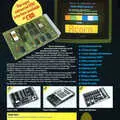
Acorn Computer: Four of a kind!
This is another early advert from Acorn Computer - the trading name of Cambridge Processor Unit Limited (CPU), a company set up in 1978 by Chris Curry - formerly of Sinclair Radionics and Science of Cambridge,...
Space Byte
March 1978
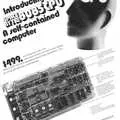
Introducing the Space Byte 8085 CPU
This advert is for one of many single-board computers available at the time, but it's worth an entry because the company name is one of comparitively few which actually used some sort of space-age theme....
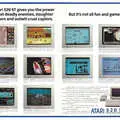
Atari
June 1987
Atari 520ST: It's not all fun and games
Here's another advert for Atari's 520ST - for Sixteen/Thirtytwo - the Motorola 68000-based machine with 512K RAM and which became popular amongst musicians, thanks to its built-in MIDI connectors. There's...
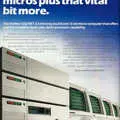
Shelton
January 1984
Sig/Net 3: All the advantages of other dual 8 and 16 bit micros plus that vital bit more
Here's an advert for the third iteration of Chris Shelton's Sig/Net - the modular multi-user system which was launched in 1981. It also implies that dual-processor multi-user microcomputers were common....
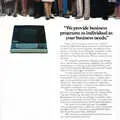
Vector Graphic
May 1982
Vector 3: Computers for the advancement of society
There weren't many micro companies of the era that claimed that their products were for the advancement of society, but here is such a mission statement from Vector Graphic in this US advert for its Vector...