1983 adverts
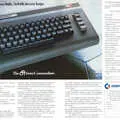
Commodore
February 1983
At £299 it's very little. At 64K it's very large
The Commodore 64 - sometimes known as the SuperVic - was the company's replacement for its VIC-20 machine, the limited but popular home micro which was the first computer to sell more than one million...
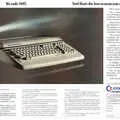
Commodore
February 1983
It's only £695. And that's the last reason you should buy it.
The Commodore 500, sometimes known as the P Series, was part of the CBM-II Series - an attempt to produce an update for the original Commodore PET and seen as the company's last chance to break the business...
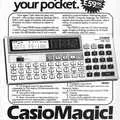
Casio
February 1983
Casio PB-100: The best way to put 1,568 steps in your pocket
Casio's PB-100 was one of several small "pocket computers" released around the same time that look more like calculators, however it was programmable as it had a resident version of BASIC capable of storing...
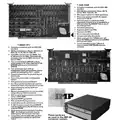
IMP
February 1983
British-made 68000 CPU and 256K Dynamic RAM cards for the S-100 bus
This advert, from Integrated Micro Products of Consett, in County Durham, is notable for a couple of things. Firstly, 1983 is the year that the old 1975 Altair Bus standard, which rapidly became known...
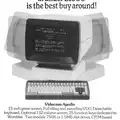
Videcom
February 1983
The Big Screen micro from KGB at under £1,800 is the best buy around!
Videcom had been formed in 1972 as a manufacturer of terminals, and along the way had carved itself a niche in the transport industry, in particular for airports, where it produced a range of products...
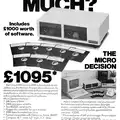
Morrow Designs
February 1983
How much? The Micro Decision for £1,095
George Morrow had started making products for microcomputers in 1976, having joined the influential Homebrew Computer Club which had formed in the wake of the launch of the Altair 8800 at the very beginning...
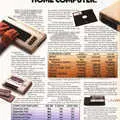
Commodore
March 1983
Home is the last place you should learn about a home computer
Even though the Commodore 64 was on the market, there was still plenty of demand for the VIC-20, launched two years before in 1981 (or three if you count Japan, where it was test-launched in 1980). Whilst...
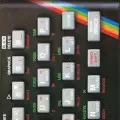
Sinclair
March 1983
ZX Spectrum - 16K or 48K RAM from only £125!
This advert is part of an impressive four-page spread that appeared early in 1983 for the Sinclair Spectrum, launched at the end of April 1982 but which took eight weeks until first deliveries actually...
Iotec
March 1983
Our professional-series integrated business systems software is free
Winner of the award for most puzzling advertising campaign must surely go to Iotec, which for the best part of a year seemed to feature adverts all in black with just the word "iotec" on them, or with...
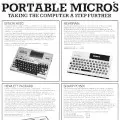
Transam
March 1983
Portable micros - taking the computer a step further
This is one of a few adverts that appeared around about the same time which could be read as something of a sad coda on the life of Transam Microsystems Limited. Transam had started out as Transam Components,...
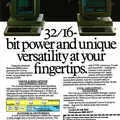
Corvus
March 1983
32/16-bit power and unique versatility at your fingertips
The Corvus Concept was one of several 32/16-bit machines appearing at the time, like the Fortune 32:16 or Sage II, in an era when 16-bit machines were only really getting going and 8-bit home computers...
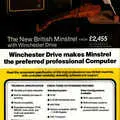
Hotel Microsystems
March 1983
The new British Minstrel with Winchester drive
This machine and advert is such a spectacular throw-back that it had to be included. It's for the "New" British Minstrel, as produced by the oddly-named Hotel Microsystems Limited of London - a name...
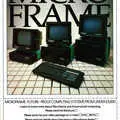
Tycom
March 1983
Microframe - Future-proof computing systems from under £3000
With a futurist "space cargo"-style modular box construction, the "future proof" Microframe seemed to live up to its name. Although not directly billed as an IBM compatible, it did use an Intel 8088...
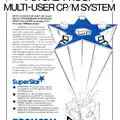
Bromcom
March 1983
Future-proof multi-user CP/M system
Here's an early advert for Bromley Computer Consultancy, trading as Bromcom, for its Superstar CP/M-based multi-user system, which would be around until at least the summer of the following year. Essentially...
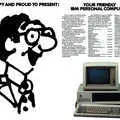
IBM
March 1983
I'm happy and proud to present your friendly IBM personal computer
The IBM PC, a.k.a 5150 had been launched in the US in 1981, but had only been unofficially available in the UK via the grey import market since the summer of 1982. It was being imported by companies...