
Future Advert - May 1984
From Personal Computer World
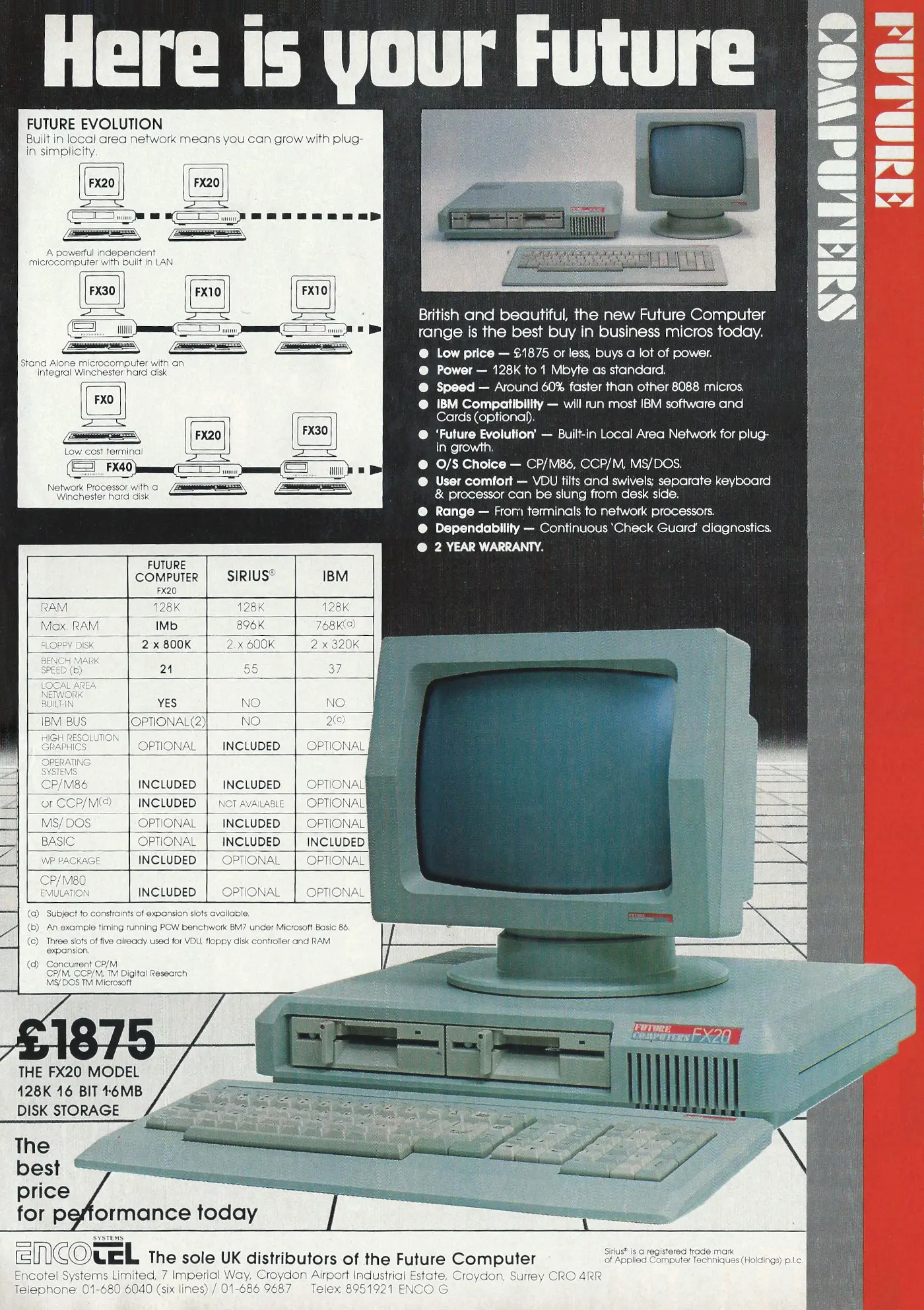
Future Computers: Here is your future
Future Computers Limited had been created in 1983 as a result of venture-capital funding from MGM/APA, and additional funding from BTG - the British Technology Group.
Each had apparently invested £400,000[1] - which is about £1,827,600 in 2026.
Along with other grants, Future's total investment was said to be around £1.3 million[2], or about £4 million now.
Its FX20 machine was quite hi-spec for the time, and was built to specifically take on Chuck Peddle's Sirius 1, as well as IBM's 5150 - the original IBM PC.
Future's managing director Brian Jackson said of the FX20 that it was designed to be "IBM think alike, but not look alike"[3].
It was also one of the slimmest machines of its day, as it used the relatively-new half-height 5¼" floppy disk drives. Unusually, these were attached to the lid, which made access to the motherboard underneath easier.
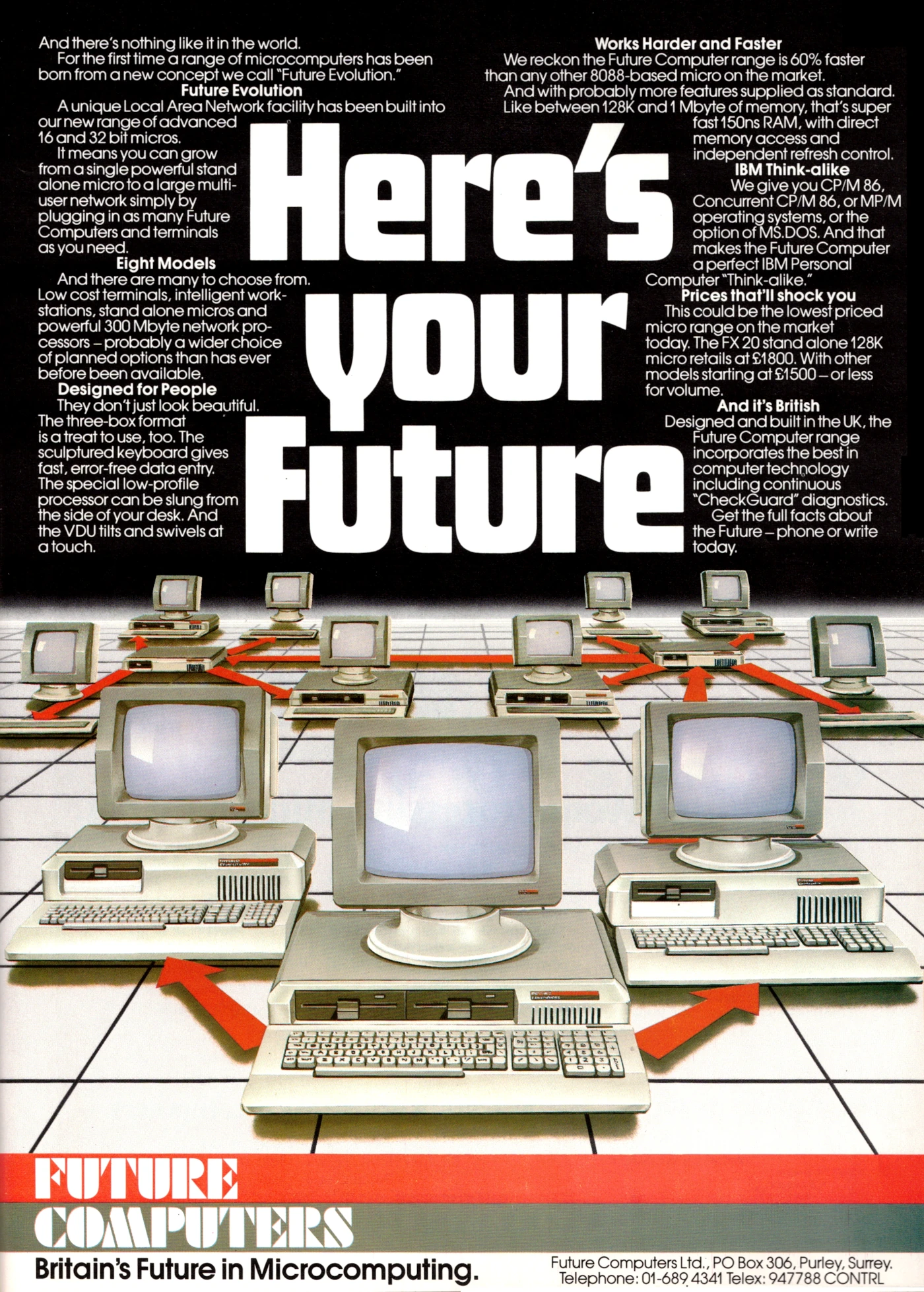
A probable launch advert for the FX 20, as featured in February 1983's Practical Computing
The FX20 used the same processor as the Sirius and IBM - Intel's 8088, the eight-bit-memory-bus version of the 8086, although it was running at 8MHz, which was 60% faster than the 5150 and the Sirius's 5MHz clock speed.
It also had an empty slot for an 8087 maths co-processor, which would make it faster yet in maths-heavy operations.
The FX20 shipped with networking built in, however this wasn't Ethernet but was of its own design, based on - according to Personal Computer World - a "Ring-type network", which required the specialist CP/NET operating system to work.
Peter Rodwell concluded in his review in October 1983's Personal Computer World that:
"Its pricing and the built-in networking capability make the FX20 one of the most competitive micros around and - with the single reservation about doing its own thing, network-wise - Future Computers seems to be far more in tune with the micro world than many other manufacturers now attacking this market[4]".
It retailed for a very competitive £1,875 plus VAT - that's about £9,390 in 2026.
The company also offered the hard-disk FX30, the lower-specification FX10, the FX0 low-cost terminal, and the network "base station" with its own Winchester hard disk - the FX40.
It also planned to follow up with an OEM version - the FX21.
Date created: 15 January 2024
Last updated: 22 June 2026
Hint: use left and right cursor keys to navigate between adverts.
Sources
Text and otherwise-uncredited photos © nosher.net 2026. Dollar/GBP conversions, where used, assume $1.50 to £1. "Now" prices are calculated dynamically using average RPI per year.