Videcom Advert - February 1983
From Practical Computing
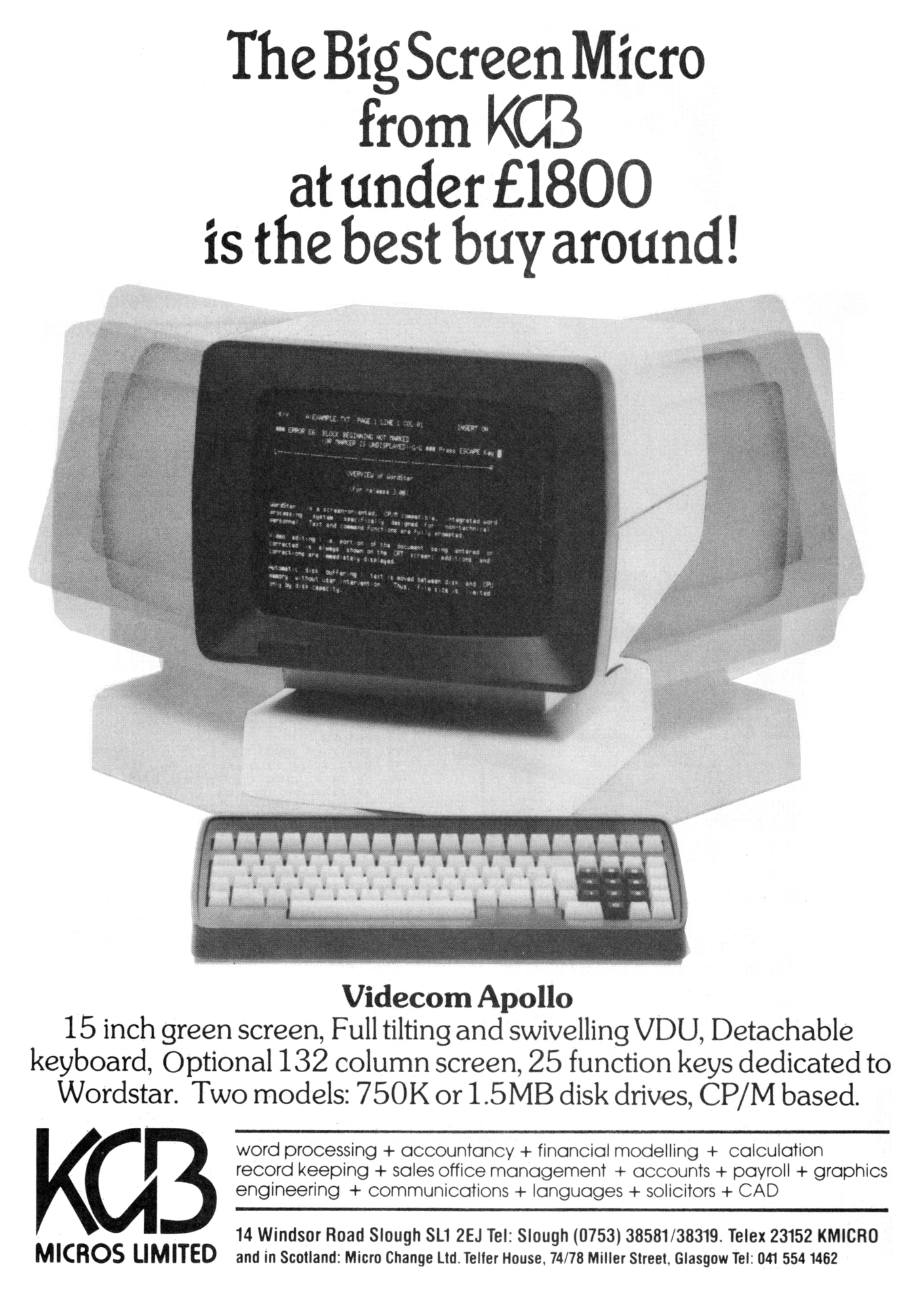
The Big Screen micro from KGB at under £1,800 is the best buy around!
Videcom had been formed in 1972[1] as a manufacturer of terminals, and along the way had carved itself a niche in the transport industry, in particular for airports[2], where it produced a range of products for managing passenger check-in[3], and the railways, where it supplied terminals for British Rail's TOPS system[4].
At some point, and in common with several other terminal manufacturers, it realised that it already had two thirds of the components required to product a complete microcomputer - a keyboard and a VDU - and so duly launched into the market with this, the Videcom Apollo.
Also in common with almost every other pre-IBM business microcomputer launched at the time, it was a Z80-based CP/M machine, with either 750K or 1.5MB disk drives - probably 5¼" or 8" floppies respectively.
The Apollo also seemed to be aimed specifically at the word-processing market, with its optional 132-column display and a keyboard with 25 function keys, all set up to run Wordstar.
However, it seemed like it had taken some effort to get Videcom to even sell its machines at retail, as it had been used to selling directly to existing customers, most of which were large government organisations like the Civil Service. Personal Computer World said:
"The company is based in Henley, is expanding like mad, is planning an IBM lookalike (but faster) which will retain its normal CP/M profile as well; and its boss, Keith Barker, appears resigned to being dragged, kicking and screaming, into the retail micro business by people who want to buy his products[5]."
Perhaps as a result of its existing government dealings, the Videcom Apollo had been selected as one of the approved micros on the Central Computer and Telecommunications Agency's top ten list - a list which had started out as a hope that all government employees would end up with the same computer, but which by now was more of a "suggestion".
According to April 1983's Personal Computer World, an anonymous source suggested that the CCTA list was:
"More intended as a guide for those of our staff who find they need a micro and really haven’t a clue what is on the market, or what machines really aren’t suitable"
The Videcom Apollo retailed for "under £1,800", probably plus VAT, which is around £9,450 in 2026 money. The company itself appears to be one of the few from that era that has survived and remains in business[6], where it continues to provide passenger systems for airlines.
Date created: 26 June 2026
Last updated: 29 June 2026
Hint: use left and right cursor keys to navigate between adverts.
Sources
Text and otherwise-uncredited photos © nosher.net 2026. Dollar/GBP conversions, where used, assume $1.50 to £1. "Now" prices are calculated dynamically using average RPI per year.