Dell Advert - February 1993
From Personal Computer World
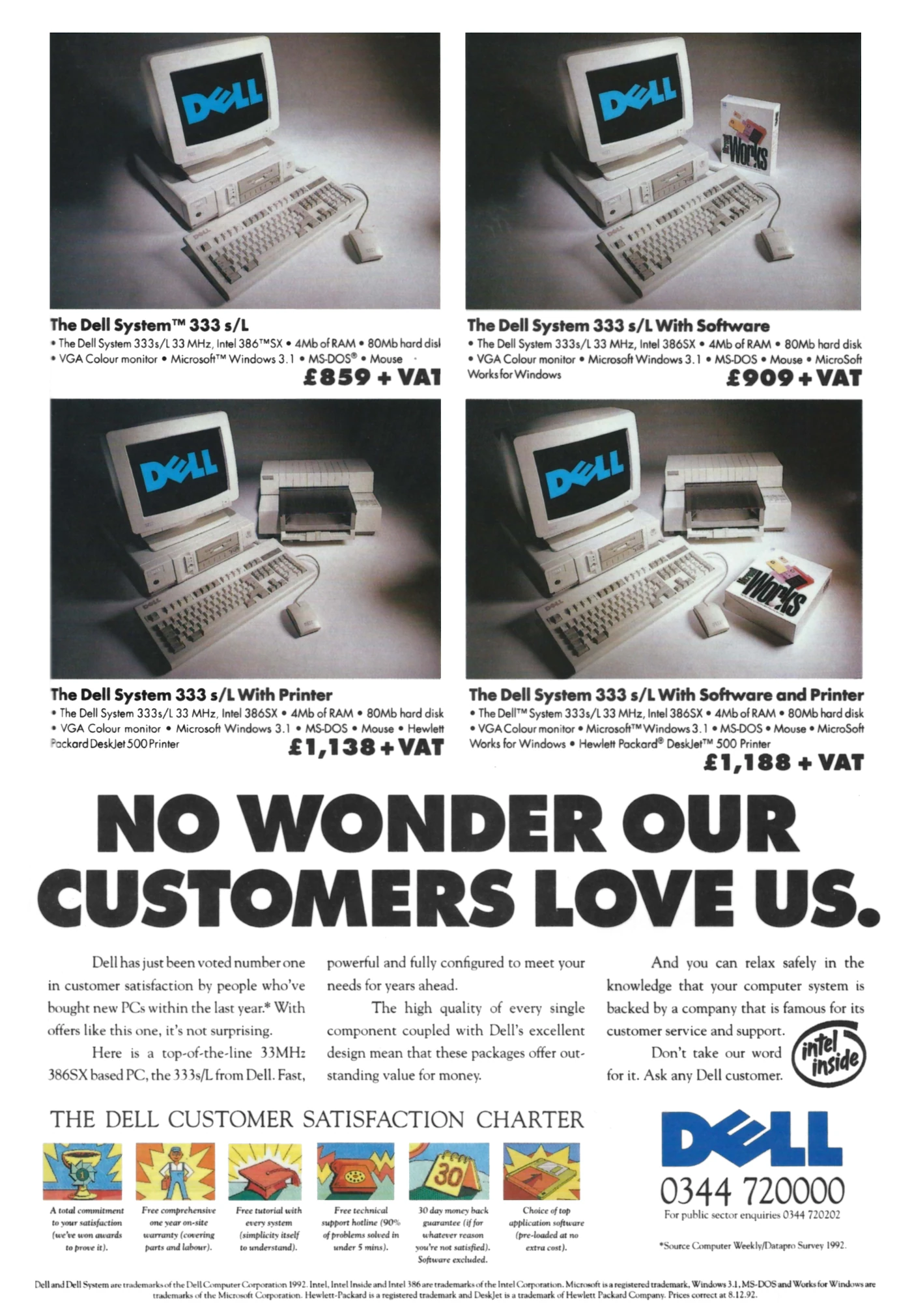
No wonder our customers love us
It's another advert for Dell, and one which effectively sums up the end of the home computer era.
The entry-level Dell System 333 s/L shown in the advert was available for £859 plus VAT, which is around £2,670 in 2026.
That compares favourably to Commodore's Amiga 1500, which retailed for £999 in 1991, whilst the 333 s/L with all the software plus a printer was less than the Amiga 4000, which cost £2,000 (£5,550) when launched in 1992.
The passing of the home-computer era was marked in February 1993's Personal Computer World, in an article written by Jack Schofield. It sums it up nicely:
Did Sonic and Mario murder the micro?
Is the home computer a dead duck, and was it killed by a hedgehog and an Italian-American plumber?
We are in the middle of a video games boom, with sales doubling every year. Newsagents' shelves are heavy with console magazines.
Video games are featured on TV in programmes like GamesMaster and Bad Influence!, and Sky plans a similar daily programme.
Specialist shops have opened to sell games cartridges, which are also stocked by record shops such as Our Price, Virgin and HMV, and chains like Dixons, Boots, WH Smith, John Menzies and Comet.
Further, you can probably hire a Sega game, along with Terminator 2, from your local video store, and some of these sell consoles and cartridges too.
The Sega Master, Sega Megadrive and Nintendo Entertainment System have all, according to their manufacturers and marketers, sold more than a million units in the UK. The GameBoy has sold almost 1.5 million.
The Super NES has sold 700,000 and it has only been widely available for a few months: it is gaining fast on the Atari ST (900,000) and Amiga (1.4 million), which have been selling for years.
Sure, the Amiga gets a bit of TV exposure, and several high street chains still stock Atari ST and Amiga games. But it's not like the days when dear old MicroLive showed you how to use your BBC B. What people want to know nowadays is how to get past Scarface at the end of level two of Super Smash TV.
Walk down today's high street and you'll be lucky if you can find a decent selection of Commodore 64 or Sinclair Spectrum games, let alone a word processor, spreadsheet or payroll package (there was quite a good one for the Spectrum).
Commodore reckons to have shipped about 1.7 million C64s in the UK, and goodness knows how many Spectrums were sold, but most must be gathering dust.
Home micros like the Atari 800, Texas Instruments TI-99/4A, Oric, Dragon, Tandy Color Computer, Lynx, Aquarius, Sord M5, Genie, Acorn Electron and Sinclair QL are remembered only by their fans.
Earlier generations of market-leading machines, the Processor Technology Sol, Exidy Sorcerer, Nascom II, Ohio Superboard/UK101 and Acorn Atom, have been forgotten even by most of those who once owned them.
Of course technology advances. Of course established machines become obsolete, fade and die. But the old faithfuls are supposed to be replaced by exciting new models with faster processors, more memory, and better graphics.
However, the Atari ST and Amiga first appeared in 1985, more than a generation ago in computer terms. Where are the brilliant new designs that will take us into the future? There aren't any. Perhaps the home micro has no future.
Home micros appealed, first, because they were cheap, and second, because they were general purpose machines.
Your Apple II, BBC B, Atari or Amiga could play games, of course, because it had graphics and sound facilities.
But it was also useful for word processing, simple accounts, controlling things (like turtles) and, importantly, for learning how to program. In short, for becoming computer literate. A home micro was an education, even if it never ran any educational software.
But computers are no longer mysterious objects with semi-religious significance. We take them for granted. Worse, home computers are no longer particularly cheap.
An ST or Amiga was once a fraction of the price of an IBM PC/AT, which cost about £5000 for a usable system.
These home micros naturally had better graphics and sound, and they ran faster than the AT, which was built around a 6MHz 286 processor.
But PCs have improved a lot since then, while intense competition and volume sales have driven down prices dramatically; home micros are little faster or cheaper than when they were launched.
Purists can argue that the Amiga has technical advantages over the PC architecture, but most people are not purists and don't care. They see that PCs are standard and cheap, and that there is a huge industry supplying PC software and services.
If they want a general purpose machine they'll buy a PC, and if they want to play arcade games, they'll buy a cheap console as well.
It would be comforting to suppose that the console's supremacy is temporary. After all, we had a boom in video games a decade ago, when Atari was the dominant supplier. Atari sold more than 25 million VCS consoles worldwide, and hundreds of millions of cartridges. And then, when the bubble burst, the company crashed.
But one factor in Atari's decline in 1983-84 was the boom in home computer sales, particularly the Sinclair Spectrum and the Commodore 64.
Home micros had four advantages. First, they had keyboards and were therefore more versatile.
Second, games could be loaded from cheap cassette tapes rather than high-priced cartridges.
Third, home computers (even the Spectrum) were technically more advanced than the old VCS with its primitive graphics and 4-bit processor, and they could offer better games.
Fourth, buying a games console was perceived as hedonistic, whereas a home computer was educational.
Children asked for home computers and their pleas were backed by the full authority of the government and the BBC. But what most kids did when they got them was... play games.
It is possible that Sega and Nintendo will, like Atari, crash when today's kids get bored with games and the current boom ends. It is even possible we will see a new generation of home micros fuelled by cheap games supplied on disc, perhaps on CD-ROM. But I suspect not.
Insofar as there is a general purpose market, it is more than filled by IBM PC compatibles. If there's a niche for home micros, it's probably a small one.
The home micro might not be dead, but it's becoming as marginal to computing as the anorak to the fashion industry, and it may sell to roughly the same people[1].
Dell's 333 s/L also won in the "Best entry-level system" category of Personal Computer World's third annual awards of 1993. Chris Cain said of the winning bundle (including Works for Windows and the HP Deskjet 500 printer) that:
"At £1,188 plus VAT, the combined price is not the lowest available but is certainly reasonable. For that you get a 33MHz i386SX with 4MB RAM, and 80MB hard disk and a VGA colour monitor. This is the only 386 we are recommending and it is by no means a power set up. The intangible benefits of ownership are even more important. Each Dell PC comes with a 30-day money-back guarantee, a year's on-site warranty and a lifetime technical support hotline with a high reputation for helpfulness. On the face of it the Ambra [Sprinta 486SX] is a better deal, but Dell's superior support pushes it ahead[2]".
Date created: 04 December 2025
Last updated: 15 January 2026
Hint: use left and right cursor keys to navigate between adverts.
Sources
Text and otherwise-uncredited photos © nosher.net 2026. Dollar/GBP conversions, where used, assume $1.50 to £1. "Now" prices are calculated dynamically using average RPI per year.