RAIR Advert - November 1978
From Practical Computing
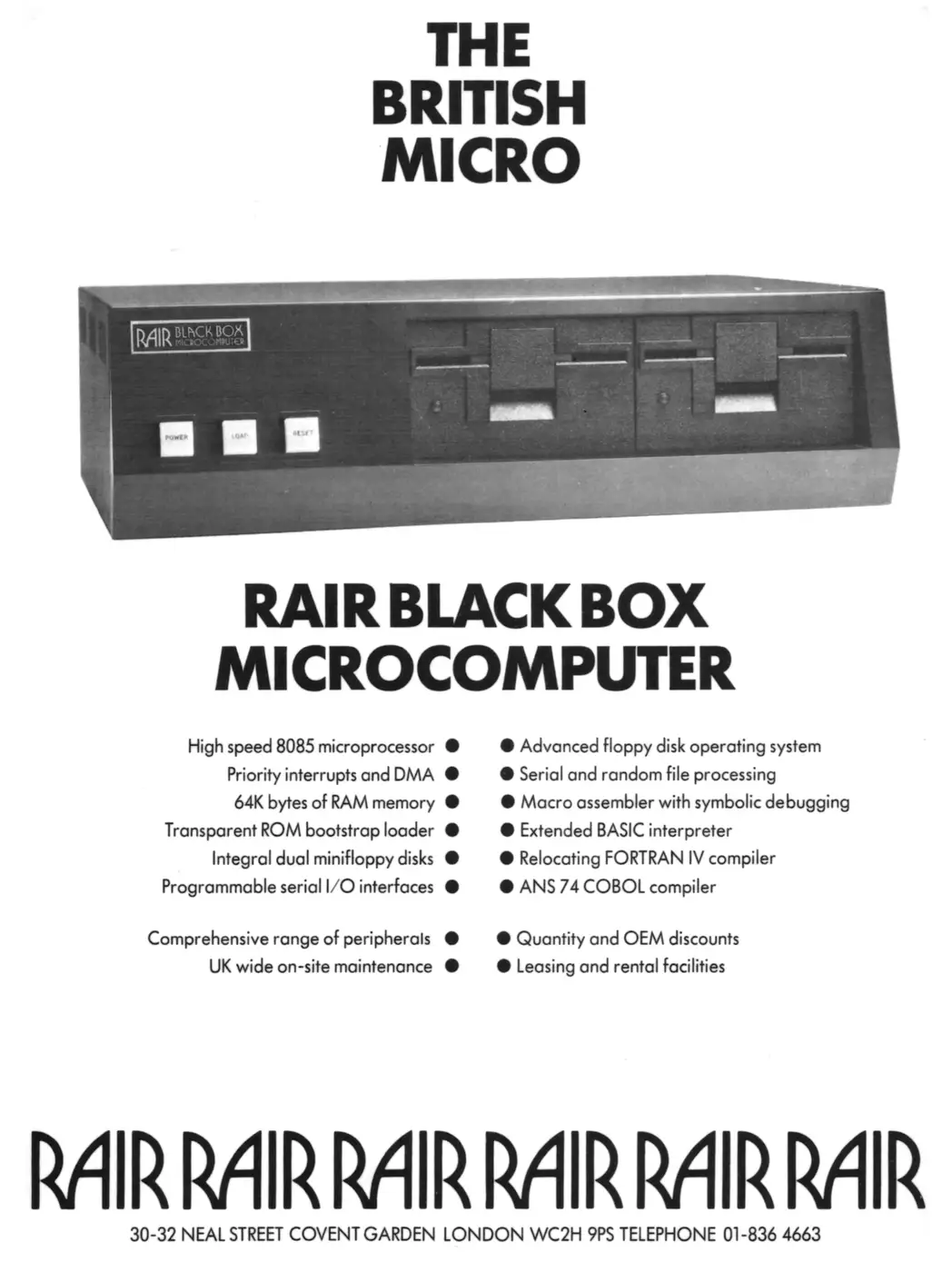
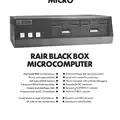
The British Micro: RAIR Black Box Microcomputer
This is probably the first advert to feature RAIR's Black Box - a microcomputer that was launched this year and which managed to survive until at least 1983, becoming popular as an OEM machine, cropping up with Ryman and Innsite badges on, and most famously as the ICL Personal Computer, or ICL PC1.
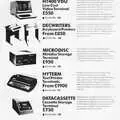
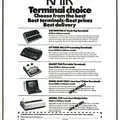
RAIR - by name and by nature - was a company that appeared to start out primarily as a time-share consultancy and a supplier of terminals and other peripherals, like printers and disk units.
The first mention of it in the UK seems to be in September 1978's Personal Computer World, where it was reported that the company was "moving into the expanding field of microcomputers with its new RAIR Black Box microcomputer". RAIR itself was reported to have said:
"RAIR sees the microcomputer industry as having a dramatic impact on the computer market. With complete systems available under £2,000 (£16,000 in 2026), few businesses will be unable to take advantage of the power of their own stand-alone microcomputer; and will have the opportunity to consider many new applications for cost-effective computerisation[1]".
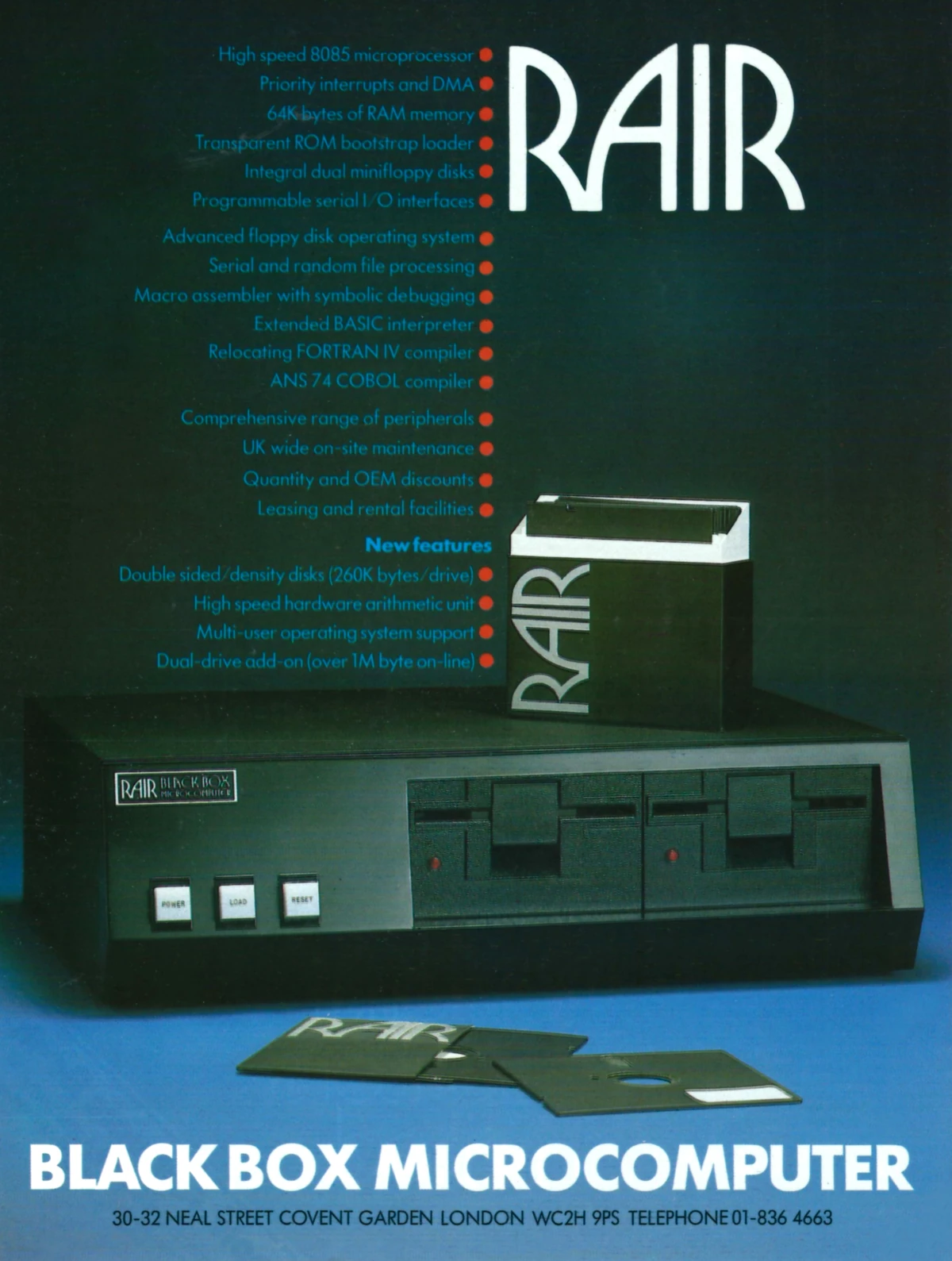
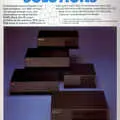
An updated advert for the original Black Box, which featured in July 1979's Practical Computing.
The Black Box was a multi-user system capable of supporting up to four users, each on their own dumb terminal, although official support for multi-user operating systems didn't appear until early 1979, at the same time as Rair added a "high speed hardware arithmetic unit", or maths co-processor, to its micro.
It was actually first introduced in the US, at the National Computer Conference in Anaheim, California, in the week of June 5th 1978, as part of a joint venture between the British Overseas Trade Board and the Business Equipment Trade Association[2].
It used Intel's 8085 CPU - apparently making RAIR one of the very first companies in the UK to do so[3] - which was a version of the earlier 8080 that was not only faster but required only a single 5V power supply[4], making it easier and cheaper to build around.
It also offered Direct Memory Access, which allowed things like floppy disk drives to directly read and write to memory without having to go through the processor, speeding up performance.
There's no price on the advert, but as it came with 64K memory - a reasonable amount at the time - and a generous selection of software, including BASIC, Fortran IV and COBOL, it was probably expensive.
Oh, and it was possible to lease or rent one, which is always a give-away that something's not exactly cheap.
The later Model 3 retailed from £1,950 right up to £7,250[5] - that's an impressive £58,300 in 2026.
Date created: 08 October 2024
Last updated: 11 March 2026
Hint: use left and right cursor keys to navigate between adverts.
Sources
Text and otherwise-uncredited photos © nosher.net 2026. Dollar/GBP conversions, where used, assume $1.50 to £1. "Now" prices are calculated dynamically using average RPI per year.