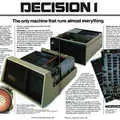
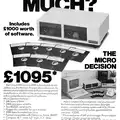
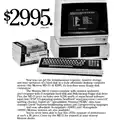
Morrow Designs Advert - October 1982
From Practical Computing
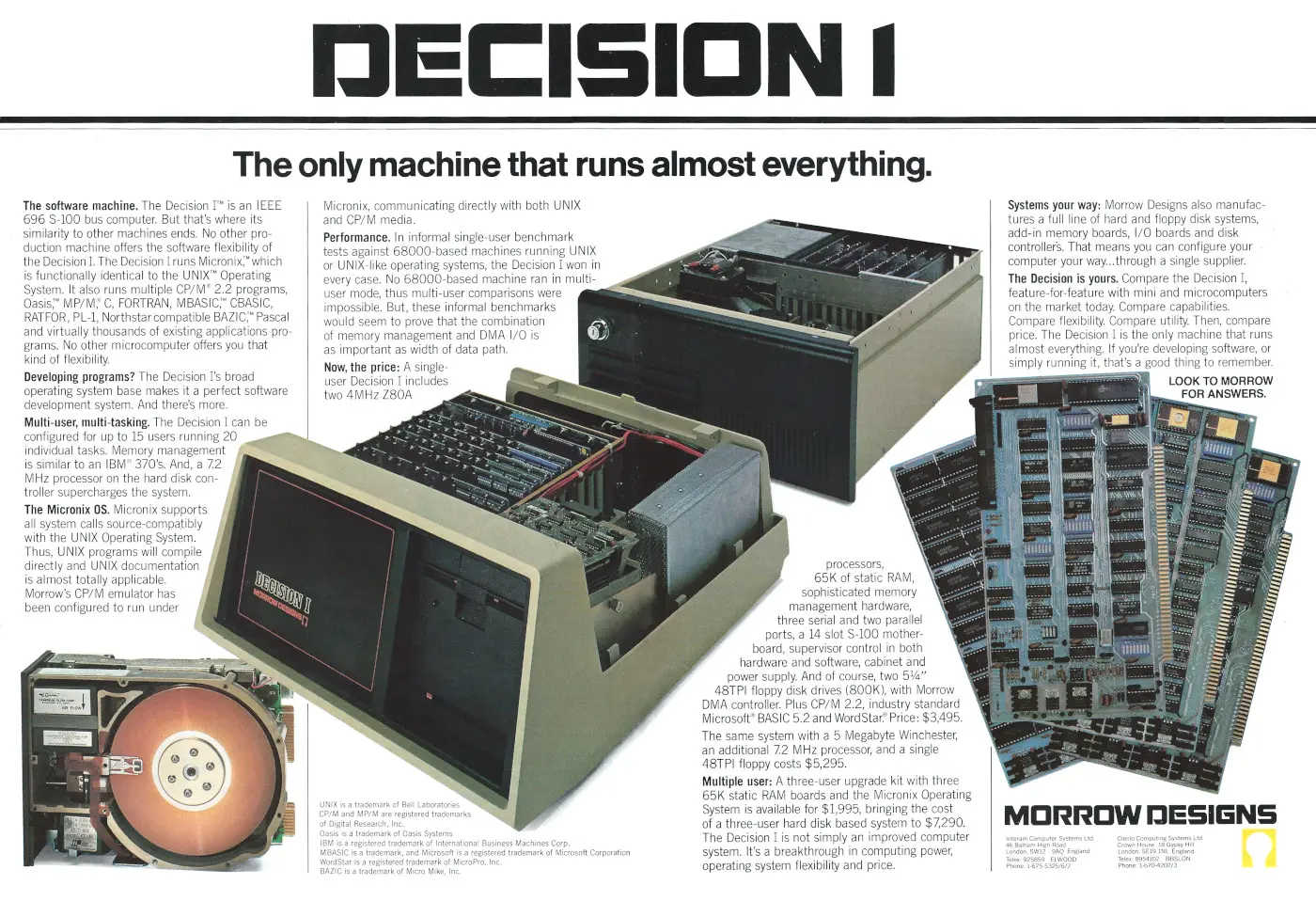
Decision 1 - the only machine that runs almost everything
George Morrow - the founder of Morrow Designs - was born in 1934 and earned a degree in physics from Stanford before going on to do a master's in mathematics at the University of Oklahoma[1].
He became active in the Homebrew Computer Club in the mid 1970s and went on to produce various add-ons for MITS' Altair and IMSAI's 8080, including a 4K memory module which he sold to Bill Godbout, another key player in the early homebrew scene, and which proved popular thanks to being significantly better than MITS' own board.
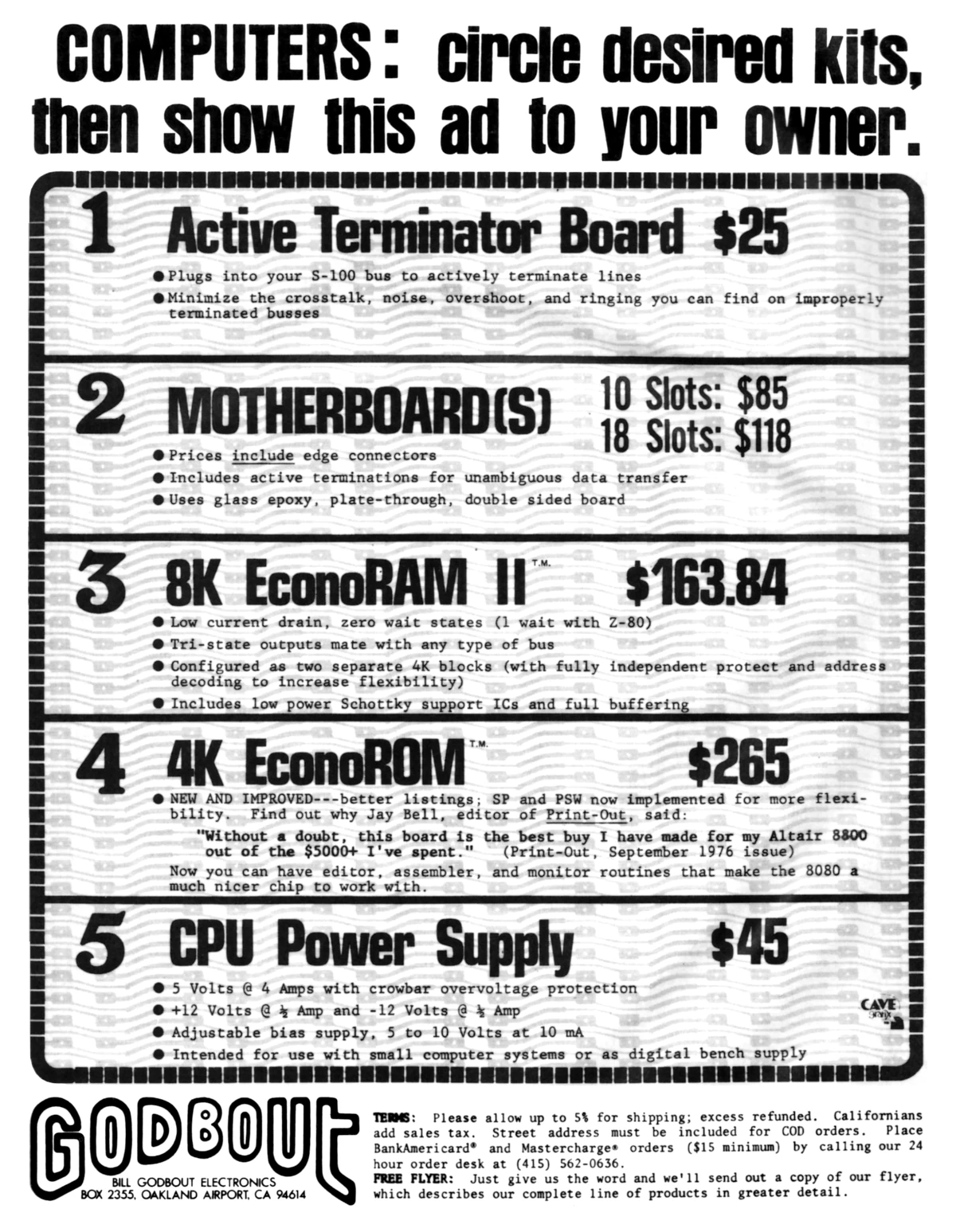
An advert from Bill Godbout Electronics, showing some of the firm's S-100 and Altair boards. From Byte, July 1977
He then formed his first proper company - Thinker Toys - to sell more of his own boards, but had to change the name to Morrow's Micro-Stuff following a trademark dispute with Playskool - owner of the Tinker Toys brand[2].
There followed a brief diversion when Morrow - along with Howard Fulmer - went off to design the Equinox-100[3], an S-100 system which used the famous WünderBuss that Morrow had also designed. Fulmer would later become vice president of R&D at Morrow Designs.
The Equinox-100 was built by Parasitic Engineering of Albany, California, and sold under the Equinox brand. Unfortunately, it was based on Intel's 8080 CPU, whilst everything else was moving towards the Z80, and so wasn't hugely successful.
Morrow returned to his original company, now called Morrow Designs, and produced several more systems based on the almost-official IEEE 696 S-100 standard, including this - the Decision 1.
It appeared to be at something of a crossroads, taking with it the S-100 bus and the 8-bit Z80A processor, both from the 1970s, into the 68000-based 1980s world of Unix, the operating system that was even older but which was only now starting to make inroads into the mainstream consciousness.
Claiming that its 4MHz processor could take on the 16/32-bit 68000, which was running at around 12MHz by 1982, might be a bit of a stretch, but with some memory management and additional 65K static-RAM cards for each additional user, plus the power of "informal single-user benchmarks" - marketing double-speak for "not actually reproducible" - the Decision 1 apparently beat a bunch of 68000 machines running Unix or Unix-like operating systems.
The entry-level Decision 1, complete with 14-slot S-100 motherboard, 65K RAM, power supply and case retailed for $3,495 - about £14,800 in 2026.
With its own version of Unix - Micronix - plus CP/M compatibility via emulation and even some North Star compatibility, at least the claim that it could run almost everything was probably not far off the mark.
North Star compatibility seemed to be a nod to an earlier project of Morrow's when he, Bill Godbout, Chuck Grant, and Mark Greenberg had attempted to build a 16-bit system based on National Semiconductor's PACE CPU. Differences of opinion led to Grant and Greenberg leaving to form North Star Computers.
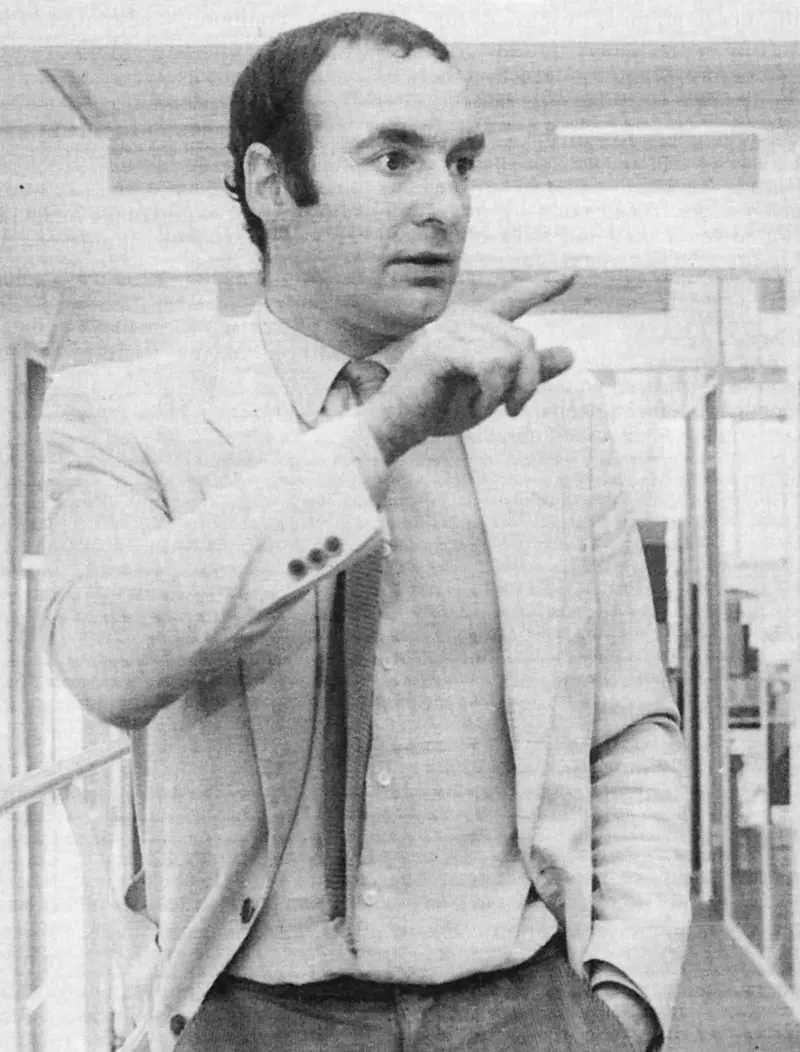
Chris Curry of Acorn offers a version of Unix for Acorn's "Gluon" 16-bit add-on system. © Practical Computing, October 1982The Decision 1's support for multiple operating systems acknowleged another crossroads, in the UK at least, as 1982 was a time where the future of 16-bit systems in the wider business market was still seen as an open two-horse race.
On one side was CP/M - the now-vintage operating system from the 1970s which was trying to keep up by releasing more-modern versions such as CP/M-86.
On the other was Unix - an operating system which could actually trace its roots back to Multics of the mid 1960s. It was a relatively end-user-hostile system which was written by hard-core nerds for use only by other hard-core nerds.
Future 68000-based operating systems such as AmigaDOS, Atari's TOS for the ST and Apple's MacOS were at this point were all glints in the eye, whilst Microsoft's hegemony of MS-DOS and later Windows was barely on the horizon and was not yet the manifest destiny of the PC industry.
Meanwhile, Unix was slowly moving out from its academic confines and was being talked about in the press as a serious contender as the new 16-bit standard, with even super-cautious Acorn offering a version of Unix for its National Semiconductor 16032-based 16-bit "Gluon" add-on for the BBC Micro[4].
What was already a given though was that the era of incompatible machines, where software written on brand X's micro had absolutely no chance of even vaguely running on brand Y's, was at an end, and whatever OS was going to win would have to finally remove all the inconsistencies between different manufacturers' machines.
The problem for both CP/M and Unix was that the users weren't really bothered, as long as the software they bought ran on the machine they had and developers were still writing software for their chosen OS.
Here CP/M had the lead in terms of its more user-friendly software, as Unix was notorious for its unforgiving environment.
The whole thing was academic though, as whilst the two thought they were in with a shout, IBM was plodding on with its 5150 PC, which was already out there with an operating system called PC-DOS, which was crucially - thanks to Microsoft's insistence on a non-exclusive licence for its software - was also available off-the-shelf as MS-DOS.
As the IBM PC gained ground - and people faithfully bought it because, well, it was IBM - it dragged MS-DOS along with it and before long IBM's PC, and all the clones that came along to copy it, were all running Microsoft's software.
As reported in Practical Computings October 1982 editorial on the subject, Adam Osborne of Osborne One fame said:
"You don't have to be best. You don't even have to be good. You just have to be first"[5].
By the summer of 1983, Digital Research had brought out a raft of updates to its venerable CP/M, including a long-awaited update to the original 8-bit version, in the guise of 3.0, by then renamed as CP/M Plus.
There was also a version for 68000 users, known as CP/M-68K, an updated version for 16-bit users - CP/M-86 - and even a graphics version - CP/M Graphics, based upon the ANSI/ISO GSK Graphics Kernal Subsystem.
All of this proliferation was a rear-guard attempt by Digital Research to reassure its dealers that CP/M itself was still a viable choice, a process which included inviting 500 of its independent software vendors to the Café Royale in London on the 21st April so it could hammer the point home.
During this event, a DR spokesperson stated that CP/M, which at that time had over 350,000 installations across more than 500 different manufacturers' computers, was:
"not dead, but revitalised and prepared to challenge MS-DOS, Unix or any other contender in the race to be the standard operating system for 16-bit processors"[6].
By way of comparison, it was announced at the 1983 National Computer Conference in the US that Tandy was offering Microsoft's version of Unix - Xenix - to all past, present and future owners of its Tandy 16 computer.
If all of these users took up the offer, it was thought that there would be more than 15,000 additional Unix installations, and would make Xenix the most popular Unix.
There obviously weren't actually that many Unix computers in the world, as that move by itself would more than double the number of existing Unix installations[7].
Date created: 02 January 2018
Last updated: 29 January 2026
Hint: use left and right cursor keys to navigate between adverts.
Sources
Text and otherwise-uncredited photos © nosher.net 2026. Dollar/GBP conversions, where used, assume $1.50 to £1. "Now" prices are calculated dynamically using average RPI per year.