CompuServe Advert - August 1984
From Compute's Gazette
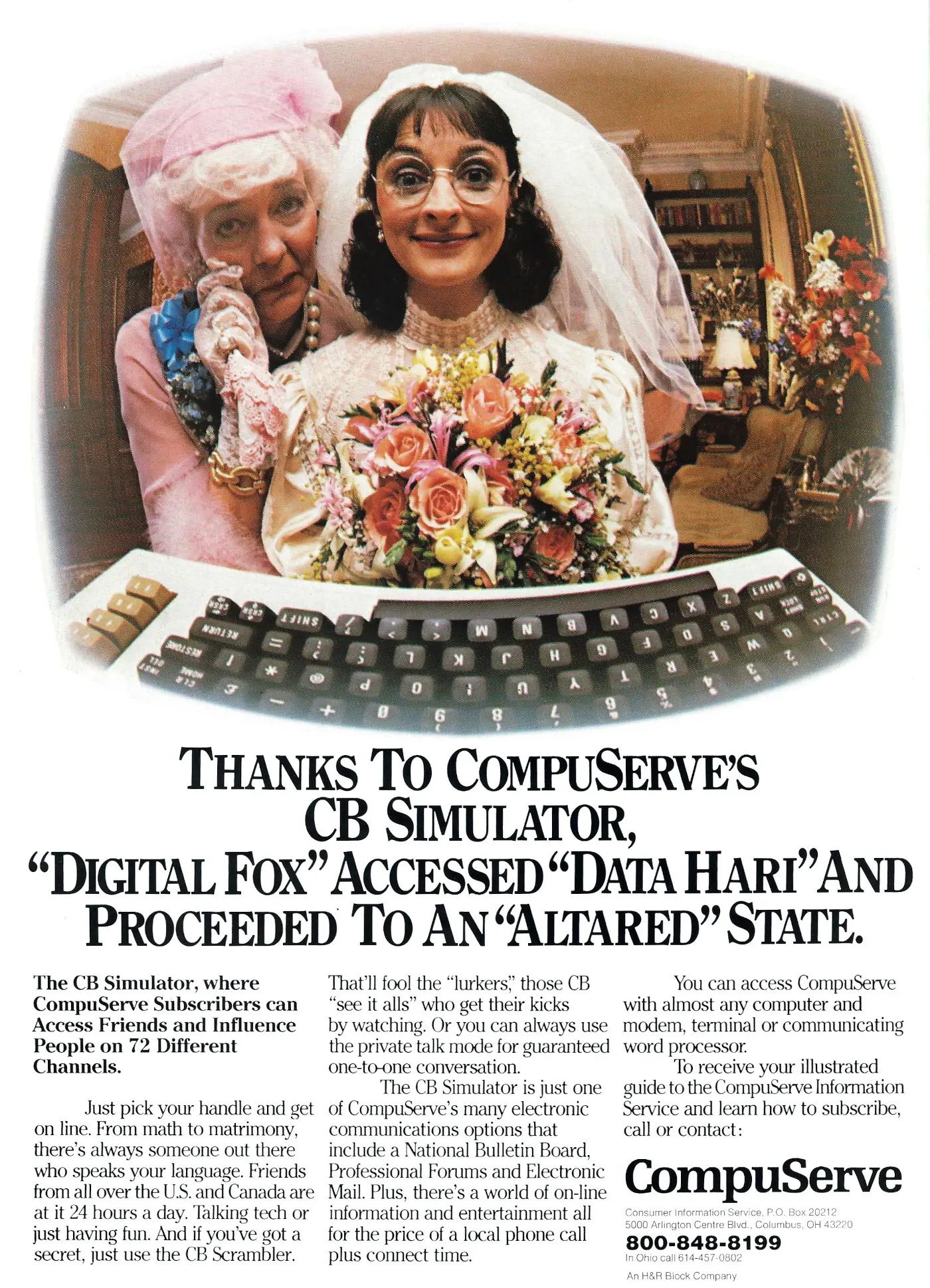
Thanks to CompuServe's CB Simulator, 'Digital Fox' Accessed 'Data Hari' and Proceeded to an 'Altared' State
Probably like the 1960's generation liked to think it invented sex, today's "yoof" probably like to assume that they invented "on-line".
However it was not so, as shown by this advert for CompuServe - a company actually founded in 1969 as a dial-up bureau service offering services like accountancy software to users without their own computer.
It soon realised that its computers were being under-utilised at night, other than as a platform for night-shift operators to play adventure games, according to Practical Computing, so it starting hosting useful information and charging users for access to it.
The resulting system was originally called Micronet - not to be confused with the UK Prestel-hosted service of the same name - and by the mid 1980s, by which time the company was known as CompuServe Information Systems, or CIS, it was running on over 40 DEC PDP-10 mainframes.
Dial-up remained alive and well thoughout this period in the form of Bulletin Board System (BBSs) or Viewdata-based technologies like Prestel, especially around the "modem explosion" years of the mid 1980s, following the de-regulation of the UK telecoms market.
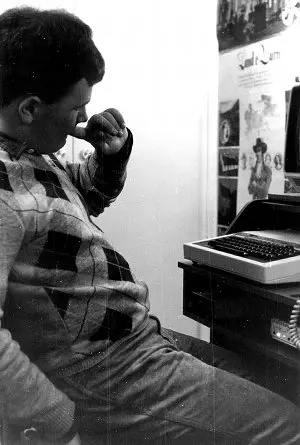
School-friend Hamish and the author online to Mitcham BBS using a BBC Micro and a Pace Nightingale modem, in 1984 or 1985CompuServe itself had become one of the "big three" ASCII-based dial-up services in the US, the others being The Source and Dow Jones. Between them, they had 400,000 subscribers.
Another service doing well in the US was Comp-U-Card.
After years of trying to kick-start teleshopping using micros, despite almost no-one at the time owning computers[1], the company finally reported profits of $800,000 on a turnover of $4 million in 1984[2].
At the time, it was listing 60,000 products that on-line tele-shoppers could get a 25% discount on by buying direct from the factory, a business model that pre-dated Amazon by over a decade.
Breaker breaker: CB Radio online
The advert is interesting in that it clearly shows the fore-runner of Internet Relay Chat - which wouldn't be "invented" until 1988 - in the form of an electronic "CB Radio".
Even the idea of a handle (or "nick" in IRC parlance) and the concept of public chat rooms and private channels are well established.
The service, which offered real-time chatting, was hosted on two mainframes, each of which hosted 36 "channels".
Each channel supported around 50 users, who could only chat directly to users on the same channel. The combined total was about 3,600 CBers at the same time.
Pat Phelps, CompuServe's product manager for the CB Simulator, said of it that:
"Everyone is totally equal. It doesn't matter what sex or race you are or what you look like, or handicaps or whatever. People judge you on your ideas, on how you communicate".
Ben Knox, writing in Practical Computing's April 1985 issue, also revealed that the advert above was not actually that fanciful, saying:
"CB Simulator is very addictive. Just imagine having a conversation where 20 or 30 people can all talk at the same time. You can become quite attached to other CBers, and a number of couples have actually got married. The first couple to meet on the system and marry even had a terminal at their wedding on St. Valentine’s Day, 1983. The proceedings were entered so that the bride’s parents, who 'witnessed' the wedding on their own computer, and all their CBer friends could join in. When the same couple had their first baby last year, there was a terminal in the delivery room."
The first known emoticon used in a computer message, e.g. the text-based :-), is said to date from 1982, but by 1985 the concept hadn't made it to CompuServe's chat rooms. Instead, these - including the CB Simulator - used a form of emotion fairly literally expressed in angle brackets.
Practical Computing gave an example:
"(Old Man) Does anyone know what time it is? (Big Mama) Way past your bedtime <smile>! (Old Man) Hmm... <frown>"
The service wasn't especially cheap, and wasn't easy to set up in the UK. In particular, a $20 or $40 Starter Pack was required, and CompuServe would only mail them to US addresses.
Beyond that, it cost $13 per hour (£37 in 2026) in peak time and $6 per hour off-peak.
Packet Switch Stream charges were an additional $6 per hour, unless you were lucky to have a local PSS-enabled telephone exchange, giving a total cost that could be up to £54 per hour now[3].
Hard Wired
Only a few years before it had still been fantastically difficult to even connect a computer to the public phone network.
In the UK in 1980, this was still run by nationalised post-and-telecomms monopoly GPO - the General Post Office.
Writing in February 1980's issue of Personal Computer World, David Hebditch recounted an epic letter exchange with the GPO going back to 1979 in which he tried to argue the case for allowing regular users to actually connect their computers to the phone network without "type approval".
The exchange involved lots of entertaining paranoia about how rogue modems might affect the public telephone network, such as in a letter dated 8th June 1979 which said:
"If the acoustically-coupled modem stands separately from the personal computer system and the interference problem can be overcome by a suitable filter in the modem I can confirm that it will not be neccessary for the computer system to undergo an evaluation. However, if the acoustic modem does not protect the network adequately or the computer system has an integral modem, an evaluation of the terminal and the modem will be required[4]".
On top of this and several other technical constraints often involving details about exactly what frequencies the equipment in use generated, it was still ultimately required to write to the local Telephone Area (Sales) Office to get their go-ahead first.
--
The advert shows a Mark 2 VIC-20. The VIC modem (which also worked on the 64) was the first to sell over 1 million units, making Commodore computers at one point the most popular networked computers in the world.
Date created: 25 February 2025
Last updated: 01 February 2026
Hint: use left and right cursor keys to navigate between adverts.
Sources
Text and otherwise-uncredited photos © nosher.net 2026. Dollar/GBP conversions, where used, assume $1.50 to £1. "Now" prices are calculated dynamically using average RPI per year.