A history of the microcomputer industry in 300 adverts
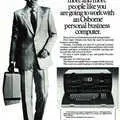
Osborne
January 1983
Every week, more and more people like you are going to work with an Osborne personal business computer
The Osborne One was designed by Lee Felsenstein, who had designed Processor Technology's Sol computer back in 1976, and was heavily influenced by Alan Kay's NoteTaker concept at Xerox PARC. It was launched...
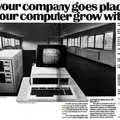
Alpha Micro
September 1983
As your company goes places, will your computer grow with it?
It's another advert for the Alpha Micro, not to be confused with the Alphatronic Micro produced by Triumph-Adler. The AM-1062 model shown in the advert was an upgrade to the original Alpha AM-100 -...
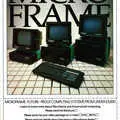
Tycom
March 1983
Microframe - Future-proof computing systems from under £3000
With a futurist "space cargo"-style modular box construction, the "future proof" Microframe seemed to live up to its name. Although not directly billed as an IBM compatible, it did use an Intel 8088...
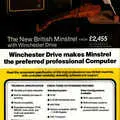
Hotel Microsystems
March 1983
The new British Minstrel with Winchester drive
This machine and advert is such a spectacular throw-back that it had to be included. It's for the "New" British Minstrel, as produced by the oddly-named Hotel Microsystems Limited of London - a name...
Corvus
March 1983
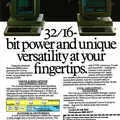
32/16-bit power and unique versatility at your fingertips
The Corvus Concept was one of several 32/16-bit machines appearing at the time, like the Fortune 32:16 or Sage II, in an era when 16-bit machines were only really getting going and 8-bit home computers...
Transam
March 1983
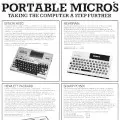
Portable micros - taking the computer a step further
This is one of a few adverts that appeared around about the same time which could be read as something of a sad coda on the life of Transam Microsystems Limited. Transam had started out as Transam Components,...
Iotec
March 1983
Our professional-series integrated business systems software is free
Winner of the award for most puzzling advertising campaign must surely go to Iotec, which for the best part of a year seemed to feature adverts all in black with just the word "iotec" on them, or with...
Texas Instruments
October 1983
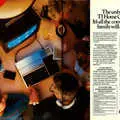
The unbeatable TI home computer. It's all the computers your family will ever need
TI's pushing of Commodore out of the calculator market in the 1970s had come back to haunt it in 1983 - the year of this advert. When TI, which had been manufacturing the calculator parts that many...
Torch
October 1983
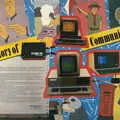
A history of communications: part 1
This colourful and quintessentially 80s advert from Torch was one of two sequential adverts in PCW and provides a nice summary of the company's output so far. This includes the original Communicator...
Digital Research
February 1983
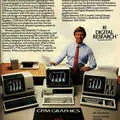
CP/M Graphics - your ticket to success
Intergalactic Digital Research was founded by Gary Kildall, along with his wife Dorothy Kildall, in 1976, three years after Kildall first wrote CP/M - the first-ever disk operating system for a microcomputer....
Globe Business Machines
April 1983
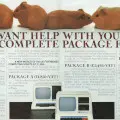
If you want to help with research, buy someone else's computer
At almost the anatomically complete-opposite end of the scale to Commodore's Maureen the Elephant comes this advert featuring cute guinea pigs, from little-known Globe Business Machines Ltd, which seems...
Coleco
December 1983
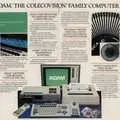
Meet Adam: the Colecovision family computer system
Coleco's Adam was announced in a "blaze of publicity" during the summer of 1983 and appeared to be a major breakthrough in price, with POCW suggesting that it provided a system comparable to machines...
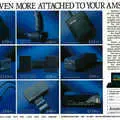
Amstrad
September 1985
Get even more attached to your Amstrad
Many computer companies of the time seemed to be happy to rely on third parties to produce peripherals for their machines, particularly Acorn which was famous for its long timescales in developing anything...
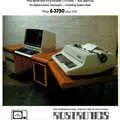
Micromation
January 1980
Micromation Z-Plus Microcomputer System
On the one hand, the Micromation Z-Plus Microcomputer System - sold in the UK via Rostronics - was a fairly standard computer of the day, with a Zilog Z80 CPU, 64K of memory, S-100 bus, Digital Research's...
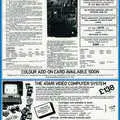
Compukit
January 1980
Compukit UK101 - Low-cost Superboard in kit form
The Compukit UK101 was effectively an unauthorised UK clone of Ohio Scientific's Superboard II - the single-board computer which gave rise to Ohio's fridge-sized machines like the C3-B. The UK101 was...