TDI/Sage Advert - July 1983
From Personal Computer World
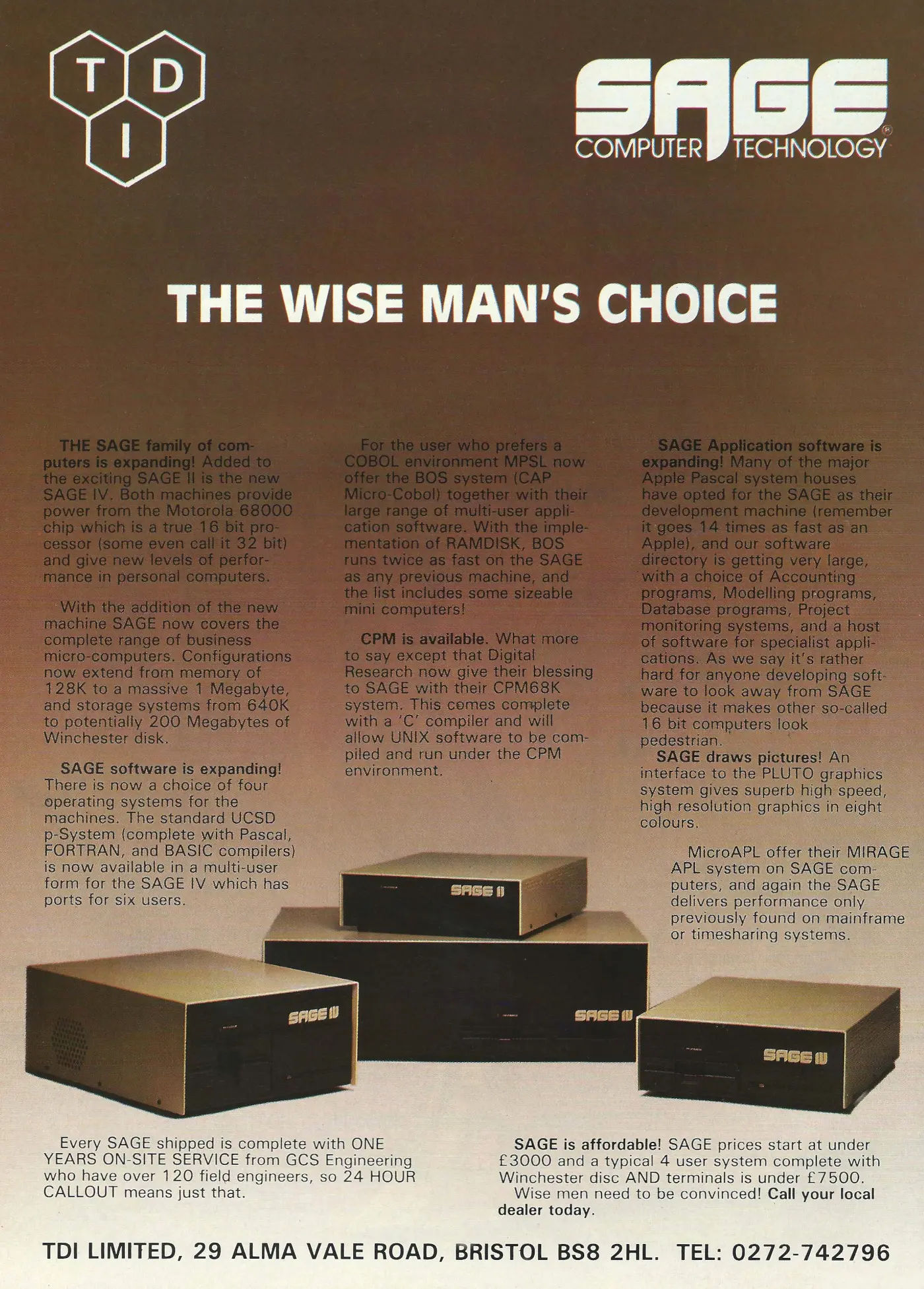
Sage Computer Technology: The wise man's choice
The Sage family of micros, looking as they do like external 5.25" floppy disk units in this advert - which is another accessiblity fail with its low-contrast black-text-on-dark-brown colour scheme - seemed to have quickly built up a reputation as speed machines.
First announced in the UK towards the end of 1982, Practical Computing said of the Sage II that:
"In a box occupying less than half a cubic foot is the processing power of a mainframe - an IBM 370/115-2 to be exact. It could be described as the first true fourth-generation micro".
The Sage II - which Practical Computing also said was claimed to be as powerful as eight Apple II's - used Motorola's 68000, a 32/16-bit CPU, which was about the best available at the time.
Rather than the usual CP/M, it ran Pascal on the unusual UCSD p-System. With a CPU that ran at 8MHz, it could compile Pascal programs at the rate of 1800 lines per second.
Developed at the University of California, San Diego, the p-System came out of work in the late 1970s to create a common Pascal platform that would run on both the university's DEC PDP-11s and various microcomputers of the day.
It ended up referring to itself as the Universal Operating System, and its virtual machine architecture was an influence on James Gosling's Java, which was first released in 1996.
It was also one of the three operating systems offered for IBM's original 5150 PC - the other two being MS-DOS and CP/M-86.
It was more expensive than the others and as a result proved unpopular, much like CP/M-86 which had been artifically priced to be more expensive than MS-DOS.
Running under the p-System, it was also possible to configure an internal chunk of the Sage's memory as a RAM disk, and even boot the machine in to this. This helped make the machine seem very fast, with "response times for everything, except jobs like disk formatting, [being] measured in fractions of a second"[1].
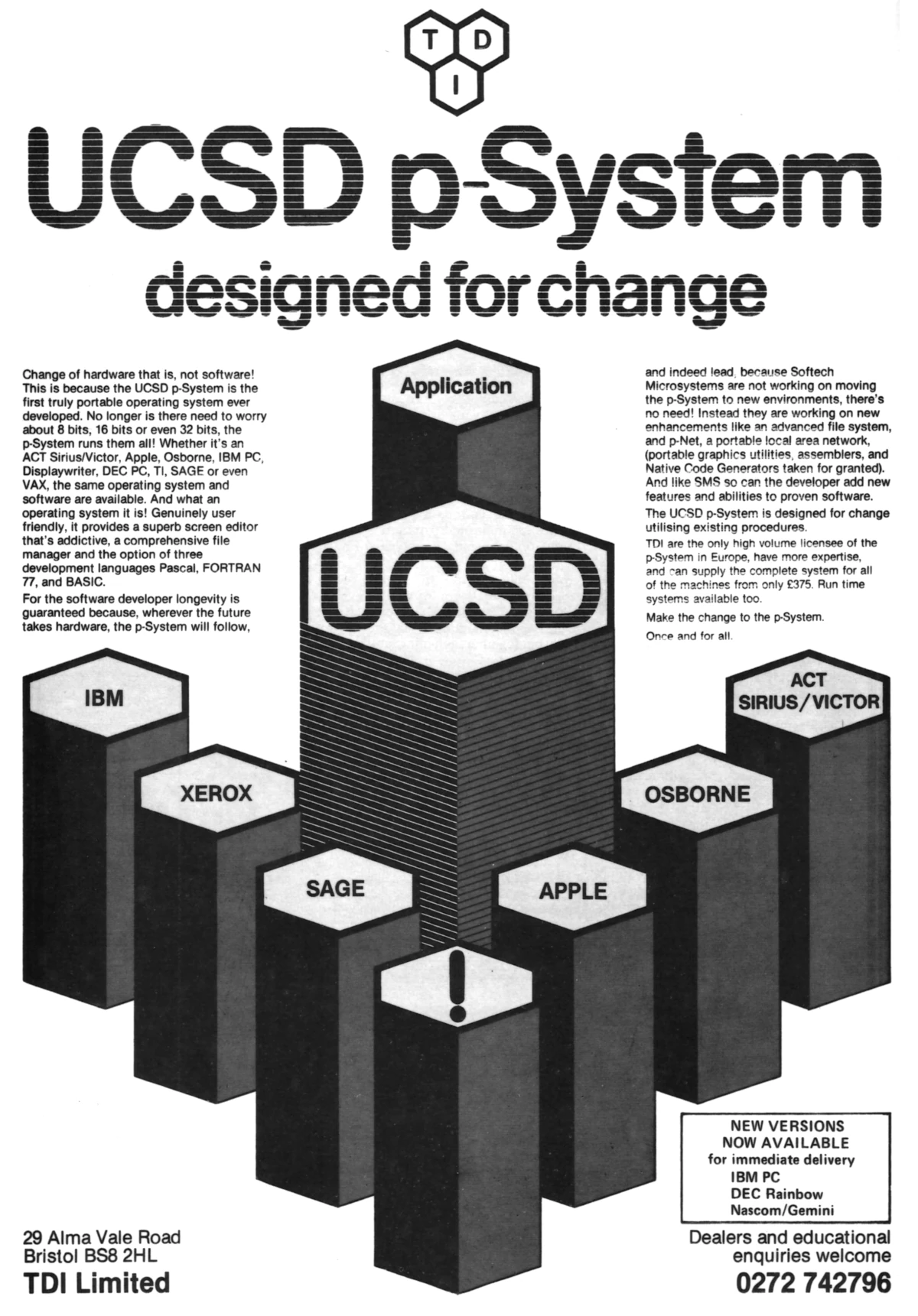
A TDI advert for its version of UCSD's p-System, which was available for DEC's Rainbow, Nascom and Gemini micros, the IBM PC and TDI's own Sage machines. It was also sold by Apple as Apple Pascal
Sage Computer Technology was founded by Rod Coleman, along with Bob Needham, who he had met at college, and Bill Bonham, an employee of Lynch Telecommunication who he was introduced to in 1976 after having moved to Reno in Nevada for work.
By 1978, Coleman was becoming interested in Motorola's new 68000 processor, which with its 32-bit registers could address much more contiguous memory than the 8/16-bit processors of the day.
After IBM suprisingly picked Intel's "severely limited" 8088 in 1981 for its upcoming 5150 IBM PC, Coleman - who by this time had moved back to California - saw a gap in the market for a niche but affordable high-speed system based on the 68000, and the idea for Sage Computer was born[2].
The company, formally founded in 1981, was self-funded with $26,000 in start-up capital - which is about £96,600 in 2026 - with over 60% coming from savings that Coleman had set aside to buy a Porsche.
The design of the company's first computer was started on August 15th 1981 by Coleman, who had learned about electronics through salvaging old TV and radio components from the dump with his cousin Lonnie, and who had built his first Arithmetic and Logic Unit (ALU) whilst still in his early teens.
The start date was significant as it was also the same day that IBM officially announced its new PC.
The micro - which became the Sage II (there was never a Sage I) - was developed from scratch as a single-user 68000 machine, at a time when this particular chip was used more commonly to drive multi-user Unix systems.
Coleman also said that it was "somewhat of a mixture of Apple computer technology and Altos packaging".
The entry-level system with 128K memory and a single 320K 40-track floppy, plus p-System version 4.1, Pascal, BASIC and Fortran compilers, a 68000 Macro assembler and on-site service for a year, retailed for £2,870, or about £13,100 in 2026.
The Sage machines were imported into the UK by TDI, a distributor and Value-Added Reseller that was based in Clifton, Britsol.
The two companies had met in the late summer of 1982 - shortly after Sage's first computer, the Sage II, had gone into production - at a p-System conference in Boston.
Sage hadn't even been considering foreign markets at the time, but TDI offered to look after all the stock and support issues and so a deal was signed.
For several years, TDI was Sage's biggest customer.
The software itself was perhaps unusal enough that TDI was also - unusually - offering a maintenance program for it as a separate option, with an acknowledgement that software was also never perfect and that "sooner or later someone will want to do something that is in the manual but just won't happen". TDI's technical chief Roger Howarth stated:
"Most software has some sort of guarantee, but it's rarely worth the paper it's not written on. We're offering a maintenance contract on the p-System in the same way were' offering one on the Sage".
Custom support for the p-System was free for the first three months of ownership, via the company's support services helpline. After that, it was £50 for the rest of the first year, and £100 (about £450 in 2026) per year thereafter. Guy Kewney writing in August 1983's Personal Computer World suggested that:
"The idea is a good one, and I hope it catches on[3]".
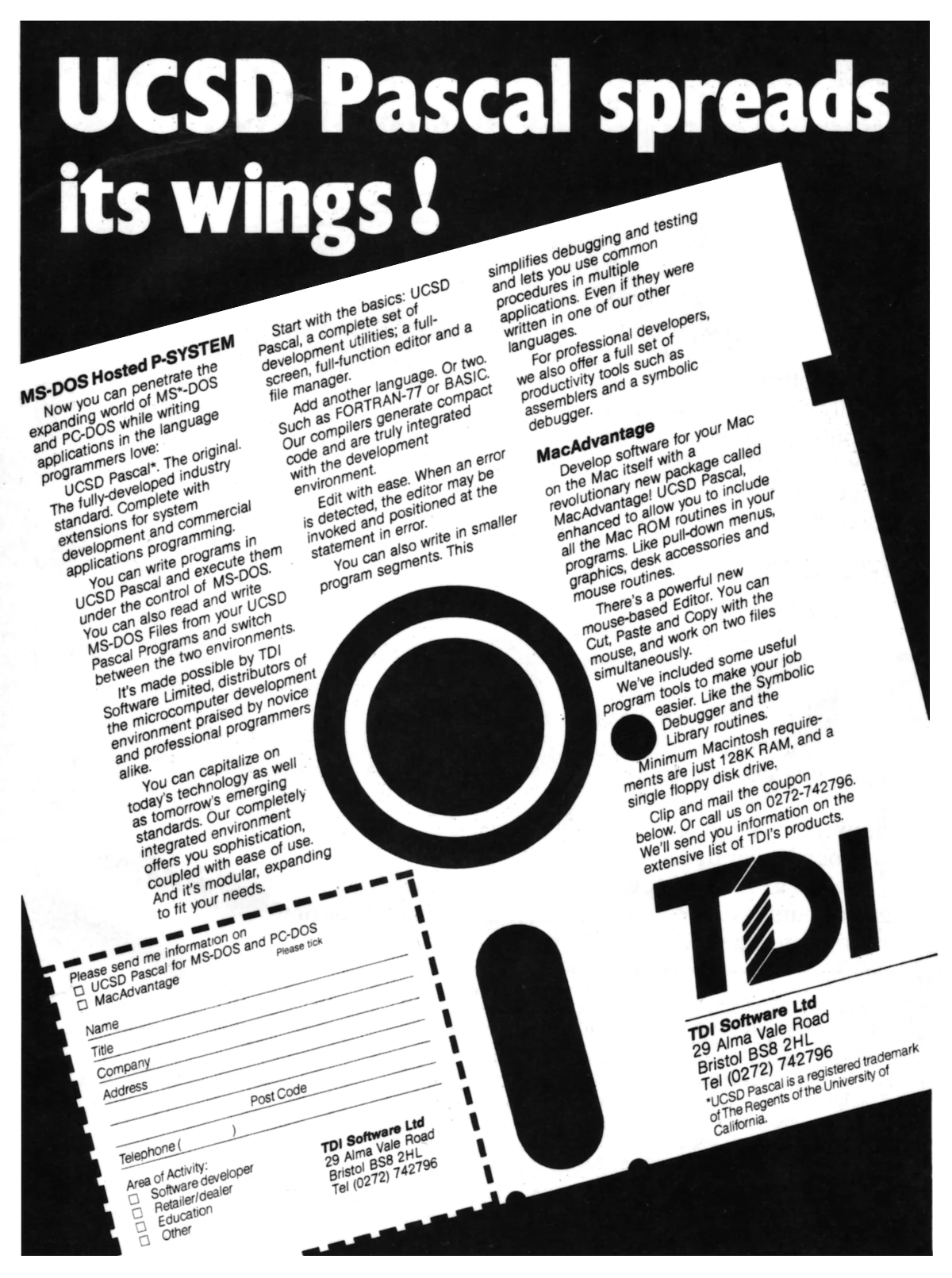
Another advert from TDI's software division for UCSD Pascal, now available for both MS-DOS as a hosted p-System, as well as for Apple's Macintosh, as the MacAdvantage product. From Personal Computer World, March 1985
Shortly after the launch of the Sage II, a multi-user version - the Sage IV - with 512K memory, six serial ports (for terminals and/or printers) and a hard-disk controller capable of supporting five Winchester drives was announced at Comdex in Las Vegas.
When asked what happened to the Sage III, Coleman referred to the ill-fated Apple III:
"We felt a bit superstitious about that, after the Apple III. There will never be a Sage III"[4].
In the summer of 1985, Personal Computer World published its updated benchmarks.
This revealed that despite being nearly two and a half years old, the p-Code-running Sage II was still the fastest machine available, topping the charts with a benchmark average of 4.47 seconds.
This was nearly twice as fast as the end-of-1984 IBM PC AT as well as Olivetti's M24, and 17 times faster than TI's failed TI-99/4A.
The next seventeen micros in the chart were all newer machines than the Sage.
Elsewhere, the BBC Micro was still holding on well at spot 19, above machines like the Sirius 1 and IBM's original PC[5].
Date created: 27 October 2014
Last updated: 07 March 2026
Hint: use left and right cursor keys to navigate between adverts.
Sources
Text and otherwise-uncredited photos © nosher.net 2026. Dollar/GBP conversions, where used, assume $1.50 to £1. "Now" prices are calculated dynamically using average RPI per year.