PBM Advert - February 1982
From Practical Computing
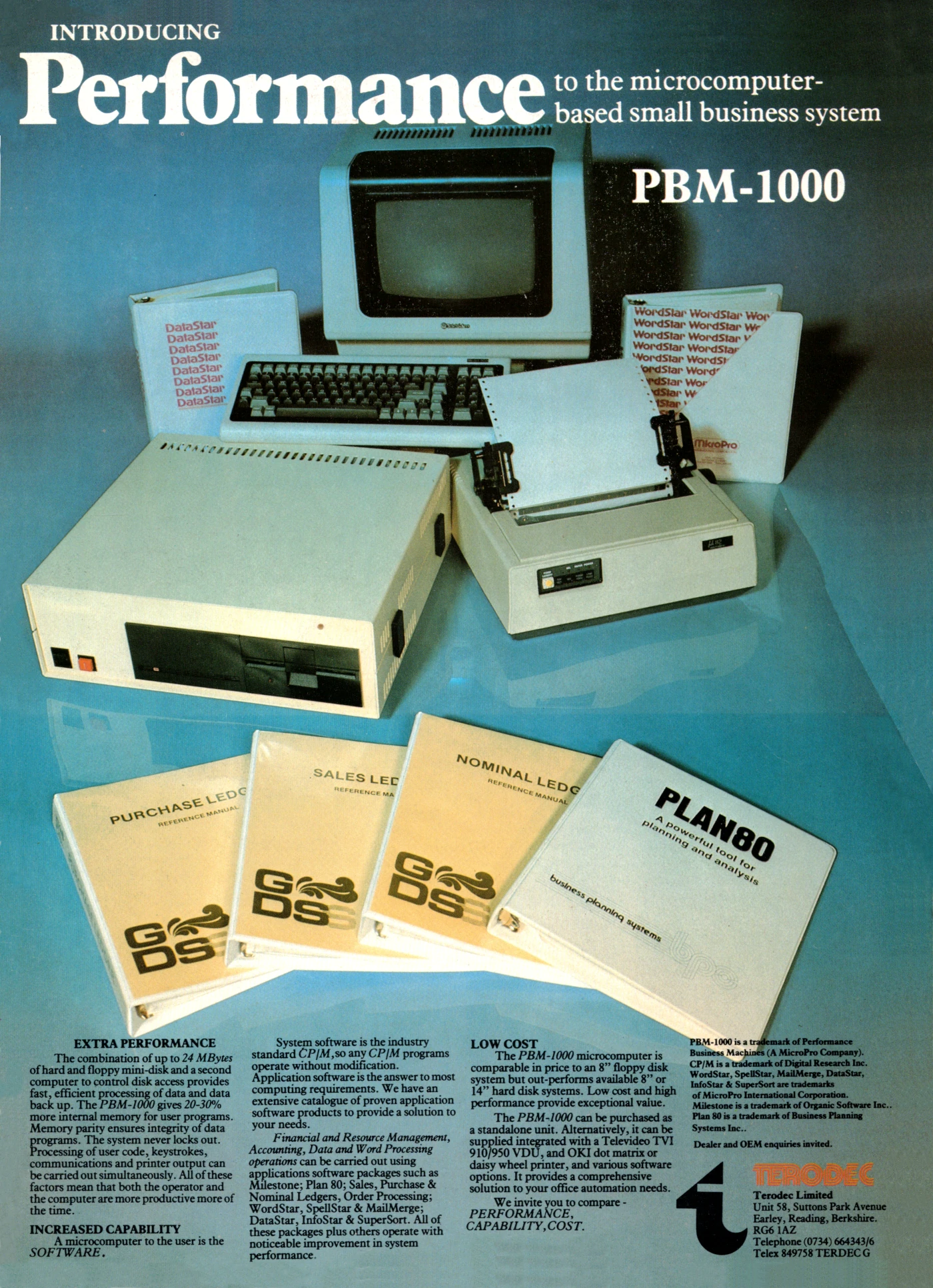
Introducing performance to the microcomputer-based small business system
On the face of it, the PBM-1000 is yet another standard business micro, what with its Z80A processor, 80K RAM, 5¼" floppy disk drives and CP/M.
Possibly designed by IMSAI 8080 co-designer Joe Killian[1], it was built in California by Performance Business Machines, which had been set up in June 1981 as an ofshoot of the software house MicroPro, and which by the latter half of that year had around $6 million - about £22 million in 2026 - of orders from distributors in the UK, France, West Germany, Australia, Japan and Mexico.
In the US, the company hoped to establish 40 or 50 regional distributors by the end of the year, with PBM's vice president of marketing and sales Larry Strober acknowledging that:
"In the beginning the main interest in the product was overseas[2]".
The PBM-1000's claim to performance comes partly from its more-generous-than-usual 80K of RAM, which enabled CP/M and a dedicated input/output buffer to be partitioned off in a separate 16K area of memory, leaving nearly all of the 64K that an eight-bit chip like the Z80 could support available to the end user.
It also contained a pair of custom DMA chips - which the advert calls a "second computer" - just to handle disc I/O, freeing up the main CPU to handle user tasks.
The company claimed that this Direct Memory Access arrangement left 97% of the host Z80 CPU free for other program use during floppy-disk usage, and 70% when using the hard disk, with Practical Computing seeming to agree when it said:
"Certainly the disk access seemed noticeably faster than equivalent non-DMA hardware we have used in the past".
The machine also used some clever techniques with bank switching, and a little-documented "extended indirect addressing" call in the Z80 processor itself, in order to move CP/M out of the way of user memory and into the extra 16K.
Unfortunately, as Practical Computing pointed out in a review of the PBM-1000 in its May 1982 edition, there was a "price to be paid" and that was that any software which addressed any of the device ports, like the printer or serial ports, would not be compatible.
However, as the advert says, "a microcomputer to the user is the software" and it was software that was this machine's "killer app", thanks to its MicroPro connections, which meant it could offer a wide range of guaranteed compatible software.
MicroPro was also the publisher of the early word processor WordStar, a package which Byte magazine, in its May 1983 issue, called "without a doubt the best-known and probably the most widely used personal computer word-processing program".
By 1984 the company was considered to be the world's largest microcomputer software company, with over 20% of the word processor market.
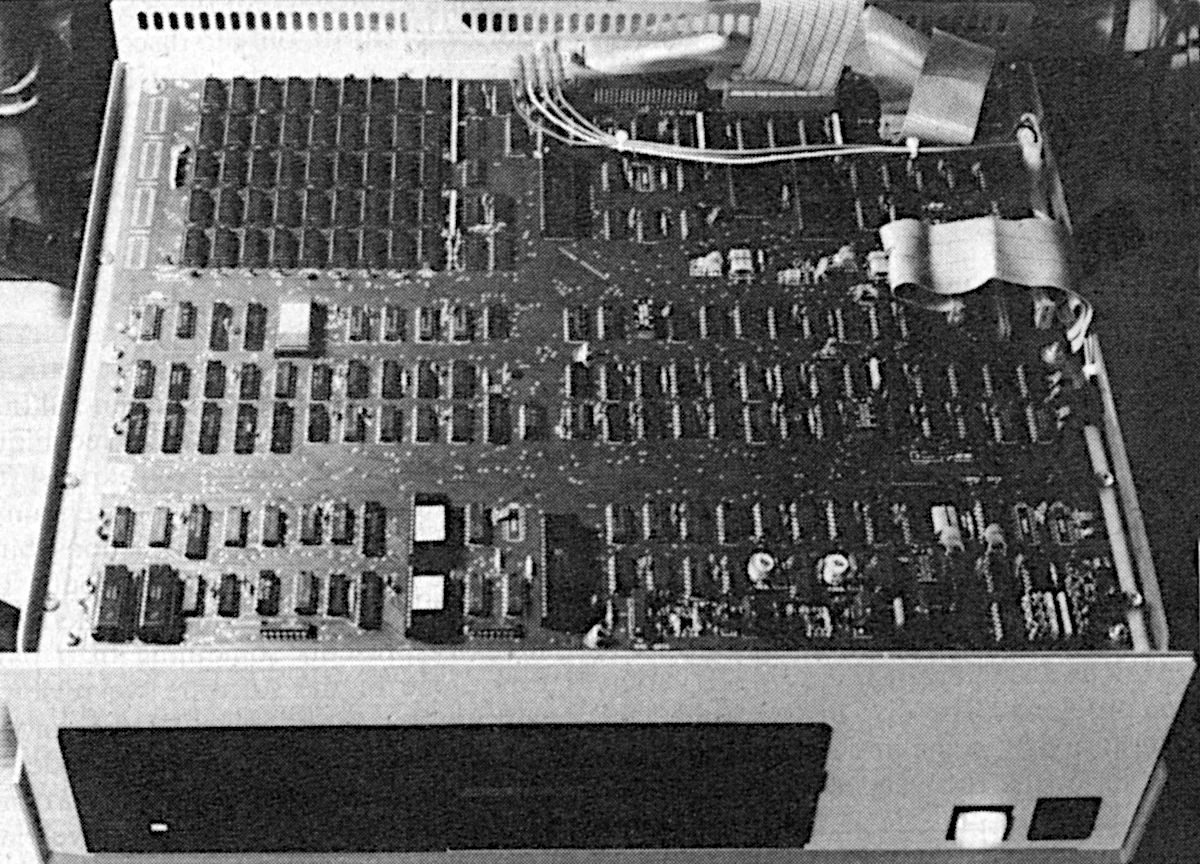
Inside the PBM-1000, showing an eight by five block of 16Kbit memory chips, plus some sort of controller chip per row, in the top left. also note that the front panel arrangement differs from the model shown in the main advert. From Practical Computing, May 1982
As well as WordStar, DataStar and presumably all the other *Star sofware from MicroPro, the PBM-1000 also shipped in the UK with a financial suite - purchase ledger, sales ledger, etc, from the less-internationally-known but still apparently popular company Graham-Dorian Software, as also found on the Onyx C8000.
As Computing Today pointed out:
"Probably the most successful way to attempt a break-in to the small business market is to ensure that the computer you supply is backed with sufficient software[3]"
Practical Computing called the PBM-1000 a "new design of Z80-based microcomputer" and reckoned that it spearheaded the arrival of extended-memory machines throughout 1982 which were part of the eight-bit fight-back against "the coming 16-bit invasion". It also wrote of it in its May 1982 review that:
"The PBM-1000 emerged as a fast, efficient, and well-built computer for general business use. It is a pity that the techniques used by its designers to expand the capabilities of the Z80 chip eliminate some of its more useful instructions, but it is a case of swings and roundabouts. The hard-won benefits of the extended core memory presents something of a paradox: none of the software we reviewed with the machine took advantage of it".
The PBM-1000, which it was hoped would be built in the UK at some point in time, retailed for about £6,000 - or around £33,300 in 2026 - although that included a hard disk, floppy drive, VDU/terminal and printer.
It was imported into the UK by Terodec of Reading, in Berkshire. Terodec appeared to be liquidated in 1983[4].
Meanwhile, MicroPro would end up faltering against new word processors from WordPerfect and Microsoft, however it lived on into 1989, at which point it renamed itself WordStar, before merging with Toronto-based SoftKey Software Produces Inc in 1993[5].
Date created: 19 February 2026
Last updated: 27 February 2026
Hint: use left and right cursor keys to navigate between adverts.
Sources
Text and otherwise-uncredited photos © nosher.net 2026. Dollar/GBP conversions, where used, assume $1.50 to £1. "Now" prices are calculated dynamically using average RPI per year.