A history of the microcomputer industry in 300 adverts
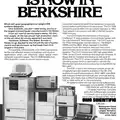
Ohio Scientific
April 1981
Ohio is now in Berkshire
Acknowledging that the opening line would "upset geographers but delight OEM systems designers", this advert from Ohio Scientific of Aurora in Ohio announced the opening of the company's UK office near...
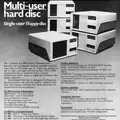
Transdata
May 1981
Transdata's Cx 500 microcomputer family: the problem solvers
Here's another Z80-based system, albeit with a slight twist in that it's aimed not just at business but at the scientific community. The entry-level Cx 502 had a Z80A CPU, 64K RAM and twin 8" IBM-format...
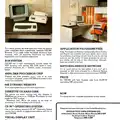
IDS
April 1981
Wouldn't you like an Oscar for a superb performance
Here's an advert for yet another Z80A-based, S-100 CP/M system, from Interactive Data Systems (IDS) of Milton Keynes. At least this time the advert admits as such, suggesting somewhat understatedly that...
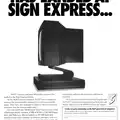
NeXT
October 1991
The NeXTStation has landed at Sign Express
After Apple had released its Macintosh in 1984, it was almost immediately found to be slow, thanks to its limited memory and disk space, and by 1985 there were already plans for a "fast Macintosh". ...
Cromemco
January 1981
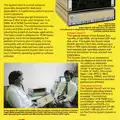
MicroCentre introduces... System Zero
Cromemco's System Zero was a small Z80A-based machine primarily intended in process control situations, and was first launched in 1980. It was designed primarily to take ROM-based software, although...
EuroMicro
March 1983
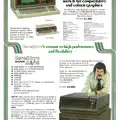
EuroMicro's answer to high-performance and flexibility
EuroMicro Ltd of north London, apparently a UK offshoot of EuroMicro Inc, is another one of those value-added reseller companies that seems to have left no trace. It first appeared in July 1982, when...
ACT/Apricot
April 1981
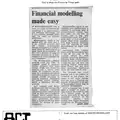
95% off the cost of financial modelling
Although this advert is for software and not a microcomputer, it does come from Applied Computer Techniques (ACT) of Birmingham - a company that had been importing Computhink's MiniMax and selling it...
Shelton
April 1981
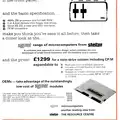
If you think you've seen it all before, then take a closer look at the Sig/Net
This is the first known advert for Chris Shelton's Sig/Net, the range of hardware which is considered as perhaps the first ever modular multi-user personal computer system. With its budget monochrome...
Gemini Micro
March 1983
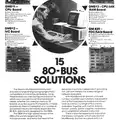
Fifteen 80-Bus solutions
Gemini Microcomputers had been founded by John Marshall towards the end of 1980 after his previous company - Nascom/Lucas - had called in the receivers. Since its founding, Nascom had produced the Nascom...
Bromcom
March 1983
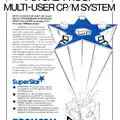
Future-proof multi-user CP/M system
Here's an early advert for Bromley Computer Consultancy, trading as Bromcom, for its Superstar CP/M-based multi-user system, which would be around until at least the summer of the following year. Essentially...
Apple
March 1983
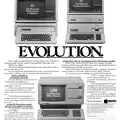
Evolution. Revolution.
With Apple's famous "reality distortion field" in full effect with the the oft-made but incorrect claim that Apple invented the personal computer, and that since the release of the Apple II the world...
TDI/Pinnacle
April 1985
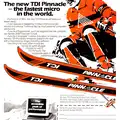
The new TDI Pinnacle - the fastest micro in the world
TDI, based in Clifton, Bristol, was a technology distributor and a VAR - a Value Added Reseller - which had become the largest customer of Sage Computer's "speed machine" micros - the Sage II and later...
Jarogate
April 1985
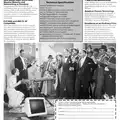
How much persuasion do you need to buy a world-beating business computer?
With an amusing still from what looks like a 1930s film featuring a Vickers Machine Gun comes this advert from Jarogate, of Brixton, London, for its Sprite 286 multi-user system. Unlike Jarogate's earlier...
Alpha Micro
April 1985
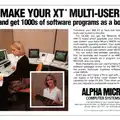
Make your XT multi-user
Alpha Microsystems Inc, or more commonly Alpha Micro, was one of relatively few multi-user manufacturers that made it through the era of the IBM PC and beyond, trading as AlphaServ during the dot-com...
Morrow Designs
August 1984
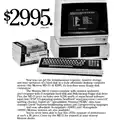
Get XT performance at a Jr. price
The MD-11 from Morrow Designs - a company founded by George Morrow which traces its roots back to the Homebrew Computer Club of the mid 1970s - was the last of the Micro Decision range of machines first...