Newbury Laboratories Advert - May 1982
From Micro Decisions
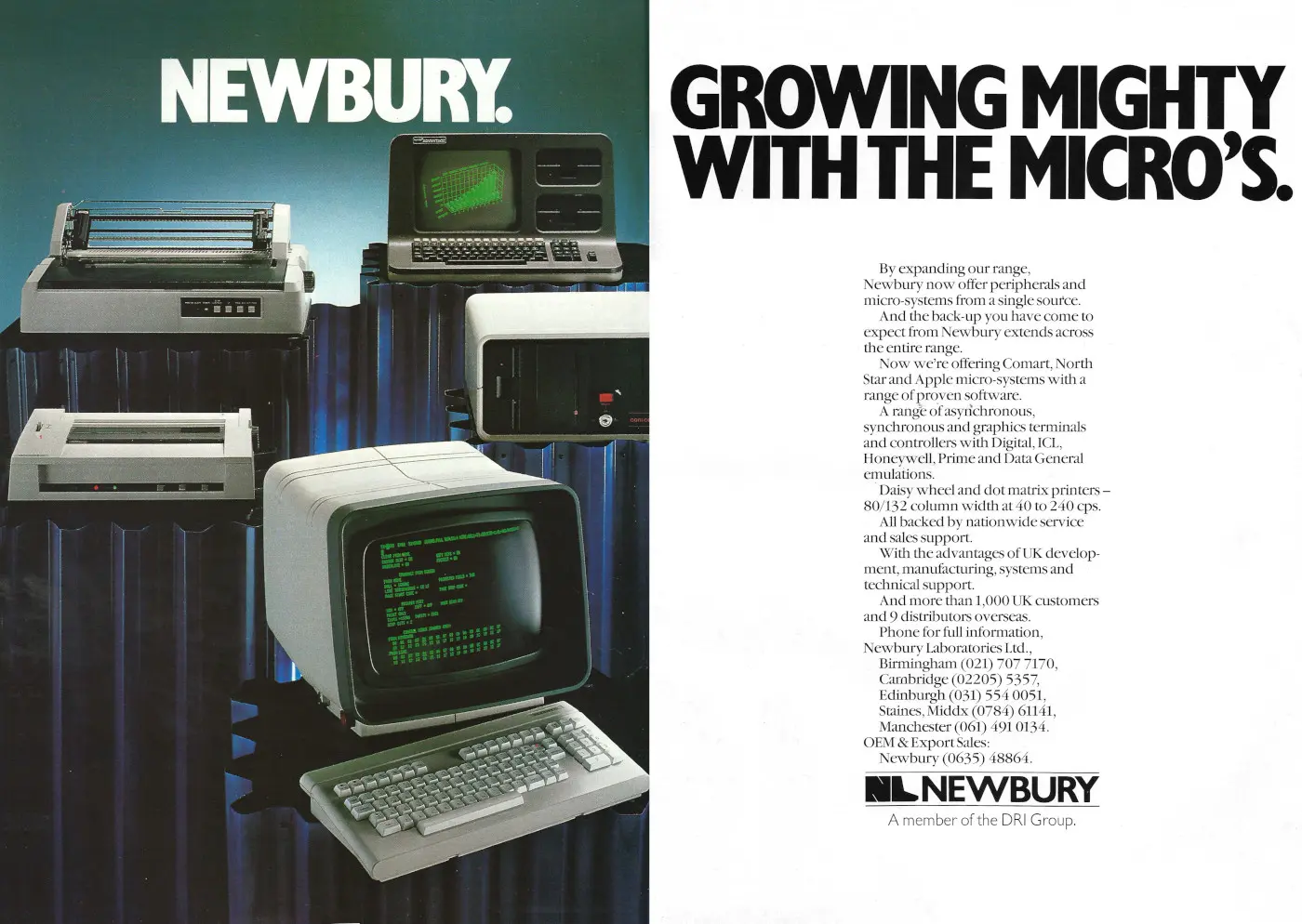
Newbury. Growing Mighty with the Micros
Newbury Laboratories will forever be associated with the NewBrain - the small, portable micro that was temporarily the choice to be the BBC Microcomputer.
However, development was slow, production was difficult and once it became clear that it was going to be late, it was dropped and the contract was opened out, resulting with the BBC ending up at Acorn.
What became the NewBrain had actually been designed by Clive Sinclair's company, Sinclair Radionics, in a project which first started in 1978, largely as a response to the "American invasion" of newly-launched fully-formed microcomputers like the Commodore PET, Tandy/RadioShack TRS-80 and the Apple II.
Sinclair however saw the market as wanting a micro that was both much cheaper and much more portable, recounting a few months after Sinclair was eventually sold to Amstrad in 1986 that:
"My belief for years and years, right back to the days of Sinclair Radionics where we had an internal project for a portable computer, was that [mobility] was the way computers ought to be. For computers to really be useful they’ve got to move with you. And they’ve got to work without the need for print and paper. To do that they’ve got to be with us all the time."
However, one of the steps taken to make the machine small was to roll much of its functionality into a single ULA - a sort-of hard-wired programmable chip combining the functionality of multiple chips and which was expensive to produce at first, but which became much cheaper at volume.
By this time, Radionics had already been part-nationalised by the National Enterprise Board in order to keep it afloat, with the successful calculator part of the business being sold off whilst the remaining company carried on with the new machine.
Unfortunately it seemed that the upfront cost of developing the machine's ULA - around £500,000, or about £4,023,200 in 2026 - was enough to give Radionics "cold feet", as it wasn't sure whether it would shift the 20,000 units it thought would be needed to break even[1].
Eventually, the NEB sold off the rest of the company, whilst the design was handed on to Newbury Laboratories, another of its investments. It was Newbury that actually gave it the name NewBrain.
When the company lost the BBC Micro contract, the government quango that had replaced the NEB - the British Technology Group - sold the NewBrain on to Grundy for a rumoured £600,000[2].
Grundy bailed out of the micro business within a couple of years have built only 50,000 NewBrains[3], but the machine had built up enough of a following that it was rescued by Tradecom International the following year[4].
Meanwhile, Newbury Laboratories - in what appears to be very much a one-off advert - has retreated back to the terminals business it had started out as back in 1971.
There were even rumours that it had actually merged with its NewBear subsidiary[5], which makes some sense in that context.
Either way, it's now selling terminals from Digital (DEC), ICL, Honeywell, Prime and Data General, as well as microcomputers from Comart, North Star and Apple.
--
Back in 1979, ITV had broadcast an influential programme based on Dr. Christopher Evans' book The Mighty Micro.
It was this that was said to influence the BBC to produce its own series of Computer Literacy programmes, first broadcast in January 1982, although planning for that had apparently started in 1978, the year before the ITV series was shown[6].
And so "Growing Mighty with the Micros" might be a little dig at losing the contract for the BBC Micro.
Date created: 26 January 2024
Last updated: 21 January 2026
Hint: use left and right cursor keys to navigate between adverts.
Sources
Text and otherwise-uncredited photos © nosher.net 2026. Dollar/GBP conversions, where used, assume $1.50 to £1. "Now" prices are calculated dynamically using average RPI per year.